

Eventually, the sun will shine ...
April 25, 2013
By Geoff Kimmerly
Second Half editor
 We all believe that, right?
Rain – and snow for some – has been the buzzword of this spring sports season. Just about every newspaper is writing about it and every athletic director, coach, player and parent is dreading it on a now-daily basis.
But eventually, we expect the weather to clear up and teams to play catch-up. To that end, there are limitations teams in some sports face when attempting to make up their games – but also opportunities to take advantage of while trying to fill out their regular-season schedules.
- Girls soccer and girls and boys lacrosse teams may play only three games during a week, Monday through Sunday. A weekend tournament – which generally includes 2 to 3 shortened games – counts as only one in this equation.
- Baseball and softball teams can play as many games as they want in a week, but no more than two on a school day – and baseball pitchers must not pitch for two days following their 30th out in a week.
- For tennis, an individual may not play more than three matches in one day – unless she or he is playing in a league championship tournament featuring more than eight schools for which a fourth match would decide the championship. That player also could not have played more than six sets that day heading into that fourth and final match.
- Golf and Track and Field do not have weekly contest limitations. Track and field athletes can compete in only four events per day.
As expected, a number of teams – especially for baseball and softball – are scheduling to smash in as many contests as possible into the next four weeks. Postseason play for tennis and lacrosse begins May 16 – three weeks from today.
But teams do have options.
One rarely used but anticipated to be used more this spring is an opportunity to continue playing regular-season contests through the final day of the MHSAA tournament in that sport. For example, a baseball team can continue making up games through June 15, the day of the MHSAA Finals in Battle Creek. A tennis team can play regular-season matches through June 1, etc.
Also, the MHSAA Executive Committee approved Thursday to allow for this spring two additional multi-team tournament dates for soccer and lacrosse, which will give those teams an opportunity to get in a few more games. That means soccer teams will be allowed to play in four multi-team tournaments instead of two, boys lacrosse four instead of two and girls lacrosse five instead of three.
Teams will have to do some juggling, no doubt, and all other tournament stipulations still apply (games generally are shortened so more can be played, etc.). But with a little creativity, teams could at least get in a few of their make-up games in this way.
Also, the Executive Committee approved a motion to waive the four-contest MHSAA tournament entry requirement for all Upper Peninsula schools in all sports this spring. As of the weekend, snow still covered parts of the U.P.
Gaps shrinking
Much has been discussed about minimums for all four MHSAA classes for 2013-14, and how they are the lowest student totals in at least a decade.
It’s true. The floor in Class A is 893 (down from 911 this school year), Class B starts at 429 (down from 449), Class C at 207 (down from 217) and Class D at 206 (down from 216).
However, there is a better way to crunch the numbers: Consider the shrinking gaps between the largest and smallest schools in each class.
For 2013-14, the gap in Class A is 1,888 students – 261 students fewer than 2007-08 and nearly 900 students fewer than in 2005-06. The gaps between largest and smallest in Classes B, C and D also are trending smaller – which means each class actually includes schools more similar in size, instead of a perceived other way around.
SAC 2013-14 on the way
We’re thankful for a valuable group of students who help us throughout the school year – our 16-member Student Advisory Council, made up of eight seniors and eight juniors from all over the state who are charged with providing feedback on issues impacting educational athletics from a student’s perspective, while also assisting at MHSAA championships and with special projects like the “Battle of the Fans.”
Selecting the next class to join is a highlight of every spring – but hardly an easy process.
A six-member selection committee, myself included, considered 62 sophomore applicants today from all over the Lower and Upper Peninsulas, representing all four of our classes and nearly every sport we sponsor.
Every candidate is impressive for a variety of reasons. That’s what makes this difficult – we could pick any number of combinations to make up our new SAC class, and no doubt leaders galore will emerge from another impressive group.
But there are only eight spots on the council. And we’ll announce who received them later next week.
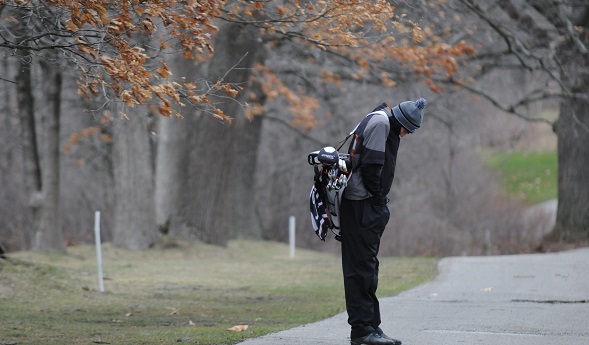
PHOTO: A golfer attempts to keep warm during a round on a dreary day earlier this season. (Click to see more at HighSchoolSportsScene.com.)
St. Mary's Record Run Recalls Homer's 'Small-Town Baseball Odyssey'
By
Geoff Kimmerly
MHSAA.com senior editor
April 21, 2023
As Orchard Lake St. Mary’s celebrated setting the MHSAA record for longest baseball winning streak at 77 and counting over the weekend – and with a national record certainly within reach this season – we can recall just two decades ago when Homer’s similar streak and the two seasons of buzz it stirred was on the verge of its start.
Homer, representing a community of about 1,700 residents, finished 38-0 on the way to winning the Division 3 championship in 2004, and then returned to win its first 37 games of 2005 before falling to Saginaw Nouvel 7-6 in that season’s Division 3 Final at Battle Creek’s C.O. Brown Stadium.
Along the way over those two seasons, the Trojans smashed the previous MHSAA baseball consecutive wins record of 56, and went on to set a national record of 75 straight wins that stood until 2011, when it was surpassed by both Martensdale St. Mary’s of Iowa and Portsmouth, N.H. The latter has topped the national list since 2012 after extending its winning streak into 2012 to the current record of 89 games.
Battle Creek Enquirer reporter Jeff Karzen followed Homer’s record run through many of its most notable moments, and that coverage and the relationships built during that time – and as the Trojans came back to win the Division 4 title in 2006 – led to his first book “Homer: The Small-Town Baseball Odyssey” published in 2011.
Below is an excerpt highlighting the small school’s run to national stardom – followed by updates on a few of the major players who helped the Trojans become unforgettable.
Buy the book here: JeffKarzen.com
***
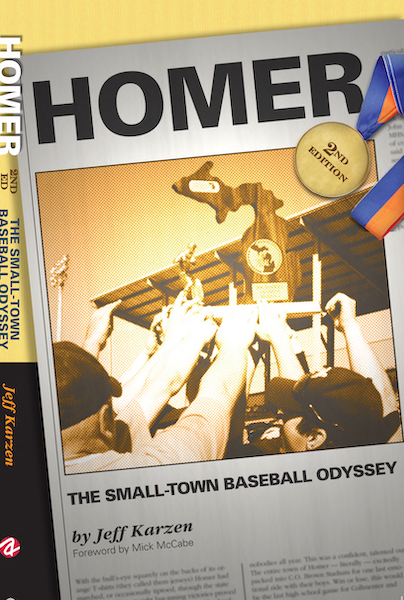 Homer: The Small-Town Baseball Odyssey
August Publications
Copyright © 2011 Jeff Karzen
All rights reserved
First edition published 2008
Second edition published 2012
Homer began the 2005 season ranked No. 1 in Division 3, a spot it had grabbed and held onto for the second half of ’04. Seven starters returned from a team that had made history with a 38-0 season. Still, Homer had some things to prove to itself.
So far in high school, and even as Little Leaguers, this group of Homer players had been largely defined by Josh Collmenter and Matt Powers. In big postseason games, Collmenter and Powers would take the pressure off their younger teammates and welcome it squarely on their shoulders. Collmenter was always the big-game pitcher. Powers could always be counted on in the middle of the batting order. How would Homer deal without having its two leaders?
“They definitely set the mindset for our team,” Dan Holcomb said of Collmenter and Powers. “When you’re a freshman coming up you don’t really know what varsity is all about or what Homer baseball is all about. You get up there and having those young guys playing against teams like Blissfield is kind of overwhelming. But having guys like Josh and Matt kept you loose and didn’t let you think about Blissfield, or think about seven state titles [won by the Royals]. They just said, ‘Hey guys, let’s have some fun. We’re going out to play some baseball today.’ They just made sure everyone had their mind right.”
Whether it was nerves about following up the unbeaten season with a good showing or an uneasy feeling taking the field without their two leaders, the Trojans began the new season with a close call in a doubleheader against Marshall and its star, Evan Sharpley. Marshall was a good team and a much bigger school, but Homer simply didn’t have it. Somehow, the Trojans escaped with a 14-13 win in eight innings (the most runs it had given up in years) and then a 4-2 triumph in Game Two. With the first two wins under their belt, the Trojans began to roll. Over the next 12 games, they gave up a total of 13 runs, proof that the season opener was nothing more than a fluke. Collmenter and Powers were missing, but junior-dominated Homer began to form its own identity.
The state record for consecutive wins was 56, set by Grand Haven High School from 1960-62. Homer’s Trojans were quickly nearing the record. The streak had reached 49 games when Homer took the short drive west on M-60 for a Big Eight tilt with the Union City Chargers. By now, the other teams in Homer’s conference had basically ruled out beating the powerhouse. Goals such as scoring runs, playing all seven innings without the mercy rule, and even putting the ball in play against Homer’s overpowering pitchers had become the scaled-down aspirations for the opponent.
One rival coach, Quincy’s Brett Allman, didn’t let his team watch Homer’s impressive pregame routine where the Trojan players showed off their big-time throwing arms and precision fielding. “When they warmed up, I talked to my team outside the dugout, or had them hit Wiffle balls or something,” Allman said. “Something besides watch them take infield. They put on a show. And they were proud of the way they took infield, and rightfully so. I don’t need to watch Dusty Compton throw the ball across the infield because I know what they can do. I didn’t think it would be real beneficial for my guys to watch them take infield.”
Under gray, rainy skies in Union City, both teams finished their warm-ups and looked around. Something was missing. It was going to be hard to play this game without any umpires in sight. They waited and waited. Finally, around 5 p.m., 30 minutes after the scheduled start time, one ump arrived. Knowing how much less is seen on the field with only one umpire (regular- season high-school games have two), Salow was hesitant to let the game begin. The lone umpire told both coaches that his partner was on the way, so the coaches acquiesced and allowed the game to start with one set of eyes in charge of the entire field. Union City must’ve forgotten that its opponent that day had won 49 consecutive games. The Chargers came out like they were the team to beat and jumped all over Homer. A few innings into the game, Homer was stunningly down 7-0. “I said to Tom, ‘Not only are we going to lose our streak but we’re going to get 10-runned (a mercy rule loss),’” Salow said.
Of course, Homer started chipping away at the lead. But seven runs was a lot to come back from, even for these Trojans. In the fifth inning, with Homer still trailing by a few runs, C.J. Finch decided it was time to take control of the perilous situation. “Not today! Not today!” Finch screamed. “This is not going to happen today.”
With rain continuing to fall, Homer got within one run in the sixth inning. That’s when the umpire, who worked alone all game, walked over to Homer’s dugout to speak with Salow.
“It’s not looking good, starting to rain harder. Not sure if we’re gonna be able to finish this thing,” the ump told Salow.
“Absolutely not,” the coach fired back. “We started this game 40 minutes late and if we’d started on time, it would be over by now. Not only that, but we have a streak going. These kids have worked too hard to put this streak together and they’re not going to lose it this way.”
The umpire caved in and so did Union City. Homer rallied to win 9-7, extending the winning streak to 50 games. Seven more remained to break the state record that had stood for 44 years.
“I was on pins and needles,” Union City coach Joe Tinervia said of his team’s near-miss. “I was playing that game like it was 1-0. That shows you what I think of Homer.”
A few weeks later, Homer easily topped Concord 10-0 to tie Grand Haven’s state record of 56 straight wins. The stage was set for the talented boys from the one-stoplight town to make history. A Friday doubleheader against Reading, one of the conference’s better teams, would be the record-breaker. It seemed fitting, too, because Reading had handed Homer its last loss in a regional playoff game in 2003. Homer made history in a rather ho-hum affair, winning Game 1 of the doubleheader, 12-2. “It wasn’t breathtaking or staggering or awe-inspiring,” a Battle Creek Enquirer columnist wrote the next day. “But it was efficient. Forgive Homer if it didn’t stage a large celebration for the new record. It’s just that the boys are used to winning.”
“It was just good enough, not flashy,” Salow said after his team won its 57th straight baseball game. “I’d like to think we’re a blue-collar club. It’s the way guys are taught in practice and in the classroom. We try and never get too high or too low.”
***
Where are they now?
- Josh Collmenter pitched in Major League Baseball for seven seasons, the first five-plus for Arizona before finishing his career with Atlanta. He won a career-high 11 games in 2014 and finished his pro career with a 38-35 MLB record. He currently is living in Phoenix and doing radio and TV for Diamondbacks broadcasts.
- Scott Salow left Homer and became superintendent at Petersburg Summerfield in 2021. He coached the Trojans through 2019, building a career record of 577-157.
- Dan Holcomb lives in Nashville, Tenn., and has been a Seattle Mariners scout for six seasons, covering Tennessee, Alabama and Mississippi. He spent six years as a college coach prior to scouting. He pitched collegiately at University of Evansville, Grand Valley State University and Huntingon University (Ind.).
- Dale Cornstubble is married with two kids and living in Homer. He is an electrician and teaches catching lessons on the side. He played at Central Michigan University and was drafted and played briefly in the minor leagues for the Kansas City Royals.
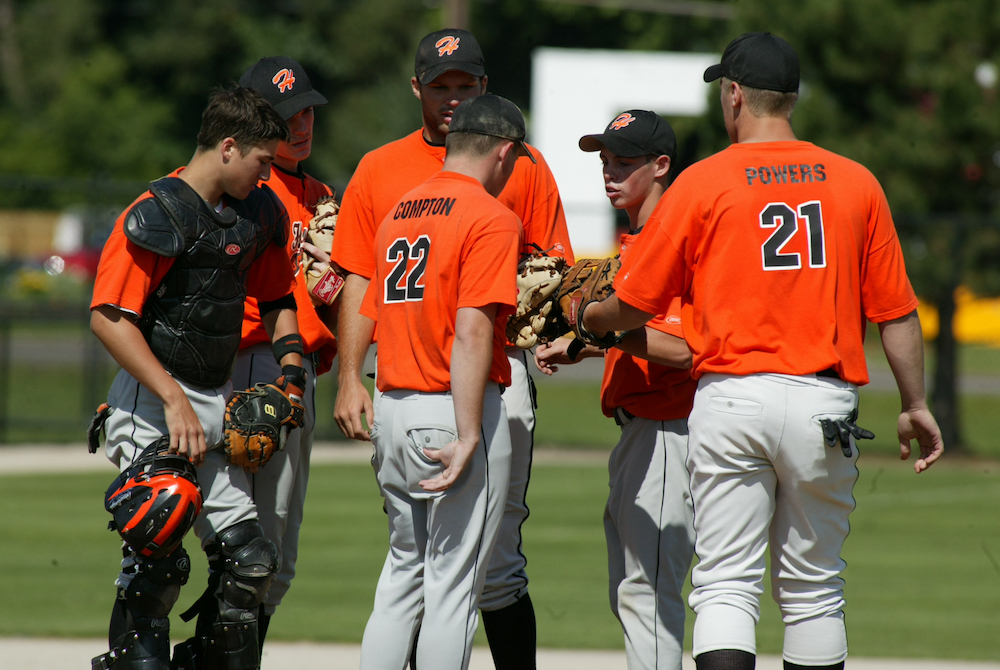
PHOTO Homer players meet on the mound during their 2004 Division 3 Semifinal win over Muskegon Oakridge.