

Eventually, the sun will shine ...
April 25, 2013
By Geoff Kimmerly
Second Half editor
 We all believe that, right?
Rain – and snow for some – has been the buzzword of this spring sports season. Just about every newspaper is writing about it and every athletic director, coach, player and parent is dreading it on a now-daily basis.
But eventually, we expect the weather to clear up and teams to play catch-up. To that end, there are limitations teams in some sports face when attempting to make up their games – but also opportunities to take advantage of while trying to fill out their regular-season schedules.
- Girls soccer and girls and boys lacrosse teams may play only three games during a week, Monday through Sunday. A weekend tournament – which generally includes 2 to 3 shortened games – counts as only one in this equation.
- Baseball and softball teams can play as many games as they want in a week, but no more than two on a school day – and baseball pitchers must not pitch for two days following their 30th out in a week.
- For tennis, an individual may not play more than three matches in one day – unless she or he is playing in a league championship tournament featuring more than eight schools for which a fourth match would decide the championship. That player also could not have played more than six sets that day heading into that fourth and final match.
- Golf and Track and Field do not have weekly contest limitations. Track and field athletes can compete in only four events per day.
As expected, a number of teams – especially for baseball and softball – are scheduling to smash in as many contests as possible into the next four weeks. Postseason play for tennis and lacrosse begins May 16 – three weeks from today.
But teams do have options.
One rarely used but anticipated to be used more this spring is an opportunity to continue playing regular-season contests through the final day of the MHSAA tournament in that sport. For example, a baseball team can continue making up games through June 15, the day of the MHSAA Finals in Battle Creek. A tennis team can play regular-season matches through June 1, etc.
Also, the MHSAA Executive Committee approved Thursday to allow for this spring two additional multi-team tournament dates for soccer and lacrosse, which will give those teams an opportunity to get in a few more games. That means soccer teams will be allowed to play in four multi-team tournaments instead of two, boys lacrosse four instead of two and girls lacrosse five instead of three.
Teams will have to do some juggling, no doubt, and all other tournament stipulations still apply (games generally are shortened so more can be played, etc.). But with a little creativity, teams could at least get in a few of their make-up games in this way.
Also, the Executive Committee approved a motion to waive the four-contest MHSAA tournament entry requirement for all Upper Peninsula schools in all sports this spring. As of the weekend, snow still covered parts of the U.P.
Gaps shrinking
Much has been discussed about minimums for all four MHSAA classes for 2013-14, and how they are the lowest student totals in at least a decade.
It’s true. The floor in Class A is 893 (down from 911 this school year), Class B starts at 429 (down from 449), Class C at 207 (down from 217) and Class D at 206 (down from 216).
However, there is a better way to crunch the numbers: Consider the shrinking gaps between the largest and smallest schools in each class.
For 2013-14, the gap in Class A is 1,888 students – 261 students fewer than 2007-08 and nearly 900 students fewer than in 2005-06. The gaps between largest and smallest in Classes B, C and D also are trending smaller – which means each class actually includes schools more similar in size, instead of a perceived other way around.
SAC 2013-14 on the way
We’re thankful for a valuable group of students who help us throughout the school year – our 16-member Student Advisory Council, made up of eight seniors and eight juniors from all over the state who are charged with providing feedback on issues impacting educational athletics from a student’s perspective, while also assisting at MHSAA championships and with special projects like the “Battle of the Fans.”
Selecting the next class to join is a highlight of every spring – but hardly an easy process.
A six-member selection committee, myself included, considered 62 sophomore applicants today from all over the Lower and Upper Peninsulas, representing all four of our classes and nearly every sport we sponsor.
Every candidate is impressive for a variety of reasons. That’s what makes this difficult – we could pick any number of combinations to make up our new SAC class, and no doubt leaders galore will emerge from another impressive group.
But there are only eight spots on the council. And we’ll announce who received them later next week.
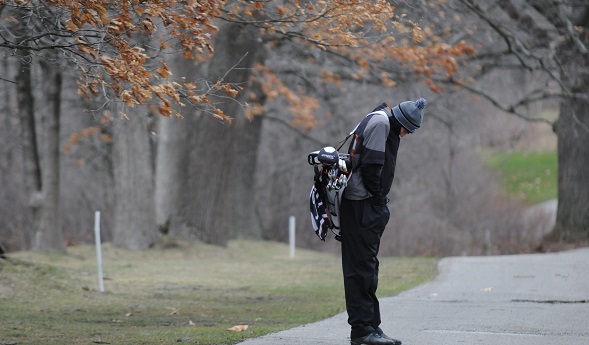
PHOTO: A golfer attempts to keep warm during a round on a dreary day earlier this season. (Click to see more at HighSchoolSportsScene.com.)

Moggach Honored Nationally for 25 Years of 'Sticking In, Doing Good'
By
Tim Robinson
Special for MHSAA.com
March 17, 2023
When Paul Moggach began his tenure as Brighton’s hockey coach, the program was at its nadir.
“When we got into high school hockey, it wasn't very good,” he said recently. “Our league wasn't very good. Our team wasn't very good. We started with character to try to build something different, you know, a different mousetrap.”
Over the next quarter of a century, Moggach and his assistants, primarily Rick Bourbonais (whom Moggach succeeded as coach) and current coach Kurt Kivisto helped lift the program into one of the most respected, and successful, in the state.
Moggach (pronounced MUG-uhth), along with former Detroit Catholic Central coach Gordon St. John, in February was named a co-recipient of the John Mariucci Award by the American Hockey Coaches Association.
They, along with Andy Weidenbach of Bloomfield Hills Cranbrook Kingswood, are the only Michigan coaches to have received the award, named after the longtime hockey coach at Michigan Tech.
“He brought in people that he knew could do things he may have had limitations at,” said Kivisto, who played for Moggach at Brighton two decades ago and was an assistant for 10 years before taking over as head coach in 2020. “He did a good job surrounding himself with people he trusted and knew would be good for the program while he steered the ship in the direction he wanted. And he was very good at that.”
Moggach calls the honor “very humbling.
“I got into hockey because there was a need,” he added, “then I ended up with Rick at the high school for those years. When you look back at it, I grew a lot. I grew a lot personally and from a coaching perspective I grew. I had to change things, and so I think it's not so much the reward as at least a recognition that I stuck it out. My grandmother used to always tell me, ‘Stick in and do good.’ She would say that when I was on the way out the door. That was her message to me, and I think (the award) just emphasizes that I did, I did stick in.”
“You can’t be happier for a guy than for a guy like Paul,” said Bourbonais, who coached with Moggach at Brighton for a total of 30 years, the last 20 as an assistant. “He took a hockey team and made it into a hockey program that is a top-five contender every year. Guys come out of the program with championships, but they also come out with life lessons and some idea of what it takes to be a great citizen and a great student as well as what it takes to be a great athlete.”
At first, though, there were trials. The Bulldogs struggled in his first two seasons, and the program itself was in jeopardy for a short while after a bench-clearing brawl.
Once that crisis passed, Moggach and his staff, which for many years consisted of Bourbonais, Mike Brown and Jason Valente, worked to rebuild the Bulldogs from a team known for its physicality to one with a more wide-open passing style of play.
When hockey trends went to a more defensive style, where the defense sparked the offense, Moggach adapted.
During the first decade of his tenure, as the Bulldogs had more success and built their reputation, teams that had shunned scheduling them in the past began adding Brighton to their schedules.
He kept looking for ways to improve his team, both on and off the ice.
Brighton was the first team to schedule a game with those in the Keweenaw Peninsula, both for the keen competition, but also as a team-bonding exercise.
The bus rides, about 11 hours each way, helped players who in many cases didn’t know each other outside the rink to bond. So did activities outside of hockey including team dinners and curling, and the experience of being together as a team for four days.
Other teams took notice, and team bonding trips, including those far shorter than the 550 miles from Brighton to Houghton, are commonplace.
 Soon after, he introduced a skating coach and stricter team nutrition to the program.
“It’s not something that we had done when I was in high school," said Kivisto, who graduated in 2003. “It was something that some of the families and players weren’t overly excited about, but he knew it was good for the team and he was always looking ahead and finding ways to give his team an advantage.”
Brighton grew to dominate its league, and winning gave Moggach the authority to introduce concepts new to players and families who grew up in travel hockey.
“I'm sure we weren't pleasing everybody,” he said, “But we thought we would do with character and live the kind of model that we would hope that the players would follow, that their families would follow. And as we did that it changed and we got in front of some things with our league, and had a good run in our league.”
Brighton won its first Division 1 championship in 2006. That was followed by back-to-back Division 1 titles in 2012 and 2013, and then 2017 and 2018, a stretch that saw the Bulldogs reach the Finals in six out of seven seasons.
“Some of that is when you learn how to win, you win, even sometimes when you shouldn't,” he said. “I'm not saying that you know when we got to the Finals that we didn't deserve to win. We had a good recipe there that got us those five wins, but once we got it rolling, that momentum kept us going sometimes then maybe it shouldn't have.”
As the program’s success and reputation grew, players who had been in travel hockey started opting to play for the Bulldogs.
“There are some kids on (this year’s Brighton) team who came from Triple A who are tired of that commitment, because of the travel, the time, the money,” he said. “And they found that high school hockey is different. I mean just look at the crowds. They don't get that kind of a reward for the work that they put in.
“I think it's developed to that point now for us and we get players like that and it's made a difference, I think, and not just for our team but for all of high school hockey, " Moggach continued. “The coaches association has done a great job in promoting now and so it is a great destination for so many good reasons for kids to spend that time and grow up with their friends who are in their neighborhoods and in their community.”
Moggach is still a fixture at Brighton games, still in close touch with Kivisto when not driving to see his grandsons play or his stepson, Damon Whitten, who coaches at Lake Superior State.
His impact will be felt in Brighton hockey for years to come.
“He left no stone unturned to try and be the best he thought we could be,” Brighton athletic director John Thompson said. “He’s one of those people who was genuinely invested in young people, and he always, always put the program first. He was a good manager of young men and developed some pretty good coaches, too.”
Moggach finished with a record of 467-172-43. St. John, who won six state titles at Catholic Central and another at Cranbrook, had a record of 229-29-18 in 10 seasons at Catholic Central.
“I was excited for (Moggach) when I heard the news,” Kivisto said, “seeing him put at a level of the guys who have won the award and the contributions they made to high school hockey. It’s neat to see him recognized at that level.”
Both men will receive their awards sometime this spring.
“I can be recognized,” Moggach said, “and I think kids are and their families are always looking for that. But I think before you do that you have to build the program, the program has to be something that's respectful and respected and competitive, and I think we accomplished that.”
***
Gordon St. John led Detroit Catholic Central and Bloomfield Hills Cranbrook Kingswood to a combined eight Finals championships over 16 seasons, the last seven with the Shamrocks including five straight in Class A or Division 1 from 1999-2003.
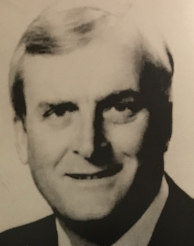 DCC’s Class A championship in 1994 was the first of now 17 Finals titles, which rank second-most in MHSAA history. He built a 222-29-18 record (.859 winning percentage) over 10 seasons leading the Shamrocks through 2003-04, the last two seasons as co-head coach before then staying with the program as an assistant and helping the team to another Division 1 championship in 2005.
St. John’s championship at Cranbrook came in 1988 in Class B-C-D.
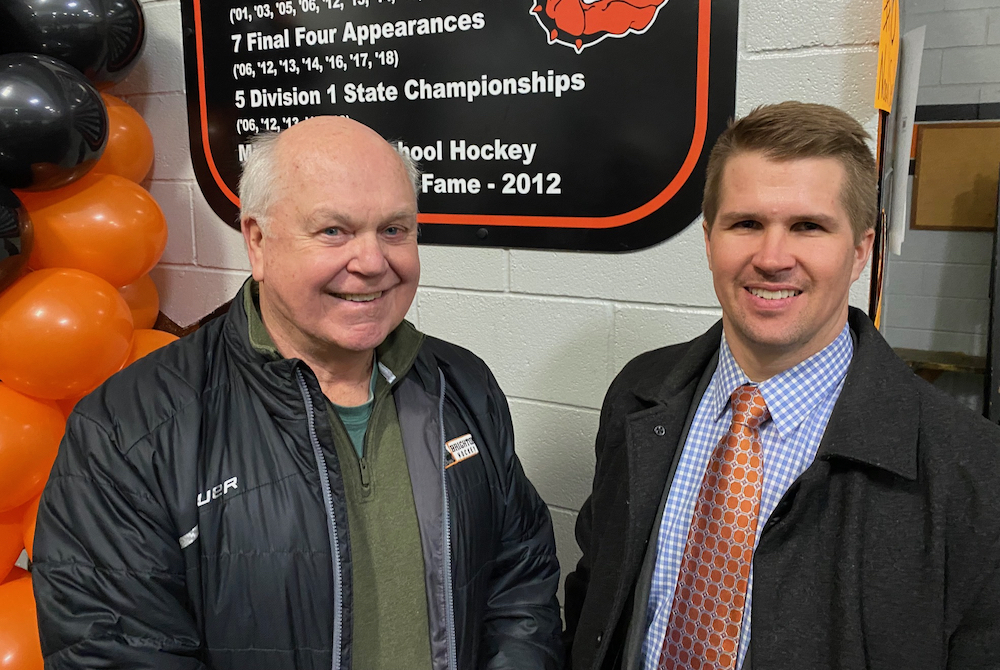
PHOTOS (Top) Retired Brighton hockey coach Paul Moggach, far right, stands alongside his players as they await to receive their medals after winning the 2018 Division 1 championship (Middle) Moggach stands with his former assistant and current Brighton head coach Kurt Kivisto. (Middle photo by Tim Robinson; St. John photo courtesy of the American Hockey Coaches Association.)