

Eventually, the sun will shine ...
April 25, 2013
By Geoff Kimmerly
Second Half editor
 We all believe that, right?
Rain – and snow for some – has been the buzzword of this spring sports season. Just about every newspaper is writing about it and every athletic director, coach, player and parent is dreading it on a now-daily basis.
But eventually, we expect the weather to clear up and teams to play catch-up. To that end, there are limitations teams in some sports face when attempting to make up their games – but also opportunities to take advantage of while trying to fill out their regular-season schedules.
- Girls soccer and girls and boys lacrosse teams may play only three games during a week, Monday through Sunday. A weekend tournament – which generally includes 2 to 3 shortened games – counts as only one in this equation.
- Baseball and softball teams can play as many games as they want in a week, but no more than two on a school day – and baseball pitchers must not pitch for two days following their 30th out in a week.
- For tennis, an individual may not play more than three matches in one day – unless she or he is playing in a league championship tournament featuring more than eight schools for which a fourth match would decide the championship. That player also could not have played more than six sets that day heading into that fourth and final match.
- Golf and Track and Field do not have weekly contest limitations. Track and field athletes can compete in only four events per day.
As expected, a number of teams – especially for baseball and softball – are scheduling to smash in as many contests as possible into the next four weeks. Postseason play for tennis and lacrosse begins May 16 – three weeks from today.
But teams do have options.
One rarely used but anticipated to be used more this spring is an opportunity to continue playing regular-season contests through the final day of the MHSAA tournament in that sport. For example, a baseball team can continue making up games through June 15, the day of the MHSAA Finals in Battle Creek. A tennis team can play regular-season matches through June 1, etc.
Also, the MHSAA Executive Committee approved Thursday to allow for this spring two additional multi-team tournament dates for soccer and lacrosse, which will give those teams an opportunity to get in a few more games. That means soccer teams will be allowed to play in four multi-team tournaments instead of two, boys lacrosse four instead of two and girls lacrosse five instead of three.
Teams will have to do some juggling, no doubt, and all other tournament stipulations still apply (games generally are shortened so more can be played, etc.). But with a little creativity, teams could at least get in a few of their make-up games in this way.
Also, the Executive Committee approved a motion to waive the four-contest MHSAA tournament entry requirement for all Upper Peninsula schools in all sports this spring. As of the weekend, snow still covered parts of the U.P.
Gaps shrinking
Much has been discussed about minimums for all four MHSAA classes for 2013-14, and how they are the lowest student totals in at least a decade.
It’s true. The floor in Class A is 893 (down from 911 this school year), Class B starts at 429 (down from 449), Class C at 207 (down from 217) and Class D at 206 (down from 216).
However, there is a better way to crunch the numbers: Consider the shrinking gaps between the largest and smallest schools in each class.
For 2013-14, the gap in Class A is 1,888 students – 261 students fewer than 2007-08 and nearly 900 students fewer than in 2005-06. The gaps between largest and smallest in Classes B, C and D also are trending smaller – which means each class actually includes schools more similar in size, instead of a perceived other way around.
SAC 2013-14 on the way
We’re thankful for a valuable group of students who help us throughout the school year – our 16-member Student Advisory Council, made up of eight seniors and eight juniors from all over the state who are charged with providing feedback on issues impacting educational athletics from a student’s perspective, while also assisting at MHSAA championships and with special projects like the “Battle of the Fans.”
Selecting the next class to join is a highlight of every spring – but hardly an easy process.
A six-member selection committee, myself included, considered 62 sophomore applicants today from all over the Lower and Upper Peninsulas, representing all four of our classes and nearly every sport we sponsor.
Every candidate is impressive for a variety of reasons. That’s what makes this difficult – we could pick any number of combinations to make up our new SAC class, and no doubt leaders galore will emerge from another impressive group.
But there are only eight spots on the council. And we’ll announce who received them later next week.
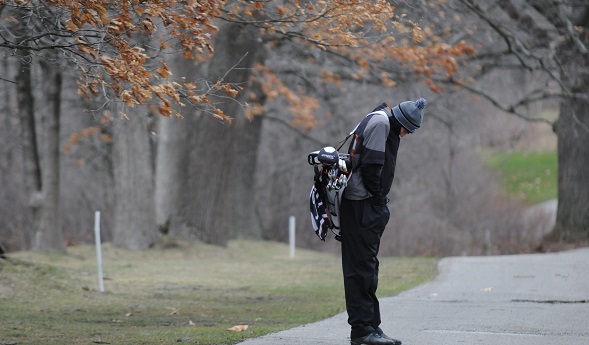
PHOTO: A golfer attempts to keep warm during a round on a dreary day earlier this season. (Click to see more at HighSchoolSportsScene.com.)
Retired NHL-er Back on Ice to Answer Call - By Making Them
By
Rob Kaminski
MHSAA benchmarks editor
March 16, 2023
The most accomplished skater on the ice during Friday’s triple-overtime MHSAA Division 1 Semifinal hockey thriller between Hartland and Brighton was not wearing the school colors of either team.
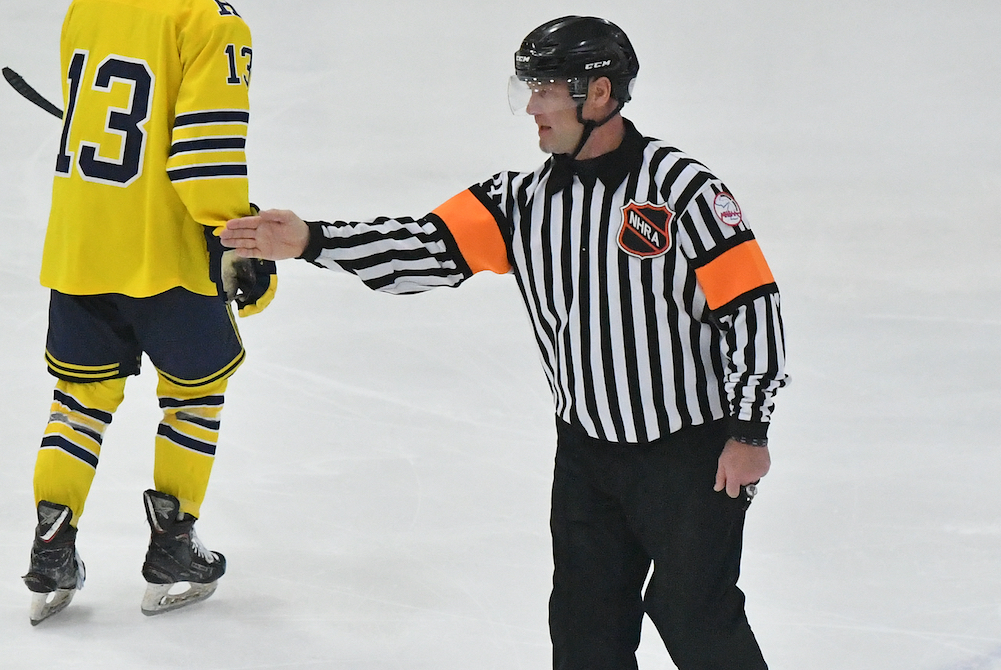
In front of a packed house at Plymouth’s USA Hockey Arena, referee Bryan Smolinski was in stripes, just like the rest of his officiating crew.
In his former life, he pulled on plenty of sweaters before lacing up the skates. That happens when one logs more than 1,000 games, tallies nearly 300 goals (274) and close to 400 assists (377) with eight teams spanning a 15-year playing career in the National Hockey League.
So, how did the 52-year-old former star player find himself on the ice last weekend as one of the referees for the pinnacle weekend of this high school season? Good question, even for the man known as “Smoke” during his playing days.
“I was working in youth development programs a few years back and reached out to some Michigan guys I had connections with about other ways to help the game,” Smolinski said. “I called Kevin May just to chat and asked, ‘Hey, how’s your reffing going?’ He said, ‘You know, we’re down a little bit,’ then said, ‘Why don’t you do it?’ I said, ‘Not a chance,’” Smolinski laughed.
Never Say Never
May persisted, imploring his friend to skate with him during a Fall league at Cranbrook in Bloomfield Hills. After eight weeks, once a week, Smolinski had a revelation.
“I’m like, ‘I’m kind of diggin’ this,’” Smolinski said “So, I did all the testing, and the educational part of it, and I really enjoyed it. I got with Danny (DiCristofaro) and his group, and he put me in as much as he could, and I really started to get my feet wet.”
 DiCristofaro is the assigner and referee-in-chief for the MHSAA’s Northeast Hockey Referees Association, and he has seen Smolinski’s growth first-hand.
“Obviously he’s got great instincts and a feel for the game, along with a wealth of experience, all of which has allowed him to climb the ladder quickly,” said DiCristofaro. “It’s been a joy to watch his growth as an official.”
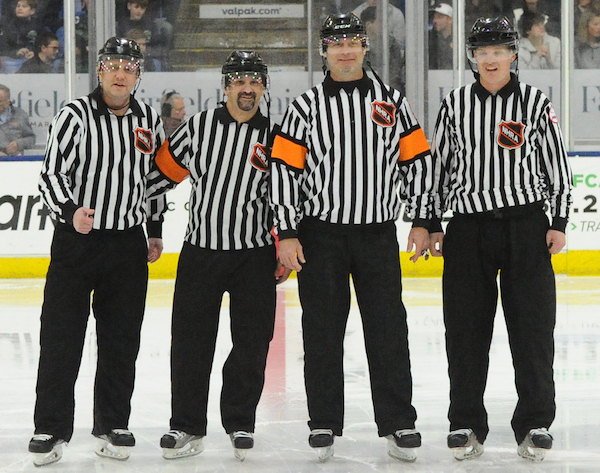
Fast forward to last Friday, and there were Smolinski and May sharing duties as referees during the MHSAA Semifinal with linesmen Michael Andrews and Thomas Robbins.
In between, there has been a learning curve that still continues, but the jump to officiating was not quite as daunting as his introduction to the NHL.
“I was scared to death. My first game was against Mario Lemieux. I’m in the old Boston Garden and now I’m playing against these guys and it’s their job, and they’re out there trying to make a living,” Smolinski recalled.
The emotions were not running nearly as frenzied for his first game as an MHSAA official, obviously, yet respect came in a different form.
“I couldn’t pick the puck up, I was breathing heavily; it was Kevin and me doing a two-man game in Brighton,” Smolinski recalled. “There were a few high-end kids playing, and I’m thinking, ‘I’m dying here.’ You know, there’s no training for that first time.”
What that experience did, however, was revitalize Smolinski in a new way. His playing career is well documented, not only in the NHL, but around Michigan. He enjoyed an honor-laden career at Michigan State University from 1989-93 before joining the Boston Bruins (who had drafted him three years earlier) at the end of the ’93 NHL campaign. Even after his final season, with Montreal in 2007-08, he stayed in the game via men’s leagues, or coaching his son, Max.
Smolinski and his wife, Julie, have three daughters: Ashtyn (22), Jojo (16) and Rylen (12), along with Max, whom dad coached for seven years including during a national championship run with a Little Caesars U15 team in 2019. Max, 19, is now playing collegiately at Rensselaer Polytechnic Institute.
So, for Smolinski, officiating offers a new chapter.
“Reffing brought back ... I wouldn’t say love of the game, because that’s always been there; it’s a different side of enjoying the game now. I have no horse in the race, my son’s off to college, my daughters are doing their thing; I wanted to find something new in the game,” Smolinski said. “I’ve coached, and I don’t want to do that. I found this, and I’ve stuck with it.”
Old College Ties
One of the great benefits of athletics at any level are the friendships made. For two kids who met in their first years on the MSU campus and forged a bond that lasts to this day, it’s amazing how their careers reached the pinnacle and have now come full circle.
Wes McCauley, an MSU teammate, is one of Smolinski’s best friends. After numerous years in the minor leagues, McCauley, like his friend, made it to the NHL. But McCauley made it as an official, working his first NHL game in 2003, when Smolinski was nearing the end of his playing career.
 Their games lined up on just a few occasions in the NHL, and the two lobbied hard to have McCauley work Smolinski’s 1,000th career game in his final season with the Canadiens in 2007-08. The request, sadly, was denied by the league.
On the rare occasions when the friends did share the same ice, less than a handful by Smolinski’s count, it was McCauley who was forced to rebuff any attempts at fraternization. It’s just part of an official’s edict.
“For both of us, it was amazing; it was just great,” Smolinski said. “I’d say, ‘Hey man what’s up?’ and he says, ‘Can’t talk.’ I’m like, ‘What do you mean, we talk all the time.’ Again, he’s like, ‘Can’t talk, get away from me.’ You know, it was just business.”
McCauley then reached the 1,000-game plateau himself in 2018 and is still going strong as a regular selection for playoff duties with nine Stanley Cup Finals assignments, including last year.
So, it should have been natural for Smolinski to go to his old friend immediately for officiating pointers once he joined the ranks, right? Well, maybe not immediately.
“I talk to Wes all the time, but I actually hid it from him right out of the gate because I didn’t want to take his razzing. Eventually it got out, and he was loving it. He started sending me whistles and visors and pants,” Smolinski said, grinning. “And none of it fit, you know, because I’m older and fatter, and he’s so damn skinny. So, I still had to go out and get all new gear.”
Both Sides Now
Having been to the top of his profession, now moving to the other side of that same mountain that his friend McCauley scaled, the respect has grown for those blowing the whistle.
“The preparation for officiating is much more mental,” Smolinski said. “Way more rules oriented. You’re always trying to get away with things that you can as a player; now you have to police that.”
Smolinski has a distinct advantage.
“I know everything they’re trying to do because I’ve done it. I know where you’re going with the puck, I know what kind of breakout you’re trying to do,” Smolinski said. “I have all the instincts, now I just try to stay out of the way and not ruin their game. The most fun is watching the game develop and the ups and downs. For me to be out there and enjoy it with them, that’s the fun part.”
 Those who have played hockey at any level have a built-in advantage should they consider the officiating avocation: the ability to skate. Unlike officiating in any other sport, skating is a prerequisite. This makes the pool limited, and almost solely composed of former players. Smolinski offers this advice.
“I prefer sticking with high school because I think there’s more decorum, more administrative structure. Kids are playing for their schools, there’s loyalty there,” said Smolinski. “And there is more accountability. People need report to athletic directors and supervisors. Other levels can be more loosely governed, or a bit more maverick in nature. Moms and dads get involved more, coaches maybe know a little less,” said Smolinski.
He has, in fact, worked a handful of non-school games, and there’s a stark difference.
“I wanted to see what was going on, and I see it first-hand,” Smolinski said. “There are some crazy people and parents out there, and these guys are getting absolutely tortured. I’ve been tortured. There has to be a level of respect for what officials do. I think schools can rein that in a little more. All the guys I’ve met give up a lot of time and work hard because they love to do it and love the game.”
All sports need an assist from school administration and from those who once played the games to keep the officials recruitment moving in the right direction. People like Smolinski can help.
“He clearly doesn’t need to do this, and that’s what makes it so fantastic,” DiCristofaro said. “We need more people who have played – at any level – to do what he’s done and stay in the game as officials.”
Smolinski continues to promote the game in other ways as well. Currently, he is involved in the NHL’s Learn To Play initiative, which aims to inspire youth and welcome more families into the hockey community.
“We work hand-in-hand with the NHL Players Association for player development and industry growth,” Smolinski said. “Ages 5 to 9 are introduced to hockey, get head-to-toe gear and instruction, and meet some former players.”
The idea is to have fun first, which can translate into years and maybe even a lifetime in the sport. It’s a lifetime that has given Smolinski so much and continues to do so as he watches it unfold for others from his new vantage point.
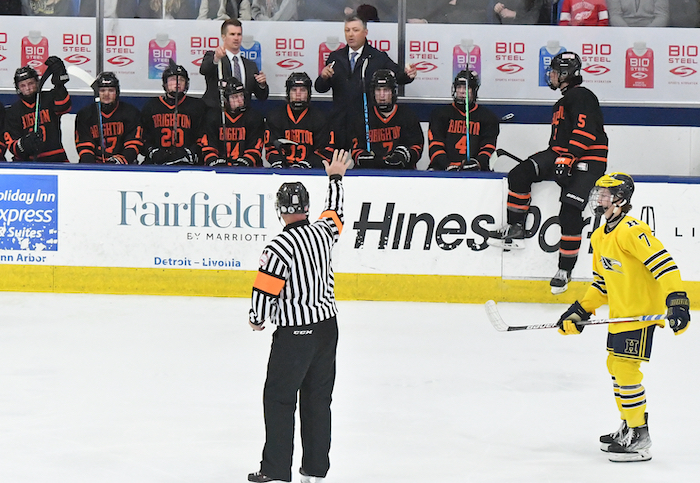
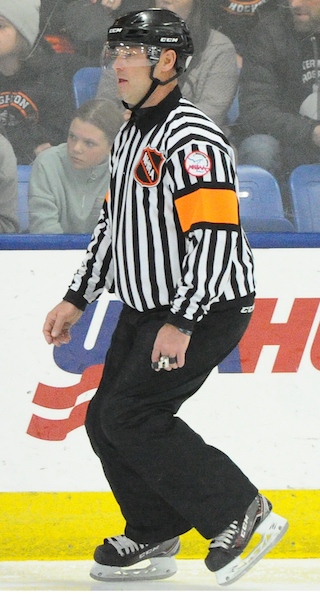
PHOTOS (Top) MHSAA official Bryan Smolinski signals during Friday's Division 1 Semifinal between Brighton and Hartland. (2) Smolinski, a retired NHL standout, communicates with the Bulldogs' bench. (3) Smolinski keeps watch during game play. (4) Smolinski, third from left, with his crew: Michael Andrews, Kevin May and Thomas Robbins.