

Eventually, the sun will shine ...
April 25, 2013
By Geoff Kimmerly
Second Half editor
 We all believe that, right?
Rain – and snow for some – has been the buzzword of this spring sports season. Just about every newspaper is writing about it and every athletic director, coach, player and parent is dreading it on a now-daily basis.
But eventually, we expect the weather to clear up and teams to play catch-up. To that end, there are limitations teams in some sports face when attempting to make up their games – but also opportunities to take advantage of while trying to fill out their regular-season schedules.
- Girls soccer and girls and boys lacrosse teams may play only three games during a week, Monday through Sunday. A weekend tournament – which generally includes 2 to 3 shortened games – counts as only one in this equation.
- Baseball and softball teams can play as many games as they want in a week, but no more than two on a school day – and baseball pitchers must not pitch for two days following their 30th out in a week.
- For tennis, an individual may not play more than three matches in one day – unless she or he is playing in a league championship tournament featuring more than eight schools for which a fourth match would decide the championship. That player also could not have played more than six sets that day heading into that fourth and final match.
- Golf and Track and Field do not have weekly contest limitations. Track and field athletes can compete in only four events per day.
As expected, a number of teams – especially for baseball and softball – are scheduling to smash in as many contests as possible into the next four weeks. Postseason play for tennis and lacrosse begins May 16 – three weeks from today.
But teams do have options.
One rarely used but anticipated to be used more this spring is an opportunity to continue playing regular-season contests through the final day of the MHSAA tournament in that sport. For example, a baseball team can continue making up games through June 15, the day of the MHSAA Finals in Battle Creek. A tennis team can play regular-season matches through June 1, etc.
Also, the MHSAA Executive Committee approved Thursday to allow for this spring two additional multi-team tournament dates for soccer and lacrosse, which will give those teams an opportunity to get in a few more games. That means soccer teams will be allowed to play in four multi-team tournaments instead of two, boys lacrosse four instead of two and girls lacrosse five instead of three.
Teams will have to do some juggling, no doubt, and all other tournament stipulations still apply (games generally are shortened so more can be played, etc.). But with a little creativity, teams could at least get in a few of their make-up games in this way.
Also, the Executive Committee approved a motion to waive the four-contest MHSAA tournament entry requirement for all Upper Peninsula schools in all sports this spring. As of the weekend, snow still covered parts of the U.P.
Gaps shrinking
Much has been discussed about minimums for all four MHSAA classes for 2013-14, and how they are the lowest student totals in at least a decade.
It’s true. The floor in Class A is 893 (down from 911 this school year), Class B starts at 429 (down from 449), Class C at 207 (down from 217) and Class D at 206 (down from 216).
However, there is a better way to crunch the numbers: Consider the shrinking gaps between the largest and smallest schools in each class.
For 2013-14, the gap in Class A is 1,888 students – 261 students fewer than 2007-08 and nearly 900 students fewer than in 2005-06. The gaps between largest and smallest in Classes B, C and D also are trending smaller – which means each class actually includes schools more similar in size, instead of a perceived other way around.
SAC 2013-14 on the way
We’re thankful for a valuable group of students who help us throughout the school year – our 16-member Student Advisory Council, made up of eight seniors and eight juniors from all over the state who are charged with providing feedback on issues impacting educational athletics from a student’s perspective, while also assisting at MHSAA championships and with special projects like the “Battle of the Fans.”
Selecting the next class to join is a highlight of every spring – but hardly an easy process.
A six-member selection committee, myself included, considered 62 sophomore applicants today from all over the Lower and Upper Peninsulas, representing all four of our classes and nearly every sport we sponsor.
Every candidate is impressive for a variety of reasons. That’s what makes this difficult – we could pick any number of combinations to make up our new SAC class, and no doubt leaders galore will emerge from another impressive group.
But there are only eight spots on the council. And we’ll announce who received them later next week.
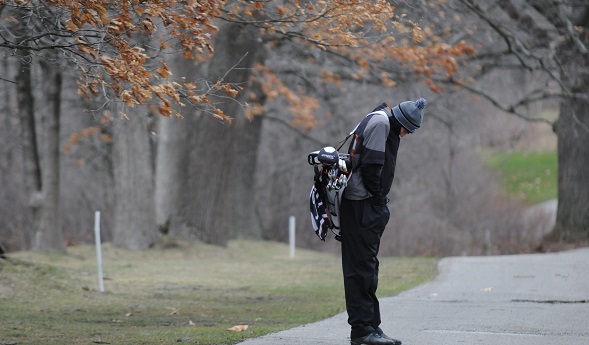
PHOTO: A golfer attempts to keep warm during a round on a dreary day earlier this season. (Click to see more at HighSchoolSportsScene.com.)
Midland Heroes Win 'Match of Life' In Saving Another On Way to Regional
By
Paul Costanzo
Special for MHSAA.com
February 22, 2023
Wilson Shinske woke up Saturday hoping to accomplish something great.
 But the Midland senior had no idea just how great and impactful his accomplishment would be, and that it would happen well before he stepped on a wrestling mat.
On the way to the Division 1 Wrestling Regional at Hartland, Shinske and his dad, Steve, pulled a man from a burning vehicle on I-75 and helped resuscitate him on the side of the road. As the man was taken by ambulance to a local hospital, the Shinskes got back in their own vehicle and made it to the meet in time for weigh-ins.
“The entire way there, I was thinking, ‘It doesn’t matter if I lose or if I win today, this was a win,’” Wilson Shinske said. “Being on the wrestling team is about being part of something bigger than yourself. Yeah, I lost both of my matches, and it was like that journey has ended. But knowing what I did earlier, I won the match of life.”
Shinske finished his wrestling season with a 21-11 record after dropping his pair of Regional matches at 215 pounds. While all of that was certainly important to him, and the end of any senior season can be tough, the events of Saturday morning put a lot of things in perspective.
“I can tell you that I was proud as hell of him,” Steve Shinske said. “I was super proud of how he handled the morning. I was proud – I’m always proud of him when he does a sport, even when he thinks he doesn’t do well. When he lost, I saw him take those losses on Saturday differently than he had in the past in some of those situations. I think he had a different mindset. After he lost the second match, he went over and sat by a wall, and there were some tears shed. There were a ton of emotions, and not just wrestling emotions.”
Wilson Shinske’s day had started like hundreds of wrestlers around the state, as he left Midland around 5:30 a.m. focused on advancing to the MHSAA Individual Finals at Ford Field.
He fell asleep during the ride, but when the car started to slow down well before he thought it should, he knew something was off.
After coming over the Zilwaukee Bridge, Steve Shinske noticed a car fire ahead. As they approached, the retired Midland fireman decided he would stop and see how he could help, figuring he would see someone outside of the vehicle.
 What he saw, however, was the driver slumped over in the front seat of the pickup truck. He pulled to the side of the road, and as he made his way to the truck, so did Wilson, who had now woken up from his pre-meet nap.
“It was 75 at 6 a.m. on a Saturday with no traffic; there’s no way we should be slowing down,” Wilson remembered. “As soon as he put it in park, not even a second later, I’m out of the car.”
As the Shinskes got to the vehicle, Steve noticed the driver – whose name they would later learn is Jerry – still had his foot crammed on the accelerator. That left the rear tires spinning until the tires had burned off and the rims were grinding on the pavement, which caused the fire at the back of the truck. His first move was to put the car in park and shut it off.
They removed Jerry – who they determined was not breathing and did not have a pulse – from the truck, and then Wilson’s training kicked in.
Wilson – a three-sport athlete who carries a 3.8 GPA – plans to study nursing in college, and spends much of his school day working in a hospital as part of a co-op. He’s CPR-certified and plans to work in the ER or a trauma unit.
A point of emphasis in Wilson’s training is to assess the situation in an emergency.
“The car is on fire, the gas tank is in the back of the car, we need to get him away from this,” Wilson said. “We need to get him up in front of our car – put a barrier between us to protect us if something happened. I don’t think there were really any nerves, just more fight or flight. I’m not running away, I’m fighting this. I wasn’t concerned with how cold it was – I wasn’t dressed for 20-degree weather – it was, ‘We have a problem here, let’s fix this problem.’”
Steve started CPR on Jerry while Wilson went back to see if they could find any personal information about him that would help, and 9-1-1 was called.
An off-duty paramedic then arrived on the scene, and put in a call to her supervisor for more assistance. That’s when Wilson took over CPR, and Steve went to put out the fire using snow from the median.
When the supervisor arrived, he brought out an AED to deliver a shock to Jerry’s heart. After some more CPR, Jerry took a gasp of air, and the monitor showed that there was heart activity.
“Then the cavalry came,” Steve said of the rush of emergency vehicles on the scene. He borrowed a fire extinguisher from a police officer to put out the remaining flames, and Jerry was loaded into an ambulance. Wilson said he could see Jerry taking breaths as he was being put into the ambulance.
The whole situation took about 15 to 20 minutes.
“Wilson’s played a lot of sports – football, tennis, he’s wrestled since he’s been 6, he plays golf – he understands that sports gives you perseverance, it gives you a different mindset,” Steve said. “I bet anybody that he works with on the floor at the hospital will tell you that he’s the most outgoing, go-getter co-op student they’ve had. Those things in his life helped him in that situation.”
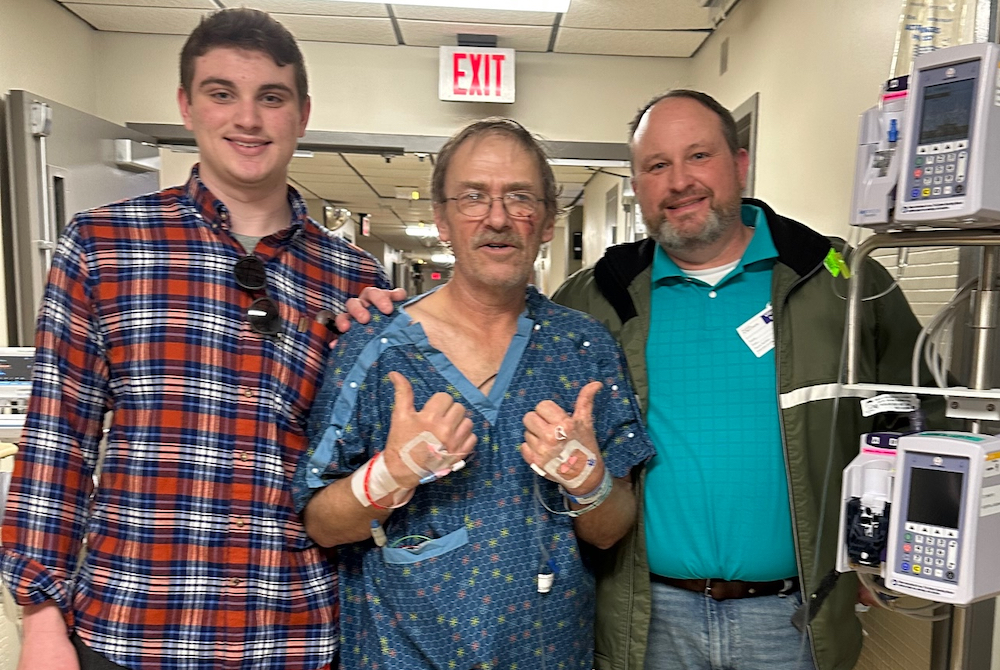
Jerry survived, and the Shinskes went to visit him in the hospital Monday. While there, they learned from the family that the fire had started to melt the gas tank before Steve was able to put it out. They also learned that Jerry’s wife had recently passed away, and that their quick action had prevented his family from adding another layer of grief in a very short time.
“I love watching (Wilson) wrestle, and I’m going to miss watching him wrestle,” Steve Shinske said. “But watching him on I-75 on Saturday morning was almost better than watching him wrestle. He, as a young man, as a person that’s getting ready to go into the next phase of his life, to be able to handle something like that and not miss a beat was special.”
For Wilson, the experience further cemented his chosen career path, and desire to help others.
“I want to be a part of saving lives more often,” he said. “Not that I want to see people in these situations, but I want to help them when they are.”
 Paul Costanzo served as a sportswriter at The Port Huron Times Herald from 2006-15, including three years as lead sportswriter, and prior to that as sports editor at the Hillsdale Daily News from 2005-06. He can be reached at [email protected] with story ideas for Genesee, Lapeer, St. Clair, Sanilac, Huron, Tuscola, Saginaw, Bay, Arenac, Midland and Gladwin counties.
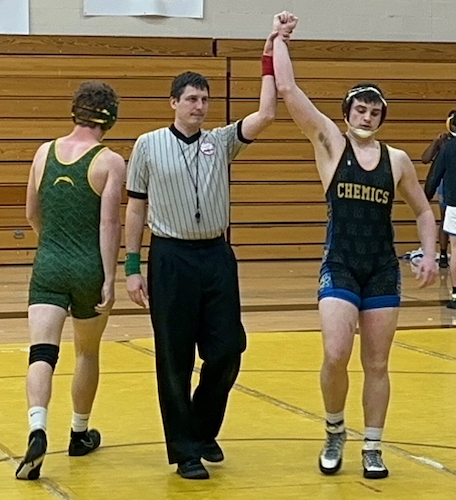
PHOTOS (Top) From left: Wilson Shinske, Jerry and Steve Shinske meet Monday, two days after the father and son helped save Jerry’s life on I-75. (Middle) Wilson Shinske, far right, has his arm raised in victory after a match. (Photos courtesy of the Shinske family, with permission.)