

Eventually, the sun will shine ...
April 25, 2013
By Geoff Kimmerly
Second Half editor
 We all believe that, right?
Rain – and snow for some – has been the buzzword of this spring sports season. Just about every newspaper is writing about it and every athletic director, coach, player and parent is dreading it on a now-daily basis.
But eventually, we expect the weather to clear up and teams to play catch-up. To that end, there are limitations teams in some sports face when attempting to make up their games – but also opportunities to take advantage of while trying to fill out their regular-season schedules.
- Girls soccer and girls and boys lacrosse teams may play only three games during a week, Monday through Sunday. A weekend tournament – which generally includes 2 to 3 shortened games – counts as only one in this equation.
- Baseball and softball teams can play as many games as they want in a week, but no more than two on a school day – and baseball pitchers must not pitch for two days following their 30th out in a week.
- For tennis, an individual may not play more than three matches in one day – unless she or he is playing in a league championship tournament featuring more than eight schools for which a fourth match would decide the championship. That player also could not have played more than six sets that day heading into that fourth and final match.
- Golf and Track and Field do not have weekly contest limitations. Track and field athletes can compete in only four events per day.
As expected, a number of teams – especially for baseball and softball – are scheduling to smash in as many contests as possible into the next four weeks. Postseason play for tennis and lacrosse begins May 16 – three weeks from today.
But teams do have options.
One rarely used but anticipated to be used more this spring is an opportunity to continue playing regular-season contests through the final day of the MHSAA tournament in that sport. For example, a baseball team can continue making up games through June 15, the day of the MHSAA Finals in Battle Creek. A tennis team can play regular-season matches through June 1, etc.
Also, the MHSAA Executive Committee approved Thursday to allow for this spring two additional multi-team tournament dates for soccer and lacrosse, which will give those teams an opportunity to get in a few more games. That means soccer teams will be allowed to play in four multi-team tournaments instead of two, boys lacrosse four instead of two and girls lacrosse five instead of three.
Teams will have to do some juggling, no doubt, and all other tournament stipulations still apply (games generally are shortened so more can be played, etc.). But with a little creativity, teams could at least get in a few of their make-up games in this way.
Also, the Executive Committee approved a motion to waive the four-contest MHSAA tournament entry requirement for all Upper Peninsula schools in all sports this spring. As of the weekend, snow still covered parts of the U.P.
Gaps shrinking
Much has been discussed about minimums for all four MHSAA classes for 2013-14, and how they are the lowest student totals in at least a decade.
It’s true. The floor in Class A is 893 (down from 911 this school year), Class B starts at 429 (down from 449), Class C at 207 (down from 217) and Class D at 206 (down from 216).
However, there is a better way to crunch the numbers: Consider the shrinking gaps between the largest and smallest schools in each class.
For 2013-14, the gap in Class A is 1,888 students – 261 students fewer than 2007-08 and nearly 900 students fewer than in 2005-06. The gaps between largest and smallest in Classes B, C and D also are trending smaller – which means each class actually includes schools more similar in size, instead of a perceived other way around.
SAC 2013-14 on the way
We’re thankful for a valuable group of students who help us throughout the school year – our 16-member Student Advisory Council, made up of eight seniors and eight juniors from all over the state who are charged with providing feedback on issues impacting educational athletics from a student’s perspective, while also assisting at MHSAA championships and with special projects like the “Battle of the Fans.”
Selecting the next class to join is a highlight of every spring – but hardly an easy process.
A six-member selection committee, myself included, considered 62 sophomore applicants today from all over the Lower and Upper Peninsulas, representing all four of our classes and nearly every sport we sponsor.
Every candidate is impressive for a variety of reasons. That’s what makes this difficult – we could pick any number of combinations to make up our new SAC class, and no doubt leaders galore will emerge from another impressive group.
But there are only eight spots on the council. And we’ll announce who received them later next week.
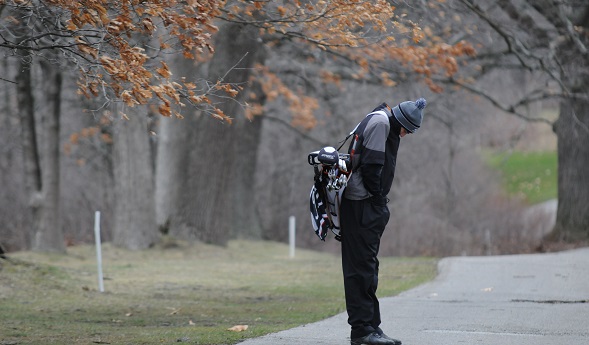
PHOTO: A golfer attempts to keep warm during a round on a dreary day earlier this season. (Click to see more at HighSchoolSportsScene.com.)
The Inside Scoop On Ski Safety: 6 Tips
January 10, 2023
Injuries happen to skiers of all levels, even under pristine conditions and when using the best available equipment. “Beginners are more likely to get injured. But when experienced skiers go down, they tend to have more severe injuries,” says Michelle Gambino-Gorney, a certified athletic trainer at the Henry Ford Kutcher Clinic for Concussion and Sports Neurology.
 But you don’t have to let the risk of injury hold you back from having fun on the slopes. A few basic safety tips? Stay within your ability level and ensure your skis are in good condition. That said, going beyond ski safety basics and learning how to avoid injuries can help you stay safe on the slopes. Here are six expert tips:
Use caution when getting on and off the ski lift. Ski lifts make a lot of people anxious. Being high off the ground on your journey up the mountain can invoke a fear of falling. “But it’s getting on and off the ski lift where the vast majority of lift-related injuries occur,” Gambino-Gorney says. To lower your risk of injury, remove pole straps and backpacks before loading, look over your shoulder to make sure you sit squarely on the seat at the correct time, and don't try to retrieve items you lose hold of (including poles, gloves and phones). It’s best to let them go and ski back for them.
Keep it simple at terrain parks. Terrain parks include human-made features like ramps and rails that enable skiers to do jumps, flips and other maneuvers. Any time your skis leave the ground, injuries are possible. You can safely enjoy terrain parks by starting with smaller obstacles and maneuvers and mastering them before moving on to other challenges. Do not rely on online tutorials to learn new skills. Ski instructors can help you learn the correct technique and provide personalized tips for achieving your goals.
Beware of trees. Trees present multiple dangers. Colliding with a tree, especially at high speed, leads to some of the most severe ski injuries. A small number of skiers die each year from tree collisions. To avoid collisions, ski with control. Other concerns include tree wells and snow immersion suffocation. This type of injury occurs when a person falls head first into a pocket of loose snow near a tree trunk and gets trapped. Skiing with a partner on ungroomed paths, which typically run past tree wells, is essential. If you become immersed in a tree well, a partner can step in to help you break free.
Pay extra attention during your final run of the day. Injuries are more common during skiers’ last runs. “Skiing later in the day can be dangerous because small changes can affect your ability to maneuver and react to conditions,” Gambino-Gorney says. Fresh powder may get matted down. Groomed areas become bumpy. And fatigue can make you less aware of hazards and other skiers. While it may be tempting to give it your all on your last run, it’s better to ease up and take your time.
Follow the Skier Code of Responsibility. People of all ages, abilities and ski levels can safely share the slopes when everyone follows the National Ski Area Association™ Responsibility Code. Key points include: Giving right of way to people ahead of (downhill from) you, staying off closed trails, and looking uphill for other skiers when merging.
Expedite access to help in an emergency. Being prepared can help you quickly reach ski patrol in an emergency. Most ski areas list their ski patrol phone number near the lifts. While you are waiting in the ski lift line, program it into your phone. If you or someone nearby experiences an injury, being able to call for help will save precious time. Instead of waiting for someone to ski down the mountain and ask for help, you can stay with the injured person and call for help. Calling also makes it easier to share important details so that ski patrol arrives with the appropriate people and equipment.
“Skiing is like any sport in that there’s a risk of injury. But many people hit the slopes without incident. Some skiers go decades without a single fall,” Gambino-Gorney says. Follow these insider tips and don't forget to wear a helmet so you can relish your next powder day and get the most out of the season.
To find a sports medicine provider at Henry Ford, visit henryford.com/sports or call 313-651-1969.
Michelle Gambino-Gorney is a certified athletic trainer at the Henry Ford Kutcher Clinic for Concussion and Sports Neurology.