

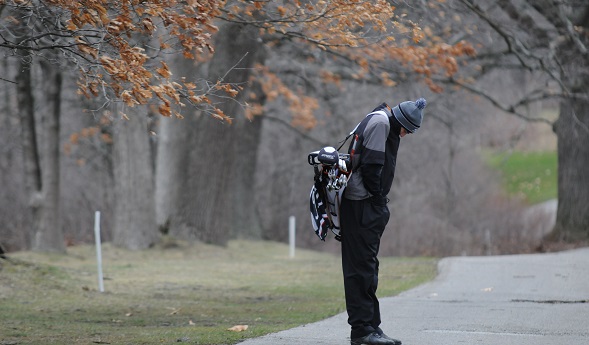
Eventually, the sun will shine ...
April 25, 2013
By Geoff Kimmerly
Second Half editor
 We all believe that, right?
Rain – and snow for some – has been the buzzword of this spring sports season. Just about every newspaper is writing about it and every athletic director, coach, player and parent is dreading it on a now-daily basis.
But eventually, we expect the weather to clear up and teams to play catch-up. To that end, there are limitations teams in some sports face when attempting to make up their games – but also opportunities to take advantage of while trying to fill out their regular-season schedules.
- Girls soccer and girls and boys lacrosse teams may play only three games during a week, Monday through Sunday. A weekend tournament – which generally includes 2 to 3 shortened games – counts as only one in this equation.
- Baseball and softball teams can play as many games as they want in a week, but no more than two on a school day – and baseball pitchers must not pitch for two days following their 30th out in a week.
- For tennis, an individual may not play more than three matches in one day – unless she or he is playing in a league championship tournament featuring more than eight schools for which a fourth match would decide the championship. That player also could not have played more than six sets that day heading into that fourth and final match.
- Golf and Track and Field do not have weekly contest limitations. Track and field athletes can compete in only four events per day.
As expected, a number of teams – especially for baseball and softball – are scheduling to smash in as many contests as possible into the next four weeks. Postseason play for tennis and lacrosse begins May 16 – three weeks from today.
But teams do have options.
One rarely used but anticipated to be used more this spring is an opportunity to continue playing regular-season contests through the final day of the MHSAA tournament in that sport. For example, a baseball team can continue making up games through June 15, the day of the MHSAA Finals in Battle Creek. A tennis team can play regular-season matches through June 1, etc.
Also, the MHSAA Executive Committee approved Thursday to allow for this spring two additional multi-team tournament dates for soccer and lacrosse, which will give those teams an opportunity to get in a few more games. That means soccer teams will be allowed to play in four multi-team tournaments instead of two, boys lacrosse four instead of two and girls lacrosse five instead of three.
Teams will have to do some juggling, no doubt, and all other tournament stipulations still apply (games generally are shortened so more can be played, etc.). But with a little creativity, teams could at least get in a few of their make-up games in this way.
Also, the Executive Committee approved a motion to waive the four-contest MHSAA tournament entry requirement for all Upper Peninsula schools in all sports this spring. As of the weekend, snow still covered parts of the U.P.
Gaps shrinking
Much has been discussed about minimums for all four MHSAA classes for 2013-14, and how they are the lowest student totals in at least a decade.
It’s true. The floor in Class A is 893 (down from 911 this school year), Class B starts at 429 (down from 449), Class C at 207 (down from 217) and Class D at 206 (down from 216).
However, there is a better way to crunch the numbers: Consider the shrinking gaps between the largest and smallest schools in each class.
For 2013-14, the gap in Class A is 1,888 students – 261 students fewer than 2007-08 and nearly 900 students fewer than in 2005-06. The gaps between largest and smallest in Classes B, C and D also are trending smaller – which means each class actually includes schools more similar in size, instead of a perceived other way around.
SAC 2013-14 on the way
We’re thankful for a valuable group of students who help us throughout the school year – our 16-member Student Advisory Council, made up of eight seniors and eight juniors from all over the state who are charged with providing feedback on issues impacting educational athletics from a student’s perspective, while also assisting at MHSAA championships and with special projects like the “Battle of the Fans.”
Selecting the next class to join is a highlight of every spring – but hardly an easy process.
A six-member selection committee, myself included, considered 62 sophomore applicants today from all over the Lower and Upper Peninsulas, representing all four of our classes and nearly every sport we sponsor.
Every candidate is impressive for a variety of reasons. That’s what makes this difficult – we could pick any number of combinations to make up our new SAC class, and no doubt leaders galore will emerge from another impressive group.
But there are only eight spots on the council. And we’ll announce who received them later next week.
PHOTO: A golfer attempts to keep warm during a round on a dreary day earlier this season. (Click to see more at HighSchoolSportsScene.com.)

Michigan Improves Ranking in 12 Sports as NFHS Participation Survey Returns
By
Geoff Kimmerly
MHSAA.com senior editor
January 4, 2023
Despite ranking 10th nationally in high school-aged population, Michigan ranked eighth nationally for participation in high school sports during the 2021-22 school year and moved up lists in 12 sports as the National Federation of State High School Associations (NFHS) conducted its national participation survey for the first time since 2018-19.
Michigan’s participation ranking was based on a number of 271,423, with 114,999 girls and 156,424 boys taking part in high school athletics, and included sports in which the Michigan High School Athletic Association does not conduct postseason tournaments. The totals count students once for each sport played, meaning students who are multiple-sport athletes are counted more than once.
Michigan previously also ranked both eighth overall in participation and 10th overall for high school-aged children from 2016-17 through 2018-19, the population rankings according to U.S. Census Bureau estimates from those years. The NFHS did not conduct its national participation survey during the 2019-20 and 2020-21 school years, although the MHSAA continued to collect participation data from member schools during that time.
A total of 18 sports bested the state’s overall national participation ranking of eighth in 2021-22 by placing seventh or higher on their respective lists. Twelve Michigan sports improved in national ranking from the last national survey in 2018-19, while the state fell in the rankings of five sports.
Michigan’s best showings were in boys bowling – where it continued to rank second nationally in participation – and also girls and boys alpine skiing, where Michigan also ranked second. Girls bowling participation moved up to third nationally from fourth in 2018-19, while boys ice hockey and girls tennis participation ranked fourth and boys tennis and girls and boys golf participation all ranked fifth nationally. Other Michigan sports ranking seventh or higher on the national participation lists were girls and boys basketball (both sixth), girls competitive cheer (sixth), girls (sixth) and boys cross country (seventh), football (sixth), boys track & field (sixth), girls volleyball (sixth) and wrestling (seventh).
Michigan’s participation in baseball (eighth), boys lacrosse (eighth), softball (eighth), girls track & field (eighth), girls soccer (ninth), girls and boys swimming & diving (both ninth) and boys soccer (10th) also met or exceeded the state’s national rank in high school-aged population.
Although the national total of 7,618,054 participants in 2021-22 was down four percent from the 2018-19 figure of 7,937,491, high school sports appear on the road back after schools in many states were unable to offer programs in normal fashion during portions of the 2019-20 and 2020-21 school years.
The 2021-22 total is composed of 4,376,582 boys and 3,241,472 girls, according to figures obtained from the 51 NFHS member state associations, including the District of Columbia.
Among the top 10 boys sports in participants nationally from 2018-19, golf was the only sport to register an increase during 2021-22 – up just under four percent with 148,585 participants and surpassing tennis as the eighth-most popular sport. Golf was one of the few sports to increase on both sides of the ledger as girls participation was up one percent to 80,829 participants.
Volleyball continued its rise in popularity among girls sports and was the only top-10 sport to register an increase from three years ago. With 454,153 participants, volleyball is only 2,500 participants behind track & field for the No. 1 participatory sport for girls nationally.
Texas topped the list of state participation with 846,161. Texas was one of 14 states that enjoyed a gain in participation since the 2018-19 survey. California retained the No. 2 position with 762,823 participants despite a drop of more than 60,000 from three years ago.
Other changes in the top 10 involved Ohio moving to No. 3 with 378,354 participants, followed by Pennsylvania (315,097), Illinois (314,839), New York (313,404), Florida (291,504), Michigan (271,423), New Jersey (264,139) and Massachusetts (215,848).
The participation survey has been compiled in its current form by the NFHS since 1971 through numbers it receives from its 51 member state associations, including the District of Columbia.
The NFHS, based in Indianapolis, Ind., is the national leadership organization for high school sports and performing arts activities. Since 1920, the NFHS has led the development of education-based interscholastic sports and performing arts activities that help students succeed in their lives. The NFHS sets direction for the future by building awareness and support, improving the participation experience, establishing consistent standards and rules for competition, and helping those who oversee high school sports and activities. The NFHS writes playing rules for 17 sports for boys and girls at the high school level. Through its 50 member state associations and the District of Columbia, the NFHS reaches more than 19,500 high schools and 12 million participants in high school activity programs, including more than 7.9 million in high school sports. As the recognized national authority on interscholastic activity programs, the NFHS conducts national meetings, sanctions interstate events, offers online publications and services for high school coaches and officials, sponsors professional organizations for high school coaches, officials, speech and debate coaches, and music adjudicators; offers online education courses for coaches, administrators, students, officials, performing arts educators, parents and others; and serves as a national information resource of interscholastic athletics and activities.
The MHSAA is a private, not-for-profit corporation of voluntary membership by more than 1,500 public and private senior high schools and junior high/middle schools which exists to develop common rules for athletic eligibility and competition. No government funds or tax dollars support the MHSAA, which was the first such association nationally to not accept membership dues or tournament entry fees from schools. Member schools which enforce these rules are permitted to participate in MHSAA tournaments, which attract more than 1.3 million spectators each year.