

Eventually, the sun will shine ...
April 25, 2013
By Geoff Kimmerly
Second Half editor
 We all believe that, right?
Rain – and snow for some – has been the buzzword of this spring sports season. Just about every newspaper is writing about it and every athletic director, coach, player and parent is dreading it on a now-daily basis.
But eventually, we expect the weather to clear up and teams to play catch-up. To that end, there are limitations teams in some sports face when attempting to make up their games – but also opportunities to take advantage of while trying to fill out their regular-season schedules.
- Girls soccer and girls and boys lacrosse teams may play only three games during a week, Monday through Sunday. A weekend tournament – which generally includes 2 to 3 shortened games – counts as only one in this equation.
- Baseball and softball teams can play as many games as they want in a week, but no more than two on a school day – and baseball pitchers must not pitch for two days following their 30th out in a week.
- For tennis, an individual may not play more than three matches in one day – unless she or he is playing in a league championship tournament featuring more than eight schools for which a fourth match would decide the championship. That player also could not have played more than six sets that day heading into that fourth and final match.
- Golf and Track and Field do not have weekly contest limitations. Track and field athletes can compete in only four events per day.
As expected, a number of teams – especially for baseball and softball – are scheduling to smash in as many contests as possible into the next four weeks. Postseason play for tennis and lacrosse begins May 16 – three weeks from today.
But teams do have options.
One rarely used but anticipated to be used more this spring is an opportunity to continue playing regular-season contests through the final day of the MHSAA tournament in that sport. For example, a baseball team can continue making up games through June 15, the day of the MHSAA Finals in Battle Creek. A tennis team can play regular-season matches through June 1, etc.
Also, the MHSAA Executive Committee approved Thursday to allow for this spring two additional multi-team tournament dates for soccer and lacrosse, which will give those teams an opportunity to get in a few more games. That means soccer teams will be allowed to play in four multi-team tournaments instead of two, boys lacrosse four instead of two and girls lacrosse five instead of three.
Teams will have to do some juggling, no doubt, and all other tournament stipulations still apply (games generally are shortened so more can be played, etc.). But with a little creativity, teams could at least get in a few of their make-up games in this way.
Also, the Executive Committee approved a motion to waive the four-contest MHSAA tournament entry requirement for all Upper Peninsula schools in all sports this spring. As of the weekend, snow still covered parts of the U.P.
Gaps shrinking
Much has been discussed about minimums for all four MHSAA classes for 2013-14, and how they are the lowest student totals in at least a decade.
It’s true. The floor in Class A is 893 (down from 911 this school year), Class B starts at 429 (down from 449), Class C at 207 (down from 217) and Class D at 206 (down from 216).
However, there is a better way to crunch the numbers: Consider the shrinking gaps between the largest and smallest schools in each class.
For 2013-14, the gap in Class A is 1,888 students – 261 students fewer than 2007-08 and nearly 900 students fewer than in 2005-06. The gaps between largest and smallest in Classes B, C and D also are trending smaller – which means each class actually includes schools more similar in size, instead of a perceived other way around.
SAC 2013-14 on the way
We’re thankful for a valuable group of students who help us throughout the school year – our 16-member Student Advisory Council, made up of eight seniors and eight juniors from all over the state who are charged with providing feedback on issues impacting educational athletics from a student’s perspective, while also assisting at MHSAA championships and with special projects like the “Battle of the Fans.”
Selecting the next class to join is a highlight of every spring – but hardly an easy process.
A six-member selection committee, myself included, considered 62 sophomore applicants today from all over the Lower and Upper Peninsulas, representing all four of our classes and nearly every sport we sponsor.
Every candidate is impressive for a variety of reasons. That’s what makes this difficult – we could pick any number of combinations to make up our new SAC class, and no doubt leaders galore will emerge from another impressive group.
But there are only eight spots on the council. And we’ll announce who received them later next week.
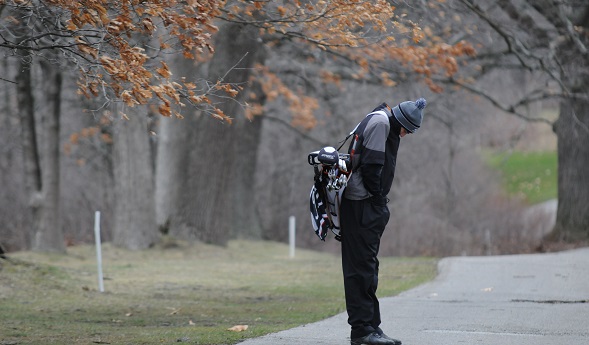
PHOTO: A golfer attempts to keep warm during a round on a dreary day earlier this season. (Click to see more at HighSchoolSportsScene.com.)

6 Tips for the Best Cold-Weather Workout
December 6, 2022
With temperatures getting colder, it may be tempting to get back to the gym.
 But it’s still possible to get your exercise outdoors if you prepare properly to counter the chillier conditions that accompany living in Michigan this time of year.
Winter Weather Workout Tips
While cold air can make it challenging to breathe, our bodies adjust to reduced temperatures over time. The key thing to watch for is hypothermia (dangerously low body heat).
"Viruses are more likely to attack our bodies if we're in a cold state," says Ramsey Shehab, M.D., a sports medicine specialist at Henry Ford Health. "If your internal body temperature drops significantly, it can suppress your immune system and make you more vulnerable to infection."
The good news: Adopting these six strategies can help ensure your outdoor workouts are safe and effective.
Check the forecast. Know what the outdoor weather is and plan accordingly. Pay attention to the temperature, wind and moisture level. If temps dip below zero, the wind chill is extreme, or it's raining or snowing, exercising outside can be risky.
Dress in layers. Dressing too warmly can increase your risk of overheating (even in frigid air). Instead, dress in layers so you can remove layers as you warm up. "The innermost layer should be made of moisture-wicking material," Dr. Shehab says. "The middle layer should have thermal protection like wool or fleece, and the outermost layer should be waterproof and breathable to protect you from wind, rain and sleet." If you get wet and moisture soaks through your clothing, you may not be able to keep your core body temperature up.
Pay attention to your hands, feet and head. When you're engaged in a heart-pumping workout, blood flows to your core, leaving your fingers, toes and head vulnerable to the cold. Wear a hat, gloves and warm socks. If it's especially chilly, consider wearing a scarf.
Take time to warm up (and cool down). Instead of leaving your cozy house and launching straight into a sprint, take time to warm up your major muscle groups. "Your joints may be stiffer when it's cold, so warming up and stretching out is especially important during the winter months," Dr. Shehab says.
Stay hydrated. People tend to think more about dehydration during the summer months, but you can get dehydrated in the winter, too. "Proper hydration before, during and after exercise is very important, not just to maintain health and well-being, but also to stave off infection," Dr. Shehab says.
Take a vitamin D supplement. Even though you're exercising outdoors, sunlight is in low supply in Michigan during the winter. To keep your immune system humming, consider taking a vitamin D supplement. "Making sure you have sufficient vitamin D can enhance your bone health, boost your immune system and keep your hormones in balance," Dr. Shehab says.
Get Savvy About Outdoor Workouts
Frigid temperatures can create obstacles for even the most enthusiastic exercisers. While it's tempting to table exercise until warmer weather returns, there are things you can do to make outdoor — and indoor — workouts more enjoyable.
You don't have to stick to the same routine of running, walking and circuit training. Take advantage of the winter chill to participate in activities like ice skating, sledding, hiking, skiing and cross-country skiing. You can even take interval workouts outdoors. Climb stairs, hike up hills or just play with a kettlebell in the snow.
"Exercise is medicine," Dr. Shehab says. "It can sometimes replace medication for people who have diabetes, hypertension and other chronic conditions. It's good for the mind and the body, and it can help stave off infections, including COVID-19."
The caveat: Working out, outdoors or indoors, is not recommended for people who are currently battling the coronavirus. Instead, it's important to preserve your energy. Once your symptoms begin to improve, you can gradually increase your exercise level.
To find a doctor or athletic trainer at Henry Ford, visit henryford.com or call 1-800-HENRYFORD (436-7936).
Dr. Ramsey Shehab is the deputy chief of Sports Medicine at Henry Ford Health. He sees patients at the Henry Ford Center for Athletic Medicine and Henry Ford Medical Center - Bloomfield Township.