

Eventually, the sun will shine ...
April 25, 2013
By Geoff Kimmerly
Second Half editor
 We all believe that, right?
Rain – and snow for some – has been the buzzword of this spring sports season. Just about every newspaper is writing about it and every athletic director, coach, player and parent is dreading it on a now-daily basis.
But eventually, we expect the weather to clear up and teams to play catch-up. To that end, there are limitations teams in some sports face when attempting to make up their games – but also opportunities to take advantage of while trying to fill out their regular-season schedules.
- Girls soccer and girls and boys lacrosse teams may play only three games during a week, Monday through Sunday. A weekend tournament – which generally includes 2 to 3 shortened games – counts as only one in this equation.
- Baseball and softball teams can play as many games as they want in a week, but no more than two on a school day – and baseball pitchers must not pitch for two days following their 30th out in a week.
- For tennis, an individual may not play more than three matches in one day – unless she or he is playing in a league championship tournament featuring more than eight schools for which a fourth match would decide the championship. That player also could not have played more than six sets that day heading into that fourth and final match.
- Golf and Track and Field do not have weekly contest limitations. Track and field athletes can compete in only four events per day.
As expected, a number of teams – especially for baseball and softball – are scheduling to smash in as many contests as possible into the next four weeks. Postseason play for tennis and lacrosse begins May 16 – three weeks from today.
But teams do have options.
One rarely used but anticipated to be used more this spring is an opportunity to continue playing regular-season contests through the final day of the MHSAA tournament in that sport. For example, a baseball team can continue making up games through June 15, the day of the MHSAA Finals in Battle Creek. A tennis team can play regular-season matches through June 1, etc.
Also, the MHSAA Executive Committee approved Thursday to allow for this spring two additional multi-team tournament dates for soccer and lacrosse, which will give those teams an opportunity to get in a few more games. That means soccer teams will be allowed to play in four multi-team tournaments instead of two, boys lacrosse four instead of two and girls lacrosse five instead of three.
Teams will have to do some juggling, no doubt, and all other tournament stipulations still apply (games generally are shortened so more can be played, etc.). But with a little creativity, teams could at least get in a few of their make-up games in this way.
Also, the Executive Committee approved a motion to waive the four-contest MHSAA tournament entry requirement for all Upper Peninsula schools in all sports this spring. As of the weekend, snow still covered parts of the U.P.
Gaps shrinking
Much has been discussed about minimums for all four MHSAA classes for 2013-14, and how they are the lowest student totals in at least a decade.
It’s true. The floor in Class A is 893 (down from 911 this school year), Class B starts at 429 (down from 449), Class C at 207 (down from 217) and Class D at 206 (down from 216).
However, there is a better way to crunch the numbers: Consider the shrinking gaps between the largest and smallest schools in each class.
For 2013-14, the gap in Class A is 1,888 students – 261 students fewer than 2007-08 and nearly 900 students fewer than in 2005-06. The gaps between largest and smallest in Classes B, C and D also are trending smaller – which means each class actually includes schools more similar in size, instead of a perceived other way around.
SAC 2013-14 on the way
We’re thankful for a valuable group of students who help us throughout the school year – our 16-member Student Advisory Council, made up of eight seniors and eight juniors from all over the state who are charged with providing feedback on issues impacting educational athletics from a student’s perspective, while also assisting at MHSAA championships and with special projects like the “Battle of the Fans.”
Selecting the next class to join is a highlight of every spring – but hardly an easy process.
A six-member selection committee, myself included, considered 62 sophomore applicants today from all over the Lower and Upper Peninsulas, representing all four of our classes and nearly every sport we sponsor.
Every candidate is impressive for a variety of reasons. That’s what makes this difficult – we could pick any number of combinations to make up our new SAC class, and no doubt leaders galore will emerge from another impressive group.
But there are only eight spots on the council. And we’ll announce who received them later next week.
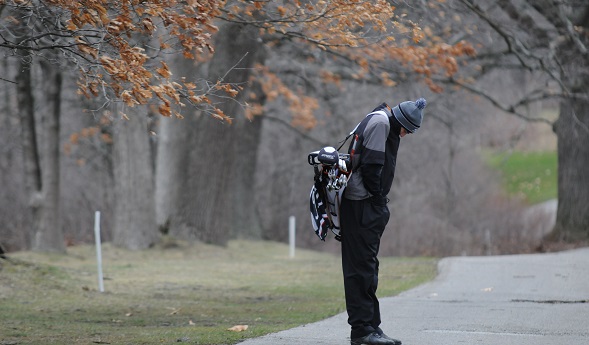
PHOTO: A golfer attempts to keep warm during a round on a dreary day earlier this season. (Click to see more at HighSchoolSportsScene.com.)

Jackson's Imprint on MHSAA Stretches 45 Years, Across 4 Executive Directors
By
Geoff Kimmerly
MHSAA.com senior editor
October 5, 2022
First impressions can be significant, as many a saying goes. And Karen Brown unknowingly provided one in 1978 that helped affect the course of athletics in this state over the next 40-plus years.
A Michigan State University student named Karen Leinaar had shown up at the Michigan High School Athletic Association for a meeting about a 5K road race she was planning that was unrelated to the MHSAA except that the building provided a good meeting place – and Brown, just a year out of high school, was the first person to greet her at the old Trowbridge Road headquarters.
Seeing someone her age immediately made Leinaar more comfortable. She ended up returning to that office several times over the years, registering as an MHSAA game official while still an MSU student and then starting a career in 1982 that has included nearly 40 years as a high school athletic director and two decades of shaping policy as part of the MHSAA Representative Council.
That’s the kind of impact that’s emanated from Karen Jackson, formerly Brown, and over the last 45 years as assistant to four of the five executive directors during the MHSAA’s 98-year history. Jackson finished that run with her retirement Friday.
“She was always one that would welcome you, and whether you walked into the office or called on the phone, she always had an answer that would calm you down or provide you with the information you needed,” said Leinaar, who currently is serving as interim athletic director at Frankfort High School in addition to her duties as executive director of the Michigan Interscholastic Athletic Administrators Association.
“I remember initially calling and needing something from Mr. Norris – it was always Mr. Norris – and she could answer the question,” Leinaar added, referring to retired MHSAA executive director Vern Norris, who served in that role from 1978-86. “You didn’t want to talk to scary Mr. Norris – Vern was a wonderful man, but he was like the superintendent or principal. Karen always had the answer. … It was always that smile that made you feel like you were more than welcomed, wanted in the office, and everything is going to be OK.”
 Jackson began at the MHSAA in June 1977, two days before her graduation from long ago-closed Harry Hill High School in Lansing.
Her high school sports career amounted to about half a season on the Hill varsity volleyball team as a sophomore before she had to switch gears to begin working for the Lansing Regional Chamber of Commerce as part of a school co-op program.
Jackson graduated as a co-valedictorian of Hill’s Class of 1977. Despite her academic standing, she hadn’t received much guidance at school on the possibility of college. But she had a job offer from the Chamber – and also had heard from grade-school friend Deborah Norris (Vern’s daughter) about an opening at the MHSAA.
The MHSAA was offering more money, and Jackson was hoping to buy a car – and so at 18, she became the secretary for executive director Allen W. Bush.
The title has changed over the years, from secretary to the executive director, to executive assistant, to senior executive assistant. The MHSAA’s administrative processes obviously have changed, mostly because of technology, from everything done on paper and through the mail to just about everything conducted digitally over the internet.
But many of Jackson’s most important duties at the end of her tenure resembled those she was hired to carry out nearly half a century ago.
Setting Exemplary Expectations
Bush retired a year after Jackson began, and she then assisted Norris for his eight as executive director. She served with Jack Roberts through his 32 years as executive director from 1986-2018 and then for these first 3½ under current director Mark Uyl.
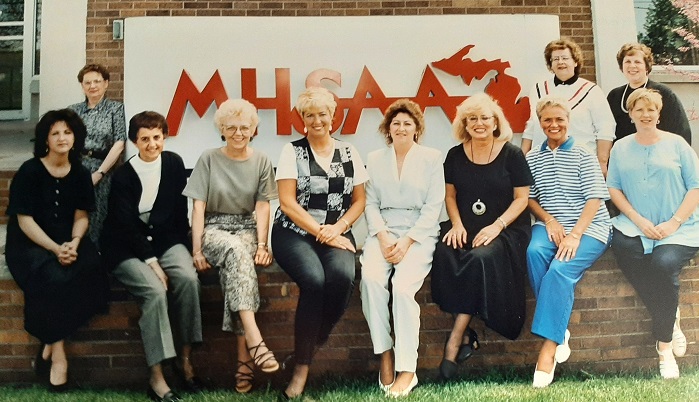
She was considered the “baby” of the MHSAA staff during her first 12 years, until she turned 30 and her support staff teammates declared she wasn’t the baby anymore during a Christmas party serenade. Just about 33 years later, she’s leaving as one of two people left who worked in the old offices before the MHSAA moved to another East Lansing headquarters at Ramblewood Drive in 1996.
School sports happen thanks to a Karen Jackson or two in every community -- people who provide the unseen support that makes these programs possible every day.
For the last 45 years, she’s provided a consistent anchor for service to 1,500 schools and millions of student-athletes across Michigan.
 “She’s shaped so much of what we’ve done,” said MHSAA assistant director Kathy Vruggink Westdorp, who joined the staff during the 2003-04 school year after more than two decades working for Grand Rapids-area schools. “Her service to schools was imperative to what she was doing, and it was a valuable part for our membership. Hers was such a dedicated service, such an exemplary service – finding solutions, to do what’s needed.”
There are file cabinets and libraries and hard drives at the MHSAA office, the contents of which are known by only a handful of people on Earth – and Jackson perhaps the most as she did most of the sorting and maintaining of those files over the years.
For a 1996 Lansing State Journal feature on the MHSAA’s support staff, Jackson (then Yonkers) explained “there are always new challenges, new issues and controversies. It never gets boring. In the past 19 years, we’ve slowly shifted from dealing with athletic administrators, principals and superintendents to dealing with legislators, attorneys and courts.”
The last 25 years has seen much of the work swing back to providing service directly to schools. And Jackson’s mind has become part MHSAA library and part card catalog of where to find those few snippets she might not recall immediately from the last half century.
“I guess what I’m proud of is being able to find things, to know where to find things and how to find things that other people don’t,” Jackson said. “Yes, the technology has changed everything. … We used to have more schools – they used to have 40-some Detroit public schools – and there was a whole era of (litigation), but it’s calmed down now.
“I liked what I did, and it kept me on my toes – that’s for sure.”
The MHSAA is rooted in its responsibilities as a championship and eligibility rules maker, and Jackson was involved in just about every communication in those areas during her time. Tournament changes are made at Representative Council meetings, and she’s reported the minutes for at least 150 of those, including piles of special sessions as the MHSAA managed sports through the COVID-19 pandemic. Eligibility waivers are requested at Executive Committee meetings, and she’s prepared somewhere north of 505 sets of minutes for those monthly sessions even as those agendas have grown in content substantially over the years.
Then there’s all of the correspondence from those four executive directors – all with the initials “kb” or “kj” to go with “AWB” or “VLN” or “JER” and “MU.” She also was in charge of MHSAA election ballots for 35 years, served as the lead organizer of cooperative programs, helped with football tickets for a time and briefly was part of the program-selling crew at early Football Finals at the Pontiac Silverdome.
“I think I’m pretty lucky, being on the Council and Executive Committee, that I’ve been able to work with her a lot. And most athletic directors, they may not even know who she is because they may not have contact with her or do anything with her – but she’s obviously been the unsung hero of that office,” said Vic Michaels, who serves as director of physical education & athletics for the Archdiocese of Detroit and has served on the Representative Council since 2003.
“She just does so much that you don’t really know about, especially with the Council. Whenever I need anything, Karen’s the one I call. She is the history, really. She’s the keeper of that.”
Unprecedented & 'Never to be Replicated'
A longtime co-worker of Jackson, Shirley Hytinen, retired in 1998 after just a few months more than 43 years. She too had worked for four executive directors, as she began in 1955 during the Charles E. Forsythe era.
Jackson surpassed Hytinen’s tenure a few years into Uyl’s, and can readily recall some of what stood out from all four directors she’s assisted.
Bush was “really stern” – he had served in the U.S. Marines – and she said he didn’t smile much until the day he announced his retirement, when it was “like a switch turned. He was smiling and happy and joking around.”
Norris was “the sweetest guy in the world.” Jackson had bought her first house in her mid-20s and was preparing to move in with only her dad and his motor home to assist, when Norris showed up to help at 7:30 a.m. that morning to provide another set of hands.
Roberts is known by Michigan administrators and national colleagues for his writing, and Jackson said jokingly she still “cringes” when she sees a yellow legal pad. She was an important proofreader and spent the majority of her career serving with her desk just a few paces away from that of the recent National Federation Hall of Fame selection, and she attended his induction this past summer and San Antonio.
 Roberts pointed out that during the 1980s, the MHSAA would conduct nine Executive Committee meetings, each averaging fewer than 10 requests for waivers. By the end of his 32 years, there were 11 Executive Committee meetings annually – with approximately 50 waiver requests presented on average. Still, he and Jackson were able to process the meeting minutes and continue to distribute those decisions within 24 hours.
“Over the more than three decades that Karen and I worked together at the MHSAA, the work became increasingly more voluminous and complicated – and Karen kept finding ways to increase our efficiency and maximize our output,” Roberts said.
Like Norris when Bush was executive director, Uyl had been part of the MHSAA staff under Roberts since 2004 before eventually moving into the corner office. After those first 15 years together, Uyl knew what a valuable person he had just a few yards away to assist in his transition, and “he just says to do this” and allows his staff to run with it, which Jackson enjoyed.
Her duties have been shifted confidently, mostly to Jamie VanDerMoere, another longtime administrative assistant who is best-known to Michigan school sports people for her leadership with the annual wrestling championship tournaments.
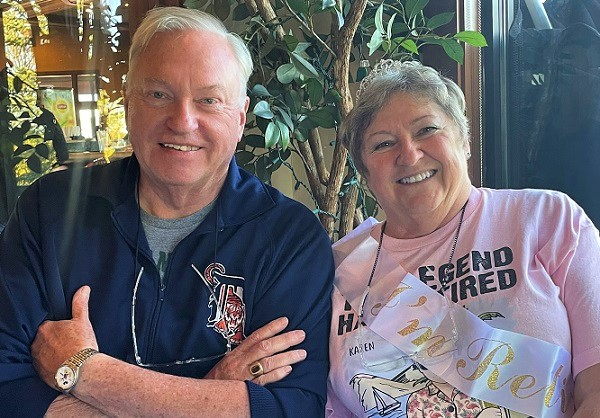
Jackson recently was married to Jim Jackson, and they have plans as they close in on their first anniversary – they’re hoping to travel to Italy at some point and also The Masters in Augusta, Ga., next spring. “I’m not going to miss coming to work every day, but the people,” Karen Jackson said.
And many in school sports across Michigan, although they may not realize it, will miss the contributions Jackson has made to their community over the decades including the context she’s provided as thousands of decisions have been made.
“Not only her understanding of our regulations and the processes of our regulations, but understanding why we have those things in place – when someone does something 45 years, you get a lot of historical context,” Uyl said. “What’s made her so effective is understanding the why – and that to me is something that’s almost impossible to replace.
“When an organization has been around 98 years with only five directors, it says something to have worked for four out of the five. That will never be replicated again.”
PHOTOS (Top) From top left, Karen Jackson has been a mainstay of the MHSAA for decades – serving membership, working with administrators like Randy Allen and Gina Mazzolini or serving as assistant to executive directors like Jack Roberts (right) and Vern Norris. (Middle) Jackson, sitting fourth from left, was the “baby” of the MHSAA staff after joining when she was 18. (Below) Jackson and husband Jim have plans to travel in retirement. (MHSAA archives.)