

Eventually, the sun will shine ...
April 25, 2013
By Geoff Kimmerly
Second Half editor
 We all believe that, right?
Rain – and snow for some – has been the buzzword of this spring sports season. Just about every newspaper is writing about it and every athletic director, coach, player and parent is dreading it on a now-daily basis.
But eventually, we expect the weather to clear up and teams to play catch-up. To that end, there are limitations teams in some sports face when attempting to make up their games – but also opportunities to take advantage of while trying to fill out their regular-season schedules.
- Girls soccer and girls and boys lacrosse teams may play only three games during a week, Monday through Sunday. A weekend tournament – which generally includes 2 to 3 shortened games – counts as only one in this equation.
- Baseball and softball teams can play as many games as they want in a week, but no more than two on a school day – and baseball pitchers must not pitch for two days following their 30th out in a week.
- For tennis, an individual may not play more than three matches in one day – unless she or he is playing in a league championship tournament featuring more than eight schools for which a fourth match would decide the championship. That player also could not have played more than six sets that day heading into that fourth and final match.
- Golf and Track and Field do not have weekly contest limitations. Track and field athletes can compete in only four events per day.
As expected, a number of teams – especially for baseball and softball – are scheduling to smash in as many contests as possible into the next four weeks. Postseason play for tennis and lacrosse begins May 16 – three weeks from today.
But teams do have options.
One rarely used but anticipated to be used more this spring is an opportunity to continue playing regular-season contests through the final day of the MHSAA tournament in that sport. For example, a baseball team can continue making up games through June 15, the day of the MHSAA Finals in Battle Creek. A tennis team can play regular-season matches through June 1, etc.
Also, the MHSAA Executive Committee approved Thursday to allow for this spring two additional multi-team tournament dates for soccer and lacrosse, which will give those teams an opportunity to get in a few more games. That means soccer teams will be allowed to play in four multi-team tournaments instead of two, boys lacrosse four instead of two and girls lacrosse five instead of three.
Teams will have to do some juggling, no doubt, and all other tournament stipulations still apply (games generally are shortened so more can be played, etc.). But with a little creativity, teams could at least get in a few of their make-up games in this way.
Also, the Executive Committee approved a motion to waive the four-contest MHSAA tournament entry requirement for all Upper Peninsula schools in all sports this spring. As of the weekend, snow still covered parts of the U.P.
Gaps shrinking
Much has been discussed about minimums for all four MHSAA classes for 2013-14, and how they are the lowest student totals in at least a decade.
It’s true. The floor in Class A is 893 (down from 911 this school year), Class B starts at 429 (down from 449), Class C at 207 (down from 217) and Class D at 206 (down from 216).
However, there is a better way to crunch the numbers: Consider the shrinking gaps between the largest and smallest schools in each class.
For 2013-14, the gap in Class A is 1,888 students – 261 students fewer than 2007-08 and nearly 900 students fewer than in 2005-06. The gaps between largest and smallest in Classes B, C and D also are trending smaller – which means each class actually includes schools more similar in size, instead of a perceived other way around.
SAC 2013-14 on the way
We’re thankful for a valuable group of students who help us throughout the school year – our 16-member Student Advisory Council, made up of eight seniors and eight juniors from all over the state who are charged with providing feedback on issues impacting educational athletics from a student’s perspective, while also assisting at MHSAA championships and with special projects like the “Battle of the Fans.”
Selecting the next class to join is a highlight of every spring – but hardly an easy process.
A six-member selection committee, myself included, considered 62 sophomore applicants today from all over the Lower and Upper Peninsulas, representing all four of our classes and nearly every sport we sponsor.
Every candidate is impressive for a variety of reasons. That’s what makes this difficult – we could pick any number of combinations to make up our new SAC class, and no doubt leaders galore will emerge from another impressive group.
But there are only eight spots on the council. And we’ll announce who received them later next week.
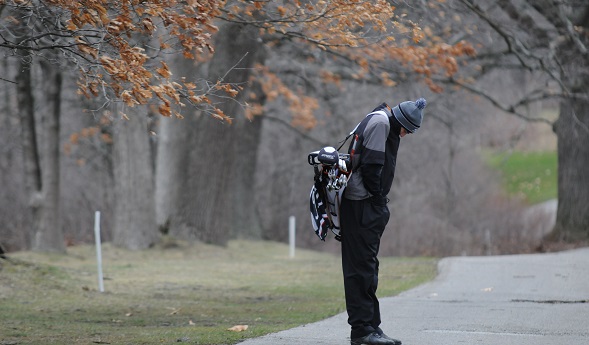
PHOTO: A golfer attempts to keep warm during a round on a dreary day earlier this season. (Click to see more at HighSchoolSportsScene.com.)
Lessons Learned on Track Have Jibowu's Business Surging to Quick Success
By
Paul Costanzo
Special for MHSAA.com
August 1, 2022
Athletics showed Soj Jibowu just how far he could push himself.
All the time spent on the track, working to become the state’s best high school 400-meter runner, and then more than that, taught him to stretch beyond what he thought were his limits.
So, when it came time to make a decision on whether to jump fully into his apparel company, Varlo, or keep it as a part-time side venture, the 2001 Saginaw Heritage graduate knew he could take himself to another level if needed.
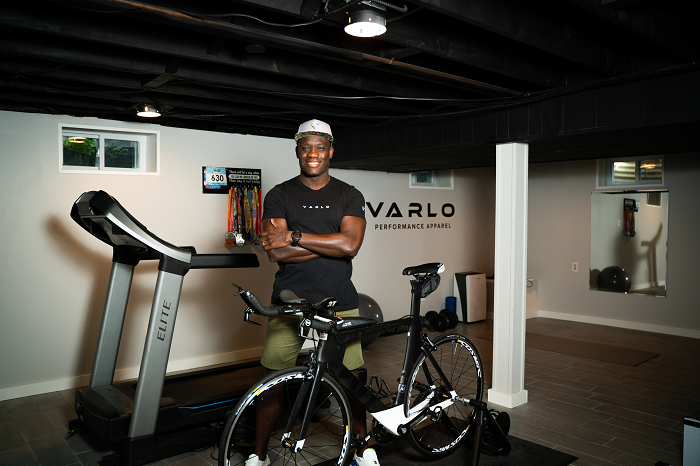
Jibowu is the founder and CEO of Varlo, a clothing company that specializes in outfitting triathletes, but also offers casual wear for men and women. The company is just over three years old, but its clientele includes hundreds of triathletes, eight professionals, three NCAA programs and even hospitals. Merchandise is sold in eight countries.
All of that is validation for Jibowu, who took the leap to pursuing the company full-time just one year into its existence.
“When I resigned (from a medical sales job) to do this full-time, my wife was pregnant with our second child, my daughter wasn’t even walking yet,” said Jibowu, who now lives in Cherry Hill, N.J., with his wife and two young children. “Where was my state of mind to leave my very comfortable, high-paying job to pursue this – to sell clothes?”
His mind was in the same place that helped him reach tremendous heights as a runner, both at Heritage and Central Michigan University.
Jibowu, who was born in Nigeria and spent much of his childhood in Huntsville, Ala., was part of some incredible Heritage teams. He graduated a year behind eventual NFL safety Stuart Schweigert, who he ran with on the Finals-winning 1,600 relay in 2000. Another member of that relay was Derold Sligh, who won the 400-meter Finals title that year, setting the Lower Peninsula Division 1 Finals record in the process. The Hawks were LP Division 1 runners-up as a team that season.
“I ran track when I was younger, and I was terrible,” Jibowu said. “In high school, if I look back at it, I probably would have called it impostor syndrome. I think that was me up until maybe like somewhere in my senior year when I started to think, ‘I’m pretty fast.’ … I had so many dominant people around me, in my mind, I was still the slow guy.”
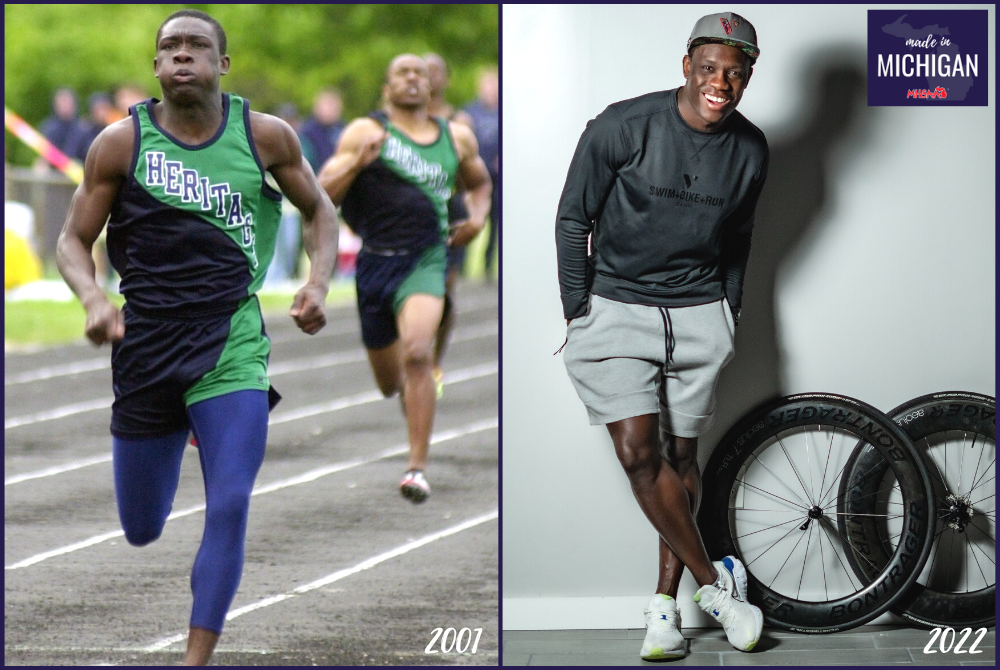
 As a senior, Jibowu erased that self-doubt. He led Heritage to its first, and still only, Division 1 Finals title, running the 400 in 48.28 and breaking the record Sligh had set the year prior.
It was working to get to that point that Jibowu still credits with his ability to push himself in all things.
“I preach this all the time: if you have the ability to be involved in sports at a young age, do it,” Jibowu said. “It’s a gift, first of all. You don’t know any better when you’re young, you think you’re just training your body, but what’s really, truly occurring is you’re training your mind and building discipline. You’re building your character as far as who you are as a person. What is your will? How far are you willing to push? Am I able to be coached? Am I able to learn? Am I able to lose over and over again and keep going? Am I able to navigate to feel what it’s like to win? What you’re truly developing is how to manage and handle life.”
Jibowu said he didn’t finalize his college decision until late in the process, as he had to work on his test scores into the summer. While at CMU, he majored in biomedical science and chemistry, and he excelled, admitting he was a much better student in college than in high school.
He was also reunited with Sligh on the Chippewas track team, and had a successful career. He was regularly within the top five in the 200 and 400 in the Mid-American Conference, and won a MAC title in the 400 at the 2004 indoor championships. His personal bests in the races were 21.19 and 46.81, respectively.
After graduating from CMU, Jibowu began working as a pharmaceutical rep, then moved into medical sales.
While he remained active, it wasn’t until he took a trip to Chicago that he discovered triathlons.
“I remember seeing these really cool bikes and these really fit people, and then they jumped into Lake Michigan,” he said. “And I didn’t know that was possible, because I didn’t grow up swimming. I didn’t know that volume of people knew how to swim like that. Then they get out of Lake Michigan, jump on their bikes and they’re flying. Then they’re sprinting a 6K and I remember thinking, ‘Oh my God, these guys are the real freaking deal.’ I was hooked and wanted to start competing.”
As he began competing, the wheels for his current venture began turning. At this point, Jibowu was living out east and had worked for a pair of successful start-ups in the medical industry. That helped give him knowledge, and confidence, to make his own moves.
“I had always been into clothes and fashion, and how you express yourself with what you wear,” Jibowu said. “There was an opportunity there. The sport of triathlon is as old as me; it started in (1983). That’s a baby. That’s like basketball without the 3-point line. There’s so much opportunity for innovation.”
With that, Varlo was born, and it has since thrived, with Jibowu and the lessons he learned on a track in Saginaw paving the way.
“If you are in high school and have the ability to be in a sport, it’s a gift,” he said. “At that young of an age, truly learning to manage the trials and tribulations of life. That is a gift.”
2021-22 Made in Michigan
July 28: Running Set Life's Stage for Grosse Pointe South's Record-Setting Meier Sisters - Read
July 25: 2005 Miss Basketball DeHaan Cherishing Newest Title: 1st-Time Mom - Read
July 21: Championship Memories Still Resonate with St. Thomas Star Lillard - Read
July 14: Portage Central Champ Rolls to Vanderbilt, Writing Next Chapter in Alabama - Read
July 12: Coaching Couple Passing On Knowledge, Providing Opportunities for Frankfort Wrestlers - Read
June 30: Hrynewich's Star Continuing to Rise with Olympic, Pro Sports Arrivals - Read
PHOTOS (Top) At left, Heritage’s Soj Jibowu wins the 400 meters during the 2001 Saginaw Valley League championship meet. At right, Jibowu is the founder and CEO of the Varlo clothing company. (Middle) Jibowu’s company specializes in outfitting triathletes, and he has taken up the sport after a successful college track & field career. (Heritage photo courtesy of Saginaw News/MLive; current photos courtesy of Soj Jibowu.)