

Eventually, the sun will shine ...
April 25, 2013
By Geoff Kimmerly
Second Half editor
 We all believe that, right?
Rain – and snow for some – has been the buzzword of this spring sports season. Just about every newspaper is writing about it and every athletic director, coach, player and parent is dreading it on a now-daily basis.
But eventually, we expect the weather to clear up and teams to play catch-up. To that end, there are limitations teams in some sports face when attempting to make up their games – but also opportunities to take advantage of while trying to fill out their regular-season schedules.
- Girls soccer and girls and boys lacrosse teams may play only three games during a week, Monday through Sunday. A weekend tournament – which generally includes 2 to 3 shortened games – counts as only one in this equation.
- Baseball and softball teams can play as many games as they want in a week, but no more than two on a school day – and baseball pitchers must not pitch for two days following their 30th out in a week.
- For tennis, an individual may not play more than three matches in one day – unless she or he is playing in a league championship tournament featuring more than eight schools for which a fourth match would decide the championship. That player also could not have played more than six sets that day heading into that fourth and final match.
- Golf and Track and Field do not have weekly contest limitations. Track and field athletes can compete in only four events per day.
As expected, a number of teams – especially for baseball and softball – are scheduling to smash in as many contests as possible into the next four weeks. Postseason play for tennis and lacrosse begins May 16 – three weeks from today.
But teams do have options.
One rarely used but anticipated to be used more this spring is an opportunity to continue playing regular-season contests through the final day of the MHSAA tournament in that sport. For example, a baseball team can continue making up games through June 15, the day of the MHSAA Finals in Battle Creek. A tennis team can play regular-season matches through June 1, etc.
Also, the MHSAA Executive Committee approved Thursday to allow for this spring two additional multi-team tournament dates for soccer and lacrosse, which will give those teams an opportunity to get in a few more games. That means soccer teams will be allowed to play in four multi-team tournaments instead of two, boys lacrosse four instead of two and girls lacrosse five instead of three.
Teams will have to do some juggling, no doubt, and all other tournament stipulations still apply (games generally are shortened so more can be played, etc.). But with a little creativity, teams could at least get in a few of their make-up games in this way.
Also, the Executive Committee approved a motion to waive the four-contest MHSAA tournament entry requirement for all Upper Peninsula schools in all sports this spring. As of the weekend, snow still covered parts of the U.P.
Gaps shrinking
Much has been discussed about minimums for all four MHSAA classes for 2013-14, and how they are the lowest student totals in at least a decade.
It’s true. The floor in Class A is 893 (down from 911 this school year), Class B starts at 429 (down from 449), Class C at 207 (down from 217) and Class D at 206 (down from 216).
However, there is a better way to crunch the numbers: Consider the shrinking gaps between the largest and smallest schools in each class.
For 2013-14, the gap in Class A is 1,888 students – 261 students fewer than 2007-08 and nearly 900 students fewer than in 2005-06. The gaps between largest and smallest in Classes B, C and D also are trending smaller – which means each class actually includes schools more similar in size, instead of a perceived other way around.
SAC 2013-14 on the way
We’re thankful for a valuable group of students who help us throughout the school year – our 16-member Student Advisory Council, made up of eight seniors and eight juniors from all over the state who are charged with providing feedback on issues impacting educational athletics from a student’s perspective, while also assisting at MHSAA championships and with special projects like the “Battle of the Fans.”
Selecting the next class to join is a highlight of every spring – but hardly an easy process.
A six-member selection committee, myself included, considered 62 sophomore applicants today from all over the Lower and Upper Peninsulas, representing all four of our classes and nearly every sport we sponsor.
Every candidate is impressive for a variety of reasons. That’s what makes this difficult – we could pick any number of combinations to make up our new SAC class, and no doubt leaders galore will emerge from another impressive group.
But there are only eight spots on the council. And we’ll announce who received them later next week.
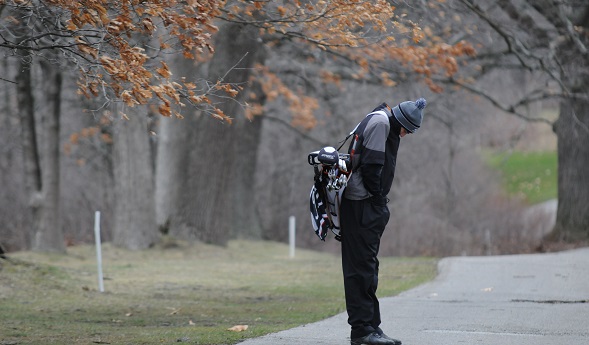
PHOTO: A golfer attempts to keep warm during a round on a dreary day earlier this season. (Click to see more at HighSchoolSportsScene.com.)
Jack Roberts, on Tom Rashid: One More Call
By
John E. (Jack) Roberts
MHSAA Executive Director, 1986-2018
December 9, 2021
More than a decade ago, with his knowledge, I placed in my “Will & Instructions Upon Death” that Tom Rashid was to be the one and only person to speak at my funeral or memorial service. A short number of years later, Tom told me that I was to do the same for him. Obviously, we knew that we could not both keep our promise to the other. But I must say, if Tom does not actually show up for my funeral, that will be the first time he has not kept a promise to me.
I understand there will be a time in the future, when the weather warms and COVID wanes, when school administrators across Michigan can gather in force to show their respects to Tom, and when I will provide the eulogy that Tom asked of me. But Tom’s recent death reminds us how uncertain life can be and suggests that I say some things now, before it’s too late.
Tom was the unparalleled master of award presentations; and for more than a dozen years he wrote and delivered polished praise on award recipients at the annual conference of the Michigan Interscholastic Athletic Administrators Association. My tribute now isn’t an awards presentation or hall-of-fame induction, so I won’t recount the particulars of Tom’s career; but what you will see here is the importance of Tom’s life … the themes that distinguish him from any other person I’ve known.
Tom comes from a large, complicated and compassionate family of parents, aunts, uncles, brothers, sisters, nephews and nieces who mourn his loss at levels few of us can fathom. Over the years, and for many years, he was the caretaker for several family members; and he was generous with all of them. My hope for each family member now – and for many days, weeks and months to come – is that you are at peace. Tom’s pain is over; and his place in eternity is secure. Tom purchased a reserved seat.
Tom often joked that his only good habit was prayer. That’s not really true, of course. But for as long as I’ve known Tom, he talked to God many times a day; and I’ve always had the feeling that he talked to God the same way he talked to us: bluntly, forcefully, passionately, honestly, loudly, making very plain what he had on his mind.
Tom was a rigorous practitioner of his devout Catholic faith; and, the God whom Tom believed in is a big God … the president, general manager and head coach of a huge, diverse team whose game plan is a large, loving Gospel of limitless parameters and possibilities. I have no doubt that, both in times of need and not, members of the Roberts family – including both my parents, my sister, my wife and our children and grandchildren – have been specific in his petitions to God. I have no doubt that Tom’s daily prayers included many of you, and your loved ones as well.
In addition to Tom’s immediate family is the even larger and even more complicated family Tom developed through a long, illustrious career in Michigan school sports administration: a full 25 years with the Archdiocese of Detroit, until 2003, when I invited him to join me at the MHSAA office in East Lansing.
During my 32 years as the executive director of the MHSAA, I never saw another like Tom … never, anywhere. He talked to anybody, anytime of the day or night, about any question or problem they might have. Usually, Tom didn’t need to give me notes reviewing his telephone conversations. From my adjacent office, and given his forceful voice, I could hear Tom’s every word, very clearly.
Tom had the ability to anticipate what I might need and take care of it without my asking. It is no exaggeration to say that Tom would do anything for me. For example, Tom’s reluctance to travel and his fear of flying are well known to many of you. I believe the one and only time that Tom flew in an airplane was in 2003, when I ordered him to fly to Texas so that he might receive the highest award of the National High School Coaches Association. He had never flown before; he has never flown since.
Most remarkable was not merely Tom’s unselfish, unlimited, legendary availability to athletic administrators at any hour of the day or night, nor his experienced, learned grasp of the subject matter in answering their calls. What was more remarkable was his effort to help school administrators through their hard times. On many occasions these callers had made an error of commission or omission. They had made a mistake or an oversight; and Tom was supremely compassionate in guiding them through the local fallout from disappointed athletes and disgruntled adults. Secure in himself and our mission to be servant-leaders, Tom very often shared or completely shouldered unjustified blame so others would not. He gave cover to countless local school administrators every year of his MHSAA career so that those administrators might survive and even thrive in their careers.
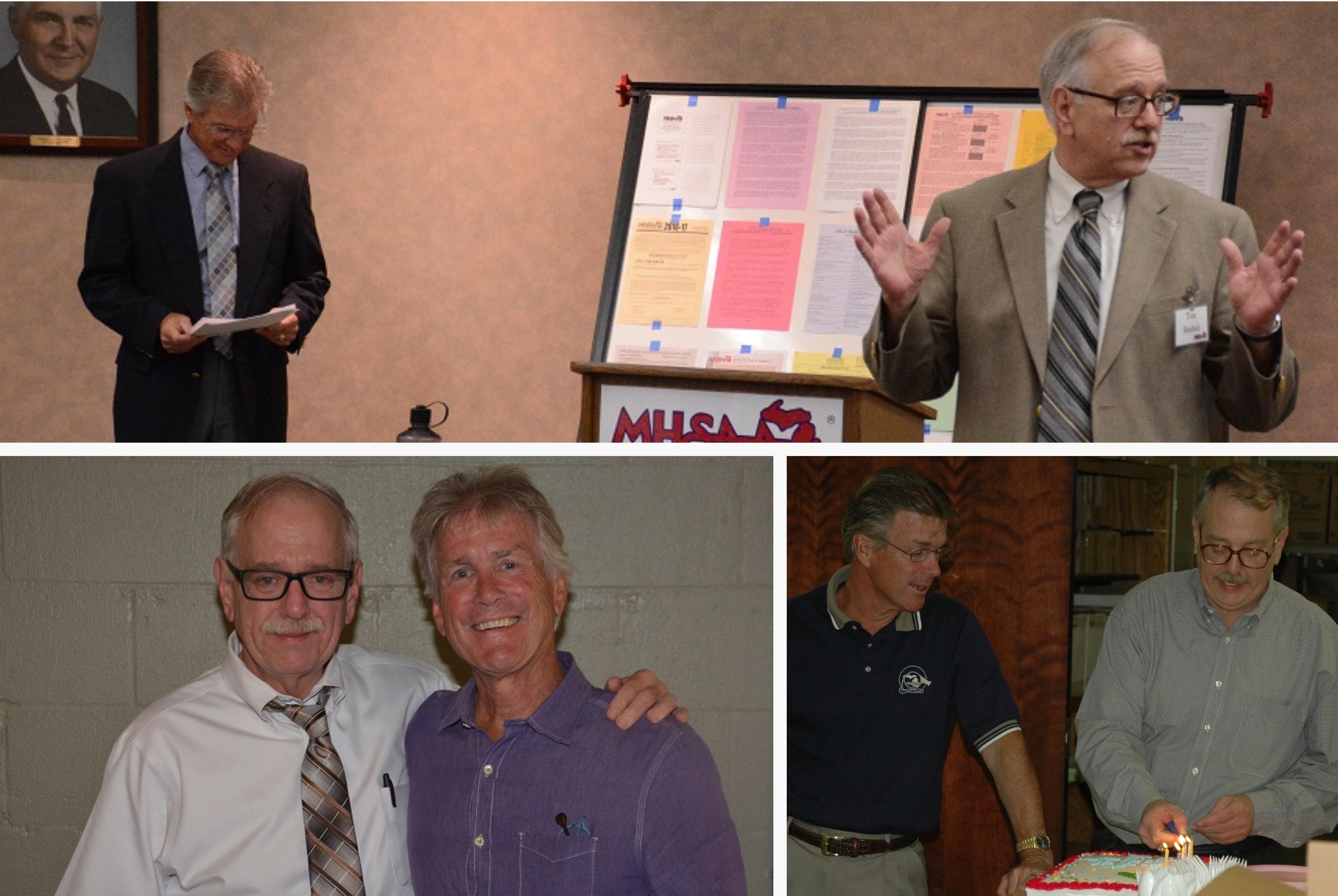
Among my remarkably loyal MHSAA staff, Tom still stands out. And he earned the enduring loyalty of those with whom he worked. I think especially of his successor at the Archdiocese of Detroit, Vic Michaels: I doubt that more than two days ever passed between their almost daily telephone conversations … usually in the morning … for the full 15 years that my office was next to Tom’s at the MHSAA. I have never, ever been witness to anything like that; and I know there is no one in our good work who misses our dear colleague more than Vic.
But most remarkable of all was Tom’s ability to turn an adversary into an ally. He could have a knock-down, drag-out argument with a person one day, and by the next day, and for years to come, that person was Tom’s greatest advocate and admirer.
Well … maybe second-greatest advocate and admirer. Because no one in athletic administration – no one – loved Tom more than I. And no one in our work told him this more than I did.
I have written often about my admiration and affection for Tom. I have spoken both publicly and privately of it, on many occasions. But let me say it one more time, here, as we celebrate his life, and mourn our loss …
Tom and I provide proof that opposites attract, and we tag-teamed MHSAA’s leadership. One of us was very outgoing and vocal, the other more reserved and reticent. One of us was loud, the other more subdued. One of us was more comfortable on the phone, the other with the pen. One of us had no idea what to do with apostrophes, while the other would put them in the correct places. One of us was more spontaneous and extemporaneous, the other a more detailed planner and measurer of consequences. One of us hated to travel, the other sent messages to him from distant oceans and continents every year on Christmas or New Year’s Day to thank him for his life and service. But in our hearts, where one’s core values are harbored, we were almost identical twins.
I doubt that any two people who were side-by-side in the workplace for 15 years expressed their gratitude for each other more than we did, nor any two co-workers who said “I love you” to one another as often as we did. We each felt in deep debt to the other for myriad gifts and gestures that improved our careers and our lives.
Over the years, Tom and I developed the strategy of making one more telephone call before we made a final decision in a difficult matter … making one more call that sometimes made a difference in the controversial decision we had to make or in how that decision was accepted by those it affected. Tom loved to be the one to make those calls. And, sometimes, that “one more call” made all the difference.
Throughout my adult life, whenever I’ve attended a funeral or memorial service, I’ve found myself asking what it is I should learn and try to emulate from the life of the deceased. If you should find your mind and heart doing anything like that now, may I suggest these two answers.
First, Tom’s life and death remind us that we should not delay a single day in telling those with whom we work that we appreciate them and are grateful for what they do. And, if it is true and you are able, say you love them. Tom did this more often than anyone I’ve known.
And the second message is this. Tom’s life stands for faithfulness … faithfulness to his God, faithfulness to his family, faithfulness to his colleagues and friends, and faithfulness to his work and the mission of not just amateur athletics, but particularly school-operated, educational athletics. His was a steadfast faithfulness, never-a-day-off faithfulness, you-come-first faithfulness.
So Tom, my dear friend, once again I say, “I love you.”
And, “Rest in peace, Tom. God knows, you rarely rested in life.”
I would give anything for just one more call.