

Eventually, the sun will shine ...
April 25, 2013
By Geoff Kimmerly
Second Half editor
 We all believe that, right?
Rain – and snow for some – has been the buzzword of this spring sports season. Just about every newspaper is writing about it and every athletic director, coach, player and parent is dreading it on a now-daily basis.
But eventually, we expect the weather to clear up and teams to play catch-up. To that end, there are limitations teams in some sports face when attempting to make up their games – but also opportunities to take advantage of while trying to fill out their regular-season schedules.
- Girls soccer and girls and boys lacrosse teams may play only three games during a week, Monday through Sunday. A weekend tournament – which generally includes 2 to 3 shortened games – counts as only one in this equation.
- Baseball and softball teams can play as many games as they want in a week, but no more than two on a school day – and baseball pitchers must not pitch for two days following their 30th out in a week.
- For tennis, an individual may not play more than three matches in one day – unless she or he is playing in a league championship tournament featuring more than eight schools for which a fourth match would decide the championship. That player also could not have played more than six sets that day heading into that fourth and final match.
- Golf and Track and Field do not have weekly contest limitations. Track and field athletes can compete in only four events per day.
As expected, a number of teams – especially for baseball and softball – are scheduling to smash in as many contests as possible into the next four weeks. Postseason play for tennis and lacrosse begins May 16 – three weeks from today.
But teams do have options.
One rarely used but anticipated to be used more this spring is an opportunity to continue playing regular-season contests through the final day of the MHSAA tournament in that sport. For example, a baseball team can continue making up games through June 15, the day of the MHSAA Finals in Battle Creek. A tennis team can play regular-season matches through June 1, etc.
Also, the MHSAA Executive Committee approved Thursday to allow for this spring two additional multi-team tournament dates for soccer and lacrosse, which will give those teams an opportunity to get in a few more games. That means soccer teams will be allowed to play in four multi-team tournaments instead of two, boys lacrosse four instead of two and girls lacrosse five instead of three.
Teams will have to do some juggling, no doubt, and all other tournament stipulations still apply (games generally are shortened so more can be played, etc.). But with a little creativity, teams could at least get in a few of their make-up games in this way.
Also, the Executive Committee approved a motion to waive the four-contest MHSAA tournament entry requirement for all Upper Peninsula schools in all sports this spring. As of the weekend, snow still covered parts of the U.P.
Gaps shrinking
Much has been discussed about minimums for all four MHSAA classes for 2013-14, and how they are the lowest student totals in at least a decade.
It’s true. The floor in Class A is 893 (down from 911 this school year), Class B starts at 429 (down from 449), Class C at 207 (down from 217) and Class D at 206 (down from 216).
However, there is a better way to crunch the numbers: Consider the shrinking gaps between the largest and smallest schools in each class.
For 2013-14, the gap in Class A is 1,888 students – 261 students fewer than 2007-08 and nearly 900 students fewer than in 2005-06. The gaps between largest and smallest in Classes B, C and D also are trending smaller – which means each class actually includes schools more similar in size, instead of a perceived other way around.
SAC 2013-14 on the way
We’re thankful for a valuable group of students who help us throughout the school year – our 16-member Student Advisory Council, made up of eight seniors and eight juniors from all over the state who are charged with providing feedback on issues impacting educational athletics from a student’s perspective, while also assisting at MHSAA championships and with special projects like the “Battle of the Fans.”
Selecting the next class to join is a highlight of every spring – but hardly an easy process.
A six-member selection committee, myself included, considered 62 sophomore applicants today from all over the Lower and Upper Peninsulas, representing all four of our classes and nearly every sport we sponsor.
Every candidate is impressive for a variety of reasons. That’s what makes this difficult – we could pick any number of combinations to make up our new SAC class, and no doubt leaders galore will emerge from another impressive group.
But there are only eight spots on the council. And we’ll announce who received them later next week.
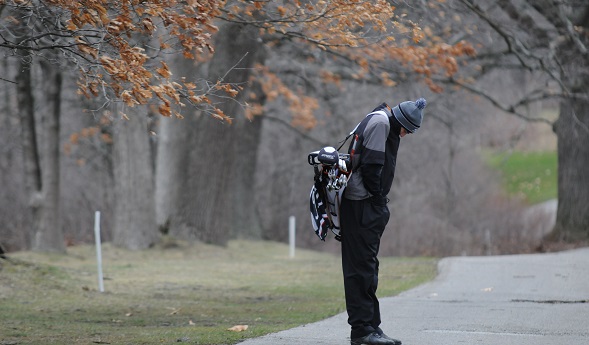
PHOTO: A golfer attempts to keep warm during a round on a dreary day earlier this season. (Click to see more at HighSchoolSportsScene.com.)

'The Comeback is Always Better than the Setback'
By
Rob Kaminski
MHSAA benchmarks editor
November 12, 2021
Following is the publisher’s note and cover story from the Fall 2021 edition of benchmarks, which was published earlier this school year and highlighted changes coming to tournaments as MHSAA activities moved back toward normal.
Suffice it to say, as we stride into the 2021-22 school year, it is not just another year for the MHSAA, nor will it be business as usual as we continue to monitor the COVID clouds that can’t dissipate quickly enough. However, we do intend to make it as close to “business as usual” as possible.
From the Publisher: Not “Just Another Year” Ahead, But Here’s Hoping
After the disheartening cancelation of numerous winter tournaments and the entire spring seasons of 2020, together we navigated through a tumultuous 2020-21 athletic campaign with plenty of blood, sweat and tears to combat a multitude of obstacles.
The entire MHSAA staff owes a debt of gratitude to every individual who made last year possible, from our school administrators to ticket takers, literally thousands of contributors who made sure we reached the finish line against seemingly insurmountable odds.
There were many occasions during the pandemic when the easiest path would have been to give up and give in. School sports was the one thread of normalcy in many school communities, and it provided the important opportunity to remain physically active. Even more critical, it offered an in-person avenue for personal connections and relationships with a student’s coaches, teammates and even opponents during a time that was so virtual and distant in most other ways.
And, now we move forward, taking steps toward a better future.
One of my favorite quotes is “The comeback is always better than the setback.” There have been many setbacks for all of us over the past 16 months, and we look forward to working with your school and school community in finding more normalcy for our kids in this year of the great comeback.
Let’s continue to come together and support our young people during a time where school sports are needed now more than ever.
The end goal? Nothing new and earth-shattering. In fact, we’re shooting for the opposite.
– Mark Uyl, MHSAA Executive Director

Off and Running
With the school year in full swing, hopes are high that the only changes for this year and beyond will be membership-driven.
The 2020-21 MHSAA athletic year could best be described as both unforgettable and forgettable. Seasons began, and were halted. Some sports didn’t begin, then they did, then were put on hold. Testing was mandated and modified. Masks were part of the uniform at some venues, and not required at others.
Last school year began, from the standpoint of the MHSAA and its constituents around the state, with the first of what would be 37 updates concerning processes and procedures outlining everything from testing to tournament schedules in the most fluid and chaotic period of time anyone currently in school sports has experienced.
In the end, through the tremendous leadership and fortitude of athletic administrators, coaches, contest officials and parents – and the resilience and the enthusiasm of the student-athletes we serve – the year culminated last June in settings as close to normal as things have been since March 2020.
Although some clouds remain overhead, and eyes and ears continue to closely monitor developments which threaten the health of athletics and participants, here’s hoping for mostly sunny skies and a 2021-22 year that will return to normalcy.
With that in mind, there are a few new wrinkles to this Fall’s tournament season.
One of the most anticipated sport-related changes for Fall 2021 is the full implementation of the “enhanced strength-of-schedule” format for selecting the 256-team field for the 11-Player Football Playoffs. The new format eliminates automatic qualification based on win total and bases it solely on playoff-point average, which also is determined differently in that it now awards teams more for playing tougher schedules.
The new playoff-point formula was used in 2020 to seed teams at the District and Regional levels, but its use for qualification was put on hold as COVID-19 caused a one-season switch in playoff format that allowed all teams to qualify.
"Schools for years have struggled finding opponents during the regular season, especially those programs that have had some success over the years,” said MHSAA Executive Director Mark Uyl. “Now, qualification for the playoffs will be based strictly on playoff points, so schools will benefit by scheduling tough opponents, win or lose. This new approach will build excitement, and will address a scheduling problem that has occurred for many years."
Lower Peninsula Cross Country also will implement a change that was postponed last year when adjustments were made to thin the Finals field by running in “sessions” and spreading the Finals over two days.
This year, spectators will likely see more runners at Michigan International Speedway than ever before due to a potential increase in Regional qualifiers to the Final.
The Cross Country/Track & Field Committee in January 2019 recommended a change to allow a minimum of seven individual qualifiers to advance from each Regional race. The MHSAA Representative Council approved the idea for 2020, and the change will take effect this fall.
 “The Committee felt that in some years a Regional with a few strong teams limits or hinders the ability of individual runners not on those teams from advancing; meaning that if they weren’t in the top 15 they weren’t going to advance,” said MHSAA Assistant Director Cody Inglis, who oversees the Cross Country Tournament.
“Standardizing the amount of individual runners per race allows more competitors while also ‘guarding the gate’ against making the races too big in each division. This standardization of the individual qualifiers allows more kids to get a taste of the Finals while not limiting the strong teams that exist in several Regionals around the state in each Division.”
Previously, runners on teams that did not qualify as a whole could still advance to the Finals if they finished among the top 15 individuals at a Regional – but at some Regionals runners from the team qualifiers filled the great majority of those top 15 finishes. The seven individual qualifiers from each Regional this season will be the first seven finishers from teams that do not qualify as a whole, even if they finish outside of the top 15.
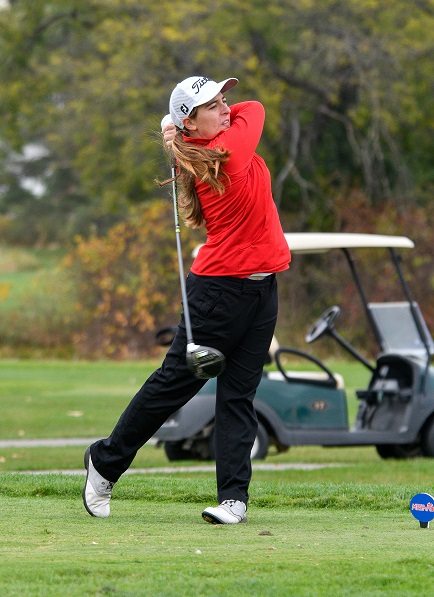
While COVID factors delayed action in most sports, the pandemic in fact expedited change in the sport of golf. The Golf Committee’s recommendation for live scoring in 2019 was implemented in tournaments during 2020-21, and now is required for regular-season events as well, beginning this school year.
“The state of the pandemic precipitated the move to the use of electronic scoring during the MHSAA Girls Golf Tournament in the fall of 2020, as eliminating the exchange of physical scorecards was a measure that decreased contact points between participants and helped ensure the safety of all at MHSAA events,” said Inglis, who also oversees all golf activities.
The scoring platform is made available through the MHSAA Golf app, which was created and is operated by iWanamaker and allows golfers, coaches and fans to chart scoring in real time.
“High school golf at times was one of the only sports where no one knew what the score was until after the round was completed, often times far too late to make any corrections or adjustments,” said MHSAA Project Coordinator Cole Malatinsky, who heads up the iWanamaker system. “The MHSAA Golf app and iWanamaker scoring platform allows people to track results in real time and helps the MHSAA better manage the logistics of tournaments, two aspects much needed in high school golf.”
Additionally, the system provides increased accountability and fair play.
 “This system not only provides coaches and tournament managers an easy and efficient means of setting up and scoring tournaments, but helps to increase scoring integrity,” Inglis said. “Recording only your score for each hole on a scorecard (electronic or paper) was defined as a deficiency in the scoring process for high school golf. While no system replaces integrity – which you either have or don’t have – iWanamaker allows more ‘eyeballs’ on all scores during the course of a match.”
Along the lines of competitive integrity, a change also has been made for the MHSAA Tennis Finals. If a seeded player withdraws on the day of the MHSAA Final, all seeded players below that withdrawing player (including the provisional seed in that flight) will move up and be placed on the proper line for that new seed. Playing against the same team more than twice at the Finals is permitted in this instance.
“The Tennis Committee felt that this was a logical solution to situations that sometimes arise on the day of the event,” said MHSAA Assistant Director Dan Hutcheson, who coordinates tennis events. “This way, individuals who have worked hard to earn seeded positions will be elevated to the next position on the brackets.”