

Eventually, the sun will shine ...
April 25, 2013
By Geoff Kimmerly
Second Half editor
 We all believe that, right?
Rain – and snow for some – has been the buzzword of this spring sports season. Just about every newspaper is writing about it and every athletic director, coach, player and parent is dreading it on a now-daily basis.
But eventually, we expect the weather to clear up and teams to play catch-up. To that end, there are limitations teams in some sports face when attempting to make up their games – but also opportunities to take advantage of while trying to fill out their regular-season schedules.
- Girls soccer and girls and boys lacrosse teams may play only three games during a week, Monday through Sunday. A weekend tournament – which generally includes 2 to 3 shortened games – counts as only one in this equation.
- Baseball and softball teams can play as many games as they want in a week, but no more than two on a school day – and baseball pitchers must not pitch for two days following their 30th out in a week.
- For tennis, an individual may not play more than three matches in one day – unless she or he is playing in a league championship tournament featuring more than eight schools for which a fourth match would decide the championship. That player also could not have played more than six sets that day heading into that fourth and final match.
- Golf and Track and Field do not have weekly contest limitations. Track and field athletes can compete in only four events per day.
As expected, a number of teams – especially for baseball and softball – are scheduling to smash in as many contests as possible into the next four weeks. Postseason play for tennis and lacrosse begins May 16 – three weeks from today.
But teams do have options.
One rarely used but anticipated to be used more this spring is an opportunity to continue playing regular-season contests through the final day of the MHSAA tournament in that sport. For example, a baseball team can continue making up games through June 15, the day of the MHSAA Finals in Battle Creek. A tennis team can play regular-season matches through June 1, etc.
Also, the MHSAA Executive Committee approved Thursday to allow for this spring two additional multi-team tournament dates for soccer and lacrosse, which will give those teams an opportunity to get in a few more games. That means soccer teams will be allowed to play in four multi-team tournaments instead of two, boys lacrosse four instead of two and girls lacrosse five instead of three.
Teams will have to do some juggling, no doubt, and all other tournament stipulations still apply (games generally are shortened so more can be played, etc.). But with a little creativity, teams could at least get in a few of their make-up games in this way.
Also, the Executive Committee approved a motion to waive the four-contest MHSAA tournament entry requirement for all Upper Peninsula schools in all sports this spring. As of the weekend, snow still covered parts of the U.P.
Gaps shrinking
Much has been discussed about minimums for all four MHSAA classes for 2013-14, and how they are the lowest student totals in at least a decade.
It’s true. The floor in Class A is 893 (down from 911 this school year), Class B starts at 429 (down from 449), Class C at 207 (down from 217) and Class D at 206 (down from 216).
However, there is a better way to crunch the numbers: Consider the shrinking gaps between the largest and smallest schools in each class.
For 2013-14, the gap in Class A is 1,888 students – 261 students fewer than 2007-08 and nearly 900 students fewer than in 2005-06. The gaps between largest and smallest in Classes B, C and D also are trending smaller – which means each class actually includes schools more similar in size, instead of a perceived other way around.
SAC 2013-14 on the way
We’re thankful for a valuable group of students who help us throughout the school year – our 16-member Student Advisory Council, made up of eight seniors and eight juniors from all over the state who are charged with providing feedback on issues impacting educational athletics from a student’s perspective, while also assisting at MHSAA championships and with special projects like the “Battle of the Fans.”
Selecting the next class to join is a highlight of every spring – but hardly an easy process.
A six-member selection committee, myself included, considered 62 sophomore applicants today from all over the Lower and Upper Peninsulas, representing all four of our classes and nearly every sport we sponsor.
Every candidate is impressive for a variety of reasons. That’s what makes this difficult – we could pick any number of combinations to make up our new SAC class, and no doubt leaders galore will emerge from another impressive group.
But there are only eight spots on the council. And we’ll announce who received them later next week.
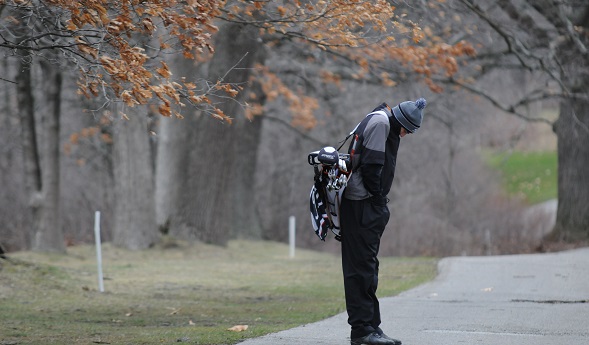
PHOTO: A golfer attempts to keep warm during a round on a dreary day earlier this season. (Click to see more at HighSchoolSportsScene.com.)

Musgrave's Iron Deficiency Work to Help Athletes 'Know If You're Low'
By
Tom Spencer
Special for MHSAA.com
November 5, 2021
Maya Musgrave wants every female high school cross country runner to know her story. And she wants to help everyone with a similar one.
 Boys, too, should take notice of what the Benzie Central senior has gone through. Her brothers already have. And, they got help.
Both the boys and girls Benzie runners have qualified for this weekend’s MHSAA Lower Peninsula Finals. The girls would not have made it without her leadership and contribution to the team. Perhaps the boys wouldn’t have either.
When she graduates in the spring, it won’t necessarily be Musgrave’s running performances people will remember. She’s in the process of starting a non-profit agency to create awareness for anemia and make iron blood testing free for future Benzie runners.
Now to her story. Musgrave started running cross country as a freshman. Her brothers Michael and Quinten also run for the Huskies.
Maya, who will be named to the academic all-state cross country team this weekend, got back into running her junior year, after recovery from an earlier surgery. She ran her best time of the season in the school’s first race.
But, Musgrave’s times dropped every race after. She and her coaches knew it wasn’t her training or effort. She and her family struggled with low energy and breathing difficulties.
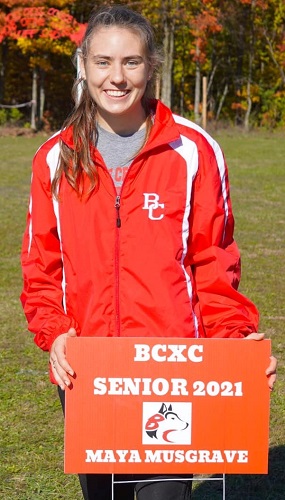 Upon receiving Musgrave’s blood test results, her personal physician actually asked Musgrave how she had been avoiding passing out. Her coaches wondered how it was possible she was staying awake during the day, let alone run.
Musgrave’s lab revealed she had iron levels just 10 percent of what they should be. She went through two iron infusions to get her levels to normal. Infusions are usually prescribed by doctors to treat iron deficiency anemia, or when needed to increase iron levels fast to avoid medical complications or a blood transfusion. They also are prescribed for iron deficiency anemia when dietary changes and iron supplements are not enough.
Her story has already led to iron testing of the entire Benzie girls team and some of the boys. Low iron levels are very common among female athletes, and to a lesser extent found among male runners. The testing revealed her brothers had low levels, as did half the girls team.
The cost of the testing was covered by Musgrave personally, with help from her family. The next step was to start the education process. She arranged to bring in Abigail Ellsworth, a local neuropathic doctor and acupuncturist, to speak to the team. Ellsworth also had volunteered her time to draw blood for the team testing.
Today, Musgrave is working with an attorney to set up her nonprofit called Know If You're Low. Once it is set up, the nonprofit will provide free iron testing and education for female runners at Benzie on an annual basis.
So others don’t have to, is Musgrave’s motivation.
“I just figured it had been a problem for girls in the past, it was obviously going to be with girls in the future as well, so I might as we’ll tell my friends about it and tell my teammates about it so they can get it checked and not have to worry about it like I did,” she said. “I didn’t want them to have to go through that.”
Her coaches, Asa and Traci Kelly, were among the first to suggest iron could be at the crux of her struggles. They’ve seen a lot of runners struggle with iron counts during their coaching and competitive personal running careers.
“She was at the point where we were consoling her after races and saying, ‘Hey, we’re sure this is what is going on,’” Asa Kelly said. “‘You just got to get tested.’”
Other than the extreme low levels, Musgrave’s story fits a pattern the Kellys have seen too often – watching times get slower without a known cause, thinking perhaps the athlete is not working hard enough and having kids quit the sport because of it.
 “A lot of coaches, a lot of athletes, a lot of parents just don’t understand how critical (iron levels are),” said Asa Kelly. “I think the biggest thing is back 30 or 40 year ago, you would just keep beating the horse.
“Low and behold many of these kids had underlying issues.”
The Kellys coach boys and girls cross country at Benzie. Their daughter Mylie broke the school record at the Regional last week and hopes to qualify for the all-state team again this year as a sophomore.
They’ve seen a couple of runners every year test low for iron when it was considered a possible culprit for decreasing performance. They can’t help but wonder what results would have shown if they had tested all the boys and girls every year. Musgrave may make that possible going forward.
“If coaches could be proactive with this kind of thing, imagine the difference in some of the lives of these kids you could make,” Asa Kelly said. “All of a sudden, ‘I just thought I was an OK runner on the team and I was just tired all of the time’ to maybe this kid has this untapped ability they are never going to discover just because of something that’s out of their control.”
Musgrave, who still takes iron supplements, has launched a website, KnowIfYoureLow.com.
“We figured that if people want to know more about this, there probably should be a website for them to go look at it,” Musgrave said. “It’s just a place that A, people can read information about this program, and B, donate if they want to. The money will go for paying for the actual blood test.”
Musgrave is undecided about college plans right how. Her coach believes she could land at one of the nation’s finest academic schools.
“She’s a spark plug,” Kelly said. “She’s a girl that is going to go places in this world for sure.
“She brings that poise, that confidence.”
 Tom Spencer is a longtime MHSAA-registered basketball and soccer official, and former softball and baseball official, and he also has coached in the northern Lower Peninsula area. He previously has written for the Saginaw News, Bay County Sports Page and Midland Daily News. He can be reached at [email protected] with story ideas for Manistee, Wexford, Missaukee, Roscommon, Ogemaw, Iosco, Alcona, Oscoda, Crawford, Kalkaska, Grand Traverse, Benzie, Leelanau, Antrim, Otsego, Montmorency, Alpena, Presque Isle, Cheboygan, Charlevoix and Emmet counties.
PHOTOS (Top) Benzie Central’s Maya Musgrave runs during a cross country race this fall. (Middle) Musgrave is a senior this season and forming a nonprofit to pay for iron deficiency testing for athletes. (Below) Musgrave, far left, with teammates Elise Johnson, Nora Grossnickle, Mylie Kelly, Ava Iverson, Hayley Vanwagoner and Ella Gaylord. (Photos courtesy of Benzie Central cross country program.)