

Eventually, the sun will shine ...
April 25, 2013
By Geoff Kimmerly
Second Half editor
 We all believe that, right?
Rain – and snow for some – has been the buzzword of this spring sports season. Just about every newspaper is writing about it and every athletic director, coach, player and parent is dreading it on a now-daily basis.
But eventually, we expect the weather to clear up and teams to play catch-up. To that end, there are limitations teams in some sports face when attempting to make up their games – but also opportunities to take advantage of while trying to fill out their regular-season schedules.
- Girls soccer and girls and boys lacrosse teams may play only three games during a week, Monday through Sunday. A weekend tournament – which generally includes 2 to 3 shortened games – counts as only one in this equation.
- Baseball and softball teams can play as many games as they want in a week, but no more than two on a school day – and baseball pitchers must not pitch for two days following their 30th out in a week.
- For tennis, an individual may not play more than three matches in one day – unless she or he is playing in a league championship tournament featuring more than eight schools for which a fourth match would decide the championship. That player also could not have played more than six sets that day heading into that fourth and final match.
- Golf and Track and Field do not have weekly contest limitations. Track and field athletes can compete in only four events per day.
As expected, a number of teams – especially for baseball and softball – are scheduling to smash in as many contests as possible into the next four weeks. Postseason play for tennis and lacrosse begins May 16 – three weeks from today.
But teams do have options.
One rarely used but anticipated to be used more this spring is an opportunity to continue playing regular-season contests through the final day of the MHSAA tournament in that sport. For example, a baseball team can continue making up games through June 15, the day of the MHSAA Finals in Battle Creek. A tennis team can play regular-season matches through June 1, etc.
Also, the MHSAA Executive Committee approved Thursday to allow for this spring two additional multi-team tournament dates for soccer and lacrosse, which will give those teams an opportunity to get in a few more games. That means soccer teams will be allowed to play in four multi-team tournaments instead of two, boys lacrosse four instead of two and girls lacrosse five instead of three.
Teams will have to do some juggling, no doubt, and all other tournament stipulations still apply (games generally are shortened so more can be played, etc.). But with a little creativity, teams could at least get in a few of their make-up games in this way.
Also, the Executive Committee approved a motion to waive the four-contest MHSAA tournament entry requirement for all Upper Peninsula schools in all sports this spring. As of the weekend, snow still covered parts of the U.P.
Gaps shrinking
Much has been discussed about minimums for all four MHSAA classes for 2013-14, and how they are the lowest student totals in at least a decade.
It’s true. The floor in Class A is 893 (down from 911 this school year), Class B starts at 429 (down from 449), Class C at 207 (down from 217) and Class D at 206 (down from 216).
However, there is a better way to crunch the numbers: Consider the shrinking gaps between the largest and smallest schools in each class.
For 2013-14, the gap in Class A is 1,888 students – 261 students fewer than 2007-08 and nearly 900 students fewer than in 2005-06. The gaps between largest and smallest in Classes B, C and D also are trending smaller – which means each class actually includes schools more similar in size, instead of a perceived other way around.
SAC 2013-14 on the way
We’re thankful for a valuable group of students who help us throughout the school year – our 16-member Student Advisory Council, made up of eight seniors and eight juniors from all over the state who are charged with providing feedback on issues impacting educational athletics from a student’s perspective, while also assisting at MHSAA championships and with special projects like the “Battle of the Fans.”
Selecting the next class to join is a highlight of every spring – but hardly an easy process.
A six-member selection committee, myself included, considered 62 sophomore applicants today from all over the Lower and Upper Peninsulas, representing all four of our classes and nearly every sport we sponsor.
Every candidate is impressive for a variety of reasons. That’s what makes this difficult – we could pick any number of combinations to make up our new SAC class, and no doubt leaders galore will emerge from another impressive group.
But there are only eight spots on the council. And we’ll announce who received them later next week.
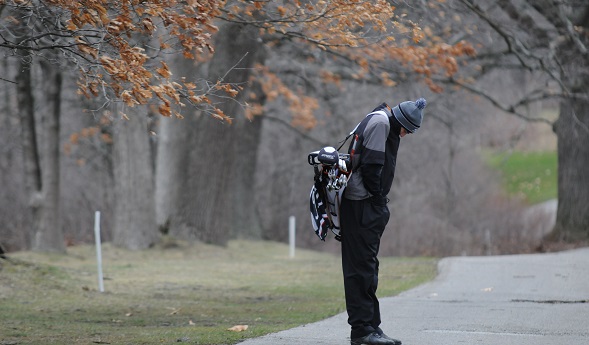
PHOTO: A golfer attempts to keep warm during a round on a dreary day earlier this season. (Click to see more at HighSchoolSportsScene.com.)
How Can COVID-19 Impact Student-Athletes' Return-To-Play?
October 5, 2021

COVID-19 And Student Athletes: How Can the Virus Impact Return-To-Play?
The end of summer marked the start of the school year, and for student athletes, the kickoff of the fall sports season. For many, COVID-19 sidelined practices, team gatherings and games to some extent last year. And while there is still hope that young athletes will have more opportunity to play this season despite rising cases of the Delta variant, there are other factors causing concern among athletes and their parents.
According to Ramsey Shehab, M.D., a sports medicine physician for Henry Ford Health System, many athletes are concerned about reaching peak performance after a long time off or after they have recovered from a COVID diagnosis. He reassures students that the feeling of exhaustion or even underperformance compared to past years is to be expected when you take time off or after fighting an illness.
“When you are infected with a virus, it taxes your immune system, and all of your energy goes towards fighting off that infection,” says Dr. Shehab. “You’ll likely feel weak and more tired during this time.”
Fortunately, as the body begins to recover, you’ll start to feel more like yourself again as you get your energy back. But this doesn’t mean that you won’t lose some of that fitness and endurance you’ve built up.
“It only takes about a week of deconditioning to set you back from peak athletic abilities,” says Dr. Shehab. “It is completely expected that your body will need time to get back to performing at your best.”
Playing Sports After Recovering From COVID-19
The unfortunate news: COVID-19 affects people differently in the long term. Some people are able to recover and get back to their routine without delay, whereas others see further complications months after an infection.
Akshay Khandelwal, M.D., a cardiologist with Henry Ford Health System, breaks down some of the more serious findings regarding COVID-19 and your heart health.
“With COVID-19, there is a risk of direct injury like heart failure or an arrhythmia due to the stress your body is under while fighting off the virus,” says Dr. Khandelwal. “As a result, having the virus can cause inflammation of the heart, a condition called myocarditis.”
Because of this, talking to your doctor before returning to a sport is a must if you had COVID or are recovering from the virus. It is important to make sure there are no systemic changes to your body such as overall heart health and lung function. They will be able to rule out any long-term effects that could impact your fitness output.
Expert-Recommended Steps for Return-To-Play
As you get back to your game, both experts share their insights for a healthy recovery:
1. Take quarantine periods seriously. If you are sick, even if you don’t necessarily feel sick, make sure you are taking time to rest and recover properly. “Don’t try to push or overexert yourself,” says Dr. Khandelwal. “It could prolong your recovery.”
2. Get back to training slowly. “Start using low-exertion activities to get your body used to working out again,” says Dr. Shehab. “Once you are able to handle each activity, you can push ahead to something more challenging.” Realistically, it may take a couple of weeks before you are able to get back to your peak.
3. Listen to your body. If workouts seem increasingly difficult, talk with your doctor or trainer before pushing yourself further. You can also help your body recover by making healthy, thoughtful choices:
► Get plenty of sleep
► Warm up and cool down before and after workouts
► Stay hydrated
► Take breaks when you’re tired
► Practice injury prevention
► Make smart food choices
4. Get vaccinated. If medical or religious reasons, or age requirements aren’t stopping you from getting the vaccine, consider getting the shot for yourself and those around you. The Delta variant is highly transmittable, meaning that, it is much easier for it to spread to teammates and family members than the original strain of the virus. To learn more about the COVID-19 vaccine, visit our Vaccine FAQs page.
Talk to your doctor to learn more about safely returning to a sport. To find a doctor, visit henryford.com or call 1-800-436-7936.
Dr. Ramsey Shehab is the deputy chief of Sports Medicine at Henry Ford Health System. He sees patients at the Henry Ford Center for Athletic Medicine and Henry Ford Medical Center - Bloomfield Township.
Dr. Akshay Khandelwal is an interventional cardiologist who sees patients at Henry Ford Medical Center – Second Avenue.