

Eventually, the sun will shine ...
April 25, 2013
By Geoff Kimmerly
Second Half editor
 We all believe that, right?
Rain – and snow for some – has been the buzzword of this spring sports season. Just about every newspaper is writing about it and every athletic director, coach, player and parent is dreading it on a now-daily basis.
But eventually, we expect the weather to clear up and teams to play catch-up. To that end, there are limitations teams in some sports face when attempting to make up their games – but also opportunities to take advantage of while trying to fill out their regular-season schedules.
- Girls soccer and girls and boys lacrosse teams may play only three games during a week, Monday through Sunday. A weekend tournament – which generally includes 2 to 3 shortened games – counts as only one in this equation.
- Baseball and softball teams can play as many games as they want in a week, but no more than two on a school day – and baseball pitchers must not pitch for two days following their 30th out in a week.
- For tennis, an individual may not play more than three matches in one day – unless she or he is playing in a league championship tournament featuring more than eight schools for which a fourth match would decide the championship. That player also could not have played more than six sets that day heading into that fourth and final match.
- Golf and Track and Field do not have weekly contest limitations. Track and field athletes can compete in only four events per day.
As expected, a number of teams – especially for baseball and softball – are scheduling to smash in as many contests as possible into the next four weeks. Postseason play for tennis and lacrosse begins May 16 – three weeks from today.
But teams do have options.
One rarely used but anticipated to be used more this spring is an opportunity to continue playing regular-season contests through the final day of the MHSAA tournament in that sport. For example, a baseball team can continue making up games through June 15, the day of the MHSAA Finals in Battle Creek. A tennis team can play regular-season matches through June 1, etc.
Also, the MHSAA Executive Committee approved Thursday to allow for this spring two additional multi-team tournament dates for soccer and lacrosse, which will give those teams an opportunity to get in a few more games. That means soccer teams will be allowed to play in four multi-team tournaments instead of two, boys lacrosse four instead of two and girls lacrosse five instead of three.
Teams will have to do some juggling, no doubt, and all other tournament stipulations still apply (games generally are shortened so more can be played, etc.). But with a little creativity, teams could at least get in a few of their make-up games in this way.
Also, the Executive Committee approved a motion to waive the four-contest MHSAA tournament entry requirement for all Upper Peninsula schools in all sports this spring. As of the weekend, snow still covered parts of the U.P.
Gaps shrinking
Much has been discussed about minimums for all four MHSAA classes for 2013-14, and how they are the lowest student totals in at least a decade.
It’s true. The floor in Class A is 893 (down from 911 this school year), Class B starts at 429 (down from 449), Class C at 207 (down from 217) and Class D at 206 (down from 216).
However, there is a better way to crunch the numbers: Consider the shrinking gaps between the largest and smallest schools in each class.
For 2013-14, the gap in Class A is 1,888 students – 261 students fewer than 2007-08 and nearly 900 students fewer than in 2005-06. The gaps between largest and smallest in Classes B, C and D also are trending smaller – which means each class actually includes schools more similar in size, instead of a perceived other way around.
SAC 2013-14 on the way
We’re thankful for a valuable group of students who help us throughout the school year – our 16-member Student Advisory Council, made up of eight seniors and eight juniors from all over the state who are charged with providing feedback on issues impacting educational athletics from a student’s perspective, while also assisting at MHSAA championships and with special projects like the “Battle of the Fans.”
Selecting the next class to join is a highlight of every spring – but hardly an easy process.
A six-member selection committee, myself included, considered 62 sophomore applicants today from all over the Lower and Upper Peninsulas, representing all four of our classes and nearly every sport we sponsor.
Every candidate is impressive for a variety of reasons. That’s what makes this difficult – we could pick any number of combinations to make up our new SAC class, and no doubt leaders galore will emerge from another impressive group.
But there are only eight spots on the council. And we’ll announce who received them later next week.
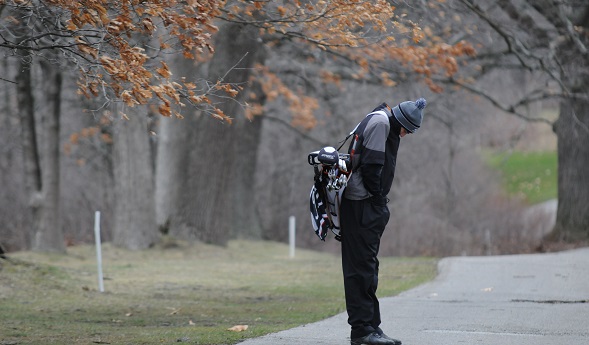
PHOTO: A golfer attempts to keep warm during a round on a dreary day earlier this season. (Click to see more at HighSchoolSportsScene.com.)

Loy Norrix Career Prepped Crocker for U-M Success, Law Degree Pursuit
By
Pam Shebest
Special for MHSAA.com
July 29, 2021
KALAMAZOO — After graduating from University of Michigan in 2018, Davis Crocker suddenly found himself surrounded by green, white and Spartys.
 With a degree in sports management from the Maize and Blue, Crocker is currently enrolled at Michigan State University’s College of Law in East Lansing.
“The first few months with all the green and Spartan heads, it’s a little bit of a culture shock,” Crocker, 25, said, laughing.
“I get the occasional comments every now and then. I try to be respectful.”
He has some backup. His brother, Reed, is on the MSU tennis team.
The Loy Norrix alumnus credits his four years playing high school tennis as “the kickstart to everything at Michigan and at law school now, balancing tennis and school with the team aspect, the coaches, the teammates.
“It laid the foundation for who I am now. My work ethic and leadership stem from that time.”
While many top tennis players opt out of high school tennis to concentrate on USTA tournaments, Crocker combined the two.
He said three things influenced his decision.
“First, that team aspect,” he said. “I think that’s so valuable. I played team sports when I was a kid, but when I just focused on tennis there weren’t as many opportunities for that. I enjoyed that aspect.
“Two, I felt I needed to give back to the school in some way. They were very flexible with my travel, my practicing and everything. I felt like doing things under their name was probably not enough, but at least a little bit.”
The third was that he just enjoyed being around the guys and going on road trips.
“The winning helped,” he added, laughing.
Winning, indeed.
He ended his high school career with some impressive numbers, enough to earn him the Michigan Mr. Tennis Award his senior year, when he went undefeated at 30-0.
His four-year record was 108-9, with seven of those losses his freshman year.
Loy Norrix did not qualify for the MHSAA Lower Peninsula Division 2 Championships as a team those four years, but Crocker did individually and won the No. 1 singles title his sophomore, junior and senior seasons.
“When I won the state championship that third time (in 2013), that meant a lot out of the three,” he said, reminiscing. “The guy I played in the finals ended up playing at Arizona State.”
Crocker, the top seed, defeated second-seeded William Kirkman from Midland Dow, 6-3, 6-1.
Telling defeat
Art Williams, who coached the team all four years, said one moment was indicative of Crocker’s work ethic.
“During Regionals of his junior year, Davis was rolling through the draw as usual. On the final day, in the final No. 1 singles match, Davis struggled with his opponent,” Williams recalled.
 “I rarely had to coach Davis through a defeat; it just rarely happened. But on this day something was off. His father told me Davis was dealing with a very upset stomach.”
Williams said Crocker made no excuses, but after losing that match took the time to walk to the net to shake his opponent’s hand.
“The story does have a happy ending though,” Williams added. “Even with the loss, Davis still qualified for the state tournament and proceeded to win his second state title by defeating the very same player (Portage Central’s Billy Heckman) he lost to just two weeks before.”
That Regional loss was Crocker’s last defeat of his high school career.
Crocker graduated early from Loy Norrix in January 2014 and headed to University of Michigan that same month.
He said high school tennis prepared him for a much different type of tennis in college.
“It helped a lot because college took the team part to even more of an extreme,” he said. “In high school, you’re only together for three or four months, then you see each other in the hallway.
“In college it’s pretty much year round. You’re either communicating or practicing or competing. I think just laying that (high school) groundwork made the transition easier.”
He said he is happy he had that extra semester at Michigan before actually competing.
“The levels were higher. With my teammates, I’m not the top guy any more. I’m just one of 12,” Crocker said. “There are no easy games at that level. You have to bring your ‘A’ game every time.”
By his senior year, Crocker was an ITA Scholar-Athlete, Academic All-Big Ten, Big Ten doubles indoor champion with Harry Brown and co-captain of the tennis team.
While at U-M, he spent three seasons as assistant to Loy Norrix coach Bill Jenkins and, before entering law school, spent a year as an instructor at West Hills Athletic Club in Kalamazoo.
After playing so much tennis, Crocker took a break from sports.
“I was mentally done with it, but now I feel ready to play a little more and be involved with the community,” he said.
“These last six months I started hitting a bit and training a little more. I did a couple tournaments recently.”
Following family traditions
Crocker’s dad, grandfather and uncle are U-M grads, and his great-great-grandfather graduated from what was then the Detroit College of Law.
Currently, his dad and uncle are partners in Crocker & Crocker, a law firm started by his grandfather in Kalamazoo.
 “I was always in that (law) environment when I was a kid,” Crocker said. “It lines up with all my interests like reading and writing and history. With sports business, I would like to do something potentially with sports and the law.
“I’ve also thought about compliance or something like that with the NCAA, which has changed a lot even since I first got into law school.”
He also has been working with his dad in telecommunications law.
“There are so many different areas that it can be overwhelming,” Crocker said. “I’ll sort that out in the next year and a half (before graduation).”
As for high school, Crocker has some advice for those in any sport:
“When you first begin, don’t be overwhelmed by the situation, just embrace it. You will look fondly back, even on those times when you are maybe teased by the older guys. You appreciate it later on because you grow so much from it.”
2020-21 Made in Michigan
July 19: Top PGA Pro Finish Latest Greatest Highlight as Cook Continues Climb - Read
July 16: TC West Standout Renews Ties to Titans, Cheers Past Teammates' Gold Pursuit - Read
July 8: Caro Champs Find Common Ground Again as Mental Health Providers - Read
June 28: Michigan's Minor Leaguers Making Up for Lost Season - Read
PHOTOS: (Top) Three-time MHSAA Finals tennis champion Davis Crocker has begun playing competitively again while also working toward a law degree. (Middle) Crocker unleashes a serve during his No. 1 singles title match in 2013. (Below) Crocker stands at the scoreboard during his championship match at the 2012 LP Division 2 Finals. (Top photo by Pam Shebest; middle and below photos by High School Sports Scene.)