

Eventually, the sun will shine ...
April 25, 2013
By Geoff Kimmerly
Second Half editor
 We all believe that, right?
Rain – and snow for some – has been the buzzword of this spring sports season. Just about every newspaper is writing about it and every athletic director, coach, player and parent is dreading it on a now-daily basis.
But eventually, we expect the weather to clear up and teams to play catch-up. To that end, there are limitations teams in some sports face when attempting to make up their games – but also opportunities to take advantage of while trying to fill out their regular-season schedules.
- Girls soccer and girls and boys lacrosse teams may play only three games during a week, Monday through Sunday. A weekend tournament – which generally includes 2 to 3 shortened games – counts as only one in this equation.
- Baseball and softball teams can play as many games as they want in a week, but no more than two on a school day – and baseball pitchers must not pitch for two days following their 30th out in a week.
- For tennis, an individual may not play more than three matches in one day – unless she or he is playing in a league championship tournament featuring more than eight schools for which a fourth match would decide the championship. That player also could not have played more than six sets that day heading into that fourth and final match.
- Golf and Track and Field do not have weekly contest limitations. Track and field athletes can compete in only four events per day.
As expected, a number of teams – especially for baseball and softball – are scheduling to smash in as many contests as possible into the next four weeks. Postseason play for tennis and lacrosse begins May 16 – three weeks from today.
But teams do have options.
One rarely used but anticipated to be used more this spring is an opportunity to continue playing regular-season contests through the final day of the MHSAA tournament in that sport. For example, a baseball team can continue making up games through June 15, the day of the MHSAA Finals in Battle Creek. A tennis team can play regular-season matches through June 1, etc.
Also, the MHSAA Executive Committee approved Thursday to allow for this spring two additional multi-team tournament dates for soccer and lacrosse, which will give those teams an opportunity to get in a few more games. That means soccer teams will be allowed to play in four multi-team tournaments instead of two, boys lacrosse four instead of two and girls lacrosse five instead of three.
Teams will have to do some juggling, no doubt, and all other tournament stipulations still apply (games generally are shortened so more can be played, etc.). But with a little creativity, teams could at least get in a few of their make-up games in this way.
Also, the Executive Committee approved a motion to waive the four-contest MHSAA tournament entry requirement for all Upper Peninsula schools in all sports this spring. As of the weekend, snow still covered parts of the U.P.
Gaps shrinking
Much has been discussed about minimums for all four MHSAA classes for 2013-14, and how they are the lowest student totals in at least a decade.
It’s true. The floor in Class A is 893 (down from 911 this school year), Class B starts at 429 (down from 449), Class C at 207 (down from 217) and Class D at 206 (down from 216).
However, there is a better way to crunch the numbers: Consider the shrinking gaps between the largest and smallest schools in each class.
For 2013-14, the gap in Class A is 1,888 students – 261 students fewer than 2007-08 and nearly 900 students fewer than in 2005-06. The gaps between largest and smallest in Classes B, C and D also are trending smaller – which means each class actually includes schools more similar in size, instead of a perceived other way around.
SAC 2013-14 on the way
We’re thankful for a valuable group of students who help us throughout the school year – our 16-member Student Advisory Council, made up of eight seniors and eight juniors from all over the state who are charged with providing feedback on issues impacting educational athletics from a student’s perspective, while also assisting at MHSAA championships and with special projects like the “Battle of the Fans.”
Selecting the next class to join is a highlight of every spring – but hardly an easy process.
A six-member selection committee, myself included, considered 62 sophomore applicants today from all over the Lower and Upper Peninsulas, representing all four of our classes and nearly every sport we sponsor.
Every candidate is impressive for a variety of reasons. That’s what makes this difficult – we could pick any number of combinations to make up our new SAC class, and no doubt leaders galore will emerge from another impressive group.
But there are only eight spots on the council. And we’ll announce who received them later next week.
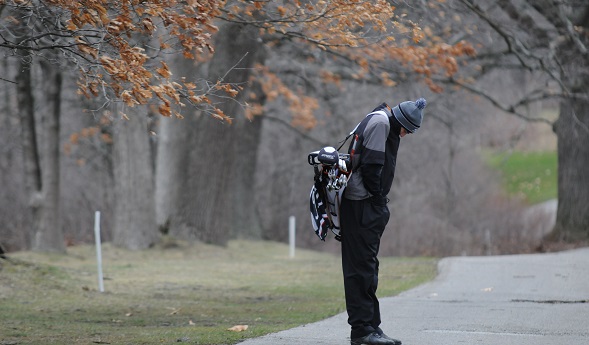
PHOTO: A golfer attempts to keep warm during a round on a dreary day earlier this season. (Click to see more at HighSchoolSportsScene.com.)

Ishpeming, Norway Race to Shared Finals Fame
By
John Vrancic
Special for MHSAA.com
June 6, 2021
KINGSFORD — The Ishpeming boys are used to winning Upper Peninsula track & field championships.
They came into Saturday’s U.P. Division 2 Finals as two-time reigning champs and had won five titles over six seasons prior to last year when all spring sports were cancelled due to COVID-19.
This time the Hematites and Norway shared the title with 95 points each. Third-place Iron Mountain had 85.
For Norway, this was its first championship since 2004.
“Not bad for us, especially with having just 10 boys,” said Norway coach Al Trudeau. “At the beginning of the year we weren’t expecting this. We had a great bunch of kids who worked hard. We had a great year.”
 Norway junior Adam Cavaghetto, who returned midseason following a blood disorder, won the 800-meter run in two minutes, 5.06 seconds and the 1,600 (4:38.59).
Ishpeming’s David Liimatta took the 400 (54.16) and placed second in the 800 (2:07.57) and 1,600 (4:41.42), and Silas Broberg was first in the 3,200 (10:50.91).
The Hematites also won the 1,600 relay (3:47.52) and 3,200 relay (9:25.34).
“We had a good day,” said Ishpeming coach P.J. Pruett. “Overall, our kids did well.”
Iron Mountain enjoyed much of its success in the sprints with senior Dante Basanese taking the 200 (23.84) and sweeping the speed relays.
“Our handoffs felt pretty good,” said Basanese, who anchored the winning 800 relay. “We had four good sprinters who definitely ran real hard.
“Norway has a good team. We felt they were the team to beat.”
The Mountaineers were clocked at 1:35.1 in the 800 relay with Norway the runner-up (1:37.99). They also took the 400 relay (45.05).
 Iron Mountain won the Regional at West Iron, and Norway was crowned champion at Ishpeming.
St. Ignace got firsts from Christian Koiveniemi in the 100 (11.79), who edged Gwinn’s Max Jayne by one hundredth of a second, and Trevor Visnaw in pole vault at nine feet. Basanese was third (11.82) in the 100.
Newberry’s lone champion was Eric Edwards in shot put (40-4½), and David Duvall provided Gwinn with its only first in the 110 hurdles (17.81), followed by Norway’s Wyatt Richter (17.9) and St. Ignace’s Jackson Ingalls (17.93).
L’Anse had a double winner in Nathan Hochstein, who took high jump at 5-9 and long jump at 18-9½. Eli Ostermeyer added a first in discus (114-11) and a second in shot put (37-9¼).
West Iron’s champion was Landon Sudelius in the 300 hurdles (43.58).
PHOTOS: (Top) Norway's Adam Cavaghetto travels the final stretch in winning the 1,600. (Middle) Ishpeming's Jordan Longtine hands off to Hunter Smith during the 3,200 relay. (Below) Iron Mountain's Dante Basanese wins the 200 with Norway's Jeffrey VanHolla taking second. (Photos by Cara Kamps. Click to see more at RunMichigan.com.)