

Eventually, the sun will shine ...
April 25, 2013
By Geoff Kimmerly
Second Half editor
 We all believe that, right?
Rain – and snow for some – has been the buzzword of this spring sports season. Just about every newspaper is writing about it and every athletic director, coach, player and parent is dreading it on a now-daily basis.
But eventually, we expect the weather to clear up and teams to play catch-up. To that end, there are limitations teams in some sports face when attempting to make up their games – but also opportunities to take advantage of while trying to fill out their regular-season schedules.
- Girls soccer and girls and boys lacrosse teams may play only three games during a week, Monday through Sunday. A weekend tournament – which generally includes 2 to 3 shortened games – counts as only one in this equation.
- Baseball and softball teams can play as many games as they want in a week, but no more than two on a school day – and baseball pitchers must not pitch for two days following their 30th out in a week.
- For tennis, an individual may not play more than three matches in one day – unless she or he is playing in a league championship tournament featuring more than eight schools for which a fourth match would decide the championship. That player also could not have played more than six sets that day heading into that fourth and final match.
- Golf and Track and Field do not have weekly contest limitations. Track and field athletes can compete in only four events per day.
As expected, a number of teams – especially for baseball and softball – are scheduling to smash in as many contests as possible into the next four weeks. Postseason play for tennis and lacrosse begins May 16 – three weeks from today.
But teams do have options.
One rarely used but anticipated to be used more this spring is an opportunity to continue playing regular-season contests through the final day of the MHSAA tournament in that sport. For example, a baseball team can continue making up games through June 15, the day of the MHSAA Finals in Battle Creek. A tennis team can play regular-season matches through June 1, etc.
Also, the MHSAA Executive Committee approved Thursday to allow for this spring two additional multi-team tournament dates for soccer and lacrosse, which will give those teams an opportunity to get in a few more games. That means soccer teams will be allowed to play in four multi-team tournaments instead of two, boys lacrosse four instead of two and girls lacrosse five instead of three.
Teams will have to do some juggling, no doubt, and all other tournament stipulations still apply (games generally are shortened so more can be played, etc.). But with a little creativity, teams could at least get in a few of their make-up games in this way.
Also, the Executive Committee approved a motion to waive the four-contest MHSAA tournament entry requirement for all Upper Peninsula schools in all sports this spring. As of the weekend, snow still covered parts of the U.P.
Gaps shrinking
Much has been discussed about minimums for all four MHSAA classes for 2013-14, and how they are the lowest student totals in at least a decade.
It’s true. The floor in Class A is 893 (down from 911 this school year), Class B starts at 429 (down from 449), Class C at 207 (down from 217) and Class D at 206 (down from 216).
However, there is a better way to crunch the numbers: Consider the shrinking gaps between the largest and smallest schools in each class.
For 2013-14, the gap in Class A is 1,888 students – 261 students fewer than 2007-08 and nearly 900 students fewer than in 2005-06. The gaps between largest and smallest in Classes B, C and D also are trending smaller – which means each class actually includes schools more similar in size, instead of a perceived other way around.
SAC 2013-14 on the way
We’re thankful for a valuable group of students who help us throughout the school year – our 16-member Student Advisory Council, made up of eight seniors and eight juniors from all over the state who are charged with providing feedback on issues impacting educational athletics from a student’s perspective, while also assisting at MHSAA championships and with special projects like the “Battle of the Fans.”
Selecting the next class to join is a highlight of every spring – but hardly an easy process.
A six-member selection committee, myself included, considered 62 sophomore applicants today from all over the Lower and Upper Peninsulas, representing all four of our classes and nearly every sport we sponsor.
Every candidate is impressive for a variety of reasons. That’s what makes this difficult – we could pick any number of combinations to make up our new SAC class, and no doubt leaders galore will emerge from another impressive group.
But there are only eight spots on the council. And we’ll announce who received them later next week.
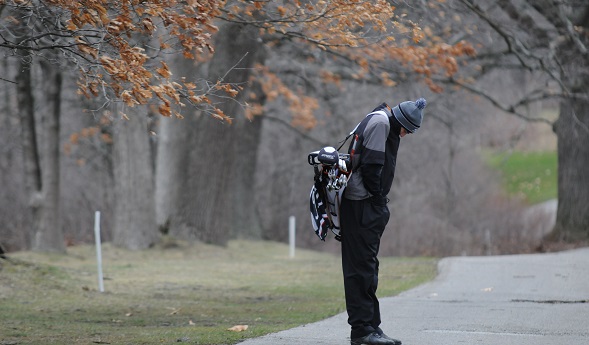
PHOTO: A golfer attempts to keep warm during a round on a dreary day earlier this season. (Click to see more at HighSchoolSportsScene.com.)
Navigating Twists, Turns Of Ankle Sprains
November 30, 2020

Henry Ford Health System
Oh, how the ankle turns! If you’ve had a misstep or wrong turn result in a sprained ankle, you know how painful this injury can be. Henry Ford podiatric surgeon Paul Di Liddo, DPM, discusses ankle sprains and treatments.
Ankle Injury 101
From risk factors to treatments (and nearly everything in between), here’s what to know — and do — about ankle sprains.
Sprained Ankles Are Painfully Common
In fact, they’re among the most frequent injuries in the United States, with up to 25,000 people per day spraining their ankles. Although often associated with sports, ankle sprains can happen to anyone, anywhere. “I see ankle sprains from tripping over curbs, stepping in holes in a yard or simply walking,” says Dr. Di Liddo. “Ankle sprains — like accidents — happen.”
Ankle Sprains Injure Ligaments
“Ankle sprains occur when the ankle suddenly and forcefully twists or rolls past a point that the ankle ligaments can tolerate,” remarks Dr. Di Liddo. “The ankle ligaments will stretch or tear, either partially or completely.” An ankle can twist, turn or roll during a fall, jump or change of direction, while walking on uneven ground and more.
A Weak Ankle Is A Vulnerable Ankle
Most sprained ankles heal without long-term concern. In some cases, however, ligaments may not fully heal, resulting in a weak or unstable ankle. “A weak or unstable ankle can make an individual more susceptible to repeated ankle sprains,” explains Dr. Di Liddo.
High Arches Can Be Risky Business
People who have high-arched feet are more at risk of rolling — and therefore spraining — their ankles. So are people who have “loose joints,” because the ankle can overstretch with a seemingly minor twist. People who are at-risk for ankle sprains should take extra precautions when playing sports or performing other activities.
Some Sprains Can Be Treated At Home — Emphasis On Some
How you treat a sprained ankle depends on the severity of the injury. Minor sprains can be treated at home with the RICE method. The RICE method include:
- Rest by avoiding use of the injured ankle
- Ice applied to the ankle (without touching the skin) for no more than 20 minutes every three to four hours
- Compression with an elastic bandage
- Elevation above the heart
Ice, compress and elevate your ankle for the first few days. Rest and refrain from sports until ankle pain and swelling have subsided.
At-home treatments aren’t right for everyone — or every ankle injury. “A swollen ankle is typical if you have experienced a sprain,” says Dr. Di Liddo. “However, if you have severe ankle swelling, are in extreme pain or notice an odd ankle appearance, seek medical attention.” This is also true if you can’t walk more than a few steps or have limited ankle mobility. A foot and ankle specialist can diagnose your injury and begin treatment.
Ankle Treatments Abound
Ankle sprain treatments are designed to decrease pain and swelling, while protecting the ligaments from further injury. Treatments include wearing an ankle brace, walking boot or cast. Physical therapy to strengthen the ankle and maintain range of motion may also be incorporated after the ligaments have started to heal.
“Of course, for more severe injuries, a thorough physical exam and X-rays are necessary,” says Dr. Di Liddo. “This helps ensure that there is no other underlying injury, such as a fractured ankle or Achilles tendon rupture.”
Healing Times Vary
The recovery time for a sprained ankle depends on the severity of the injury. Sprains with minimal ligament stretching and no tear require one to three weeks. Partially torn ankle ligaments may take up to six to eight weeks to heal. A fully torn ligament can take several months to fully heal.
What To Do When Ankle Problems Persist
For people who continue to experience ankle instability, there are a host of options. “Physical therapy is the first step — but not the only one,” says Dr. Di Liddo. “If physical therapy has not been beneficial, we can discuss surgical approaches.”
Surgical options include:
- Ligament repair or reinforcement via an outpatient procedure
- Osteotomy, which is surgical cutting of bone, to lower arches when ankle instability is caused by high arches
For those with frequent ankle sprains or instability, a medical assessment is necessary and may include:
- Physical exam
- X-rays to assess bones and joints
- MRI to evaluate ankle ligaments
With this information in mind, you can prevent — or address — the twists and turns of ankle sprains.
Want to learn more? Henry Ford Health System sports medicine experts are treating the whole athlete, in a whole new way. From nutrition to neurology, and from injury prevention to treatment of sports-related conditions, they can give your athlete a unique game plan.
Visit henryford.com/sports or call (313) 972-4216 for an appointment within 24 business hours.