

Eventually, the sun will shine ...
April 25, 2013
By Geoff Kimmerly
Second Half editor
 We all believe that, right?
Rain – and snow for some – has been the buzzword of this spring sports season. Just about every newspaper is writing about it and every athletic director, coach, player and parent is dreading it on a now-daily basis.
But eventually, we expect the weather to clear up and teams to play catch-up. To that end, there are limitations teams in some sports face when attempting to make up their games – but also opportunities to take advantage of while trying to fill out their regular-season schedules.
- Girls soccer and girls and boys lacrosse teams may play only three games during a week, Monday through Sunday. A weekend tournament – which generally includes 2 to 3 shortened games – counts as only one in this equation.
- Baseball and softball teams can play as many games as they want in a week, but no more than two on a school day – and baseball pitchers must not pitch for two days following their 30th out in a week.
- For tennis, an individual may not play more than three matches in one day – unless she or he is playing in a league championship tournament featuring more than eight schools for which a fourth match would decide the championship. That player also could not have played more than six sets that day heading into that fourth and final match.
- Golf and Track and Field do not have weekly contest limitations. Track and field athletes can compete in only four events per day.
As expected, a number of teams – especially for baseball and softball – are scheduling to smash in as many contests as possible into the next four weeks. Postseason play for tennis and lacrosse begins May 16 – three weeks from today.
But teams do have options.
One rarely used but anticipated to be used more this spring is an opportunity to continue playing regular-season contests through the final day of the MHSAA tournament in that sport. For example, a baseball team can continue making up games through June 15, the day of the MHSAA Finals in Battle Creek. A tennis team can play regular-season matches through June 1, etc.
Also, the MHSAA Executive Committee approved Thursday to allow for this spring two additional multi-team tournament dates for soccer and lacrosse, which will give those teams an opportunity to get in a few more games. That means soccer teams will be allowed to play in four multi-team tournaments instead of two, boys lacrosse four instead of two and girls lacrosse five instead of three.
Teams will have to do some juggling, no doubt, and all other tournament stipulations still apply (games generally are shortened so more can be played, etc.). But with a little creativity, teams could at least get in a few of their make-up games in this way.
Also, the Executive Committee approved a motion to waive the four-contest MHSAA tournament entry requirement for all Upper Peninsula schools in all sports this spring. As of the weekend, snow still covered parts of the U.P.
Gaps shrinking
Much has been discussed about minimums for all four MHSAA classes for 2013-14, and how they are the lowest student totals in at least a decade.
It’s true. The floor in Class A is 893 (down from 911 this school year), Class B starts at 429 (down from 449), Class C at 207 (down from 217) and Class D at 206 (down from 216).
However, there is a better way to crunch the numbers: Consider the shrinking gaps between the largest and smallest schools in each class.
For 2013-14, the gap in Class A is 1,888 students – 261 students fewer than 2007-08 and nearly 900 students fewer than in 2005-06. The gaps between largest and smallest in Classes B, C and D also are trending smaller – which means each class actually includes schools more similar in size, instead of a perceived other way around.
SAC 2013-14 on the way
We’re thankful for a valuable group of students who help us throughout the school year – our 16-member Student Advisory Council, made up of eight seniors and eight juniors from all over the state who are charged with providing feedback on issues impacting educational athletics from a student’s perspective, while also assisting at MHSAA championships and with special projects like the “Battle of the Fans.”
Selecting the next class to join is a highlight of every spring – but hardly an easy process.
A six-member selection committee, myself included, considered 62 sophomore applicants today from all over the Lower and Upper Peninsulas, representing all four of our classes and nearly every sport we sponsor.
Every candidate is impressive for a variety of reasons. That’s what makes this difficult – we could pick any number of combinations to make up our new SAC class, and no doubt leaders galore will emerge from another impressive group.
But there are only eight spots on the council. And we’ll announce who received them later next week.
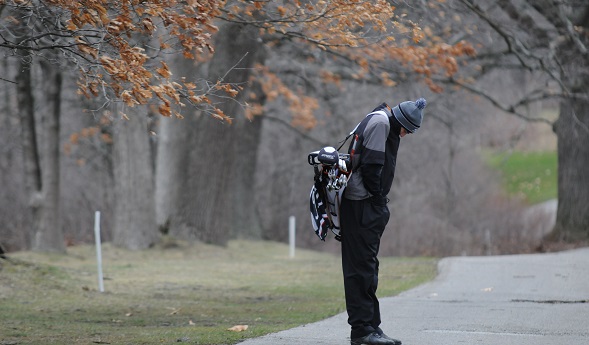
PHOTO: A golfer attempts to keep warm during a round on a dreary day earlier this season. (Click to see more at HighSchoolSportsScene.com.)
The Official View: The Next Generation
By
Brent Rice
MHSAA Assistant Director
October 27, 2020
By Brent Rice
MHSAA Assistant Director
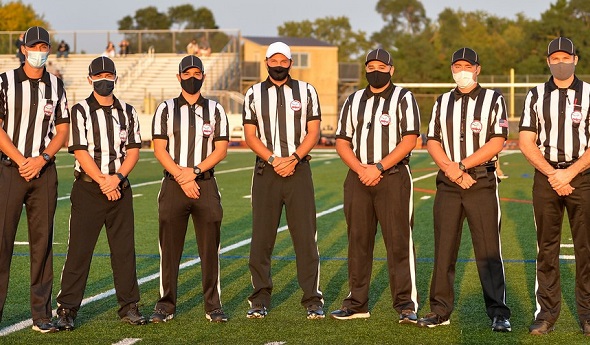
At a time when we continually hear about the aging population of our veteran officials, it is refreshing to have an entire varsity crew made up of officials under 30.
 The MHSAA continues to push to recruit the next generation of officials. Current officials can do their part by signing up someone new each year … and of any age.
We kick of our October installment of “The Official View” with this photo of one of those up-and-coming crews.
Pictured above (left to right) are Nick Wallace, Joey Lapinski, Dan Dobrosielski, Nick Meyer, Zach Ferguson, Austin White and Kevin Klein.
It’s Official!
Postseason assignments: Officials in cross country, football, soccer, swim and volleyball are being notified of their postseason assignments. Especially during a year when it has been difficult to find officials to conduct our sports safely and fairly, we appreciate all of those who have been able to put on the uniforms for both the regular and postseason. For those who were not able to officiate this year, we understand; and we look forward to having you back as soon as we can get back to normal.
Meetings & exams: Rules meetings for winter sports have been released, and tournament exams will soon follow. Please make sure to mark Dec. 10 on your calendar as the date when winter postseason eligibility requirements are due for officials.
Guidelines: Officials for all sports can keep up-to-date on facial covering requirements by CLICKING HERE, and stay current on policies for your specific sport by going to the sport-specific officials page of the MHSAA website.
Know Your Rules
SWIMMING For an event requiring a forward start, a swimmer requests permission to start in the water.
Ruling: This is permissible. In order to remain legal though, the swimmer must enter the pool feet first.
It’s Your Call
Last month’s IYC involved a trick play with Team A players leaving the playing field. First this is a no goal, and each of the players that left without the permission of the official should receive a yellow card. However, since the cards occurred during a stoppage of play, and before the kick was made, Team A retains the corner kick when play resumes.
VOLLEYBALL The newest “It’s Your Call” comes from the volleyball court. Team A’s kill attempt is blocked back to its side of the net. As the ball is about to hit the floor, A13 lunges her leg out and kicks the ball in the air. Then, the libero instinctively kicks her leg out, doing the same. Finally, A3 makes a diving dig back to the other side of the net. The ball lands in, near Team B’s end line. What’s the call?
The Official View: What’s in a Uniform
Officials in most sports are identified by the style of their shirts. Soccer referees are well-known for wearing shirts in a variety of bright, stunning colors. For many years, baseball umpires were so closely identified with the color of their uniform tops, they were (and often still are) contemptibly referred to as “Blue.”
But perhaps there is no more iconic uniform shirt than the black and white stripes worn by officials in a number of sports over the last century. In fact, this easily recognizable pattern associated with referees has its origins in Michigan high school sports.
That’s right, the first reported occurrence of any official wearing stripes goes back to the 1921 Michigan high school basketball finals. That referee was Lloyd Olds, and he was a multi-sport official out of Ypsilanti. The idea came to him following an unfortunate incident in a college football game when the Arizona quarterback mistook Olds as a teammate and threw him the football. You see, the Arizona team wore white uniforms, and were very similar looking to Olds’ own officials uniform – consisting of black slacks and a white dress shirt with bow tie. It became apparent to him that officials should wear a uniform that distinguished them from the teams.
When Olds returned home, he sat down with friend and sporting goods store owner, Greg Moe, to design the first black-and-white striped uniform. He decided to pull the uniform shirt out of the closet for the final game of the high school basketball postseason, and soon began wearing it when he worked both basketball and football.
This new outfit quickly caught on at both the high school and college levels, and it wasn’t long before this became the norm around the world and across all levels. While officials’ uniforms regularly change these days, some form of stripes will likely be around forever – and it all started with a Michigan high school official.
If you have an interesting story or an official you’d like to see promoted, send details and pictures to [email protected].