

Eventually, the sun will shine ...
April 25, 2013
By Geoff Kimmerly
Second Half editor
 We all believe that, right?
Rain – and snow for some – has been the buzzword of this spring sports season. Just about every newspaper is writing about it and every athletic director, coach, player and parent is dreading it on a now-daily basis.
But eventually, we expect the weather to clear up and teams to play catch-up. To that end, there are limitations teams in some sports face when attempting to make up their games – but also opportunities to take advantage of while trying to fill out their regular-season schedules.
- Girls soccer and girls and boys lacrosse teams may play only three games during a week, Monday through Sunday. A weekend tournament – which generally includes 2 to 3 shortened games – counts as only one in this equation.
- Baseball and softball teams can play as many games as they want in a week, but no more than two on a school day – and baseball pitchers must not pitch for two days following their 30th out in a week.
- For tennis, an individual may not play more than three matches in one day – unless she or he is playing in a league championship tournament featuring more than eight schools for which a fourth match would decide the championship. That player also could not have played more than six sets that day heading into that fourth and final match.
- Golf and Track and Field do not have weekly contest limitations. Track and field athletes can compete in only four events per day.
As expected, a number of teams – especially for baseball and softball – are scheduling to smash in as many contests as possible into the next four weeks. Postseason play for tennis and lacrosse begins May 16 – three weeks from today.
But teams do have options.
One rarely used but anticipated to be used more this spring is an opportunity to continue playing regular-season contests through the final day of the MHSAA tournament in that sport. For example, a baseball team can continue making up games through June 15, the day of the MHSAA Finals in Battle Creek. A tennis team can play regular-season matches through June 1, etc.
Also, the MHSAA Executive Committee approved Thursday to allow for this spring two additional multi-team tournament dates for soccer and lacrosse, which will give those teams an opportunity to get in a few more games. That means soccer teams will be allowed to play in four multi-team tournaments instead of two, boys lacrosse four instead of two and girls lacrosse five instead of three.
Teams will have to do some juggling, no doubt, and all other tournament stipulations still apply (games generally are shortened so more can be played, etc.). But with a little creativity, teams could at least get in a few of their make-up games in this way.
Also, the Executive Committee approved a motion to waive the four-contest MHSAA tournament entry requirement for all Upper Peninsula schools in all sports this spring. As of the weekend, snow still covered parts of the U.P.
Gaps shrinking
Much has been discussed about minimums for all four MHSAA classes for 2013-14, and how they are the lowest student totals in at least a decade.
It’s true. The floor in Class A is 893 (down from 911 this school year), Class B starts at 429 (down from 449), Class C at 207 (down from 217) and Class D at 206 (down from 216).
However, there is a better way to crunch the numbers: Consider the shrinking gaps between the largest and smallest schools in each class.
For 2013-14, the gap in Class A is 1,888 students – 261 students fewer than 2007-08 and nearly 900 students fewer than in 2005-06. The gaps between largest and smallest in Classes B, C and D also are trending smaller – which means each class actually includes schools more similar in size, instead of a perceived other way around.
SAC 2013-14 on the way
We’re thankful for a valuable group of students who help us throughout the school year – our 16-member Student Advisory Council, made up of eight seniors and eight juniors from all over the state who are charged with providing feedback on issues impacting educational athletics from a student’s perspective, while also assisting at MHSAA championships and with special projects like the “Battle of the Fans.”
Selecting the next class to join is a highlight of every spring – but hardly an easy process.
A six-member selection committee, myself included, considered 62 sophomore applicants today from all over the Lower and Upper Peninsulas, representing all four of our classes and nearly every sport we sponsor.
Every candidate is impressive for a variety of reasons. That’s what makes this difficult – we could pick any number of combinations to make up our new SAC class, and no doubt leaders galore will emerge from another impressive group.
But there are only eight spots on the council. And we’ll announce who received them later next week.
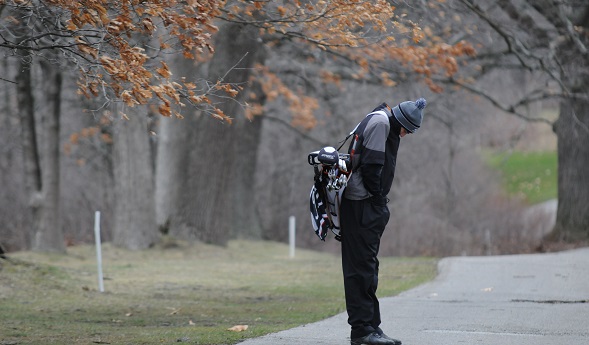
PHOTO: A golfer attempts to keep warm during a round on a dreary day earlier this season. (Click to see more at HighSchoolSportsScene.com.)
Fall 2020 to Proceed with Fall Sports
July 17, 2020
By Geoff Kimmerly
Second Half editor
Michigan High School Athletic Association member schools will begin the 2020-21 school year playing Fall sports as traditionally scheduled, but with contingency concepts for potential interruptions due to the spread of COVID-19.
The MHSAA Representative Council, the Association’s 19-member legislative body, met virtually with MHSAA staff Wednesday (July 15) to discuss a series of ideas for playing sports beginning in August. The Council will meet again July 29 for further discussion. Currently, high school football practices are scheduled to begin Aug. 10, with all other Fall sports to start practice Aug. 12.
The MHSAA is moving forward with a plan that first calls for all Fall sports to be started and played as scheduled. However, if the situation deems it necessary, the start of some or all Fall sports practices or competitions could be delayed. The next step in the plan’s progression calls for lower-risk Fall sports that can be played to be completed, with higher-risk Fall sports postponed until later in the school year. If all Fall sports must be suspended, they will be rescheduled during a reconfigured calendar that would see Winter sports begin in November followed by the conclusion of Fall and Spring seasons potentially extending into July 2021.
Additionally, the Council considered a concept that would swap traditional Fall and Spring sports, but determined that was not a feasible plan. Football, girls volleyball, girls swimming & diving and boys soccer during the Fall are considered moderate or high-risk sports because they include athletes in close contact or are played indoors; they were considered the impetus for potentially switching all Fall sports to Spring. But traditional Spring sports – girls soccer and girls and boys lacrosse – carry similar risk, negating the value of making that full season switch. Moving only selected Spring sports, like all low-risk to Fall, was not considered sound because it would force student-athletes to pick between sports they’ve previously played.
Plans remain reliant on progression by schools and regions across the state according to Governor Gretchen Whitmer’s MI Safe Start Plan. Currently two regions are in Phase 5, which allow for limited indoor activity, while the rest are in Phase 4 and unable to host indoor training, practice or competition.
“Our student-athletes just want to play, and we’ve gone far too long without them playing. But doing so safely, of course, remains the priority,” MHSAA Executive Director Mark Uyl said. “Our plan moving forward is Fall in the Fall, starting on time. We’re excited to continue moving forward to bring back sports safely. It’s important for keeping students in our schools and keeping students in our sports programs.
“We remain grateful to the Governor for the opportunity to build the schedule and policies for returning sports to schools. We will continue to support her directives and those of the state and local health departments as we work to create the safest environment for all involved in our activities.”
The MHSAA staff is building COVID-related policies for all Fall sports and will make those guidelines and precautions available to member schools as the season approaches. Those policies will follow up what was presented to schools for summer offseason training, which began June 1 across the state and has seen thousands of student-athletes participate.
The MHSAA is a private, not-for-profit corporation of voluntary membership by more than 1,500 public and private senior high schools and junior high/middle schools which exists to develop common rules for athletic eligibility and competition. No government funds or tax dollars support the MHSAA, which was the first such association nationally to not accept membership dues or tournament entry fees from schools. Member schools which enforce these rules are permitted to participate in MHSAA tournaments, which attract more than 1.4 million spectators each year.