

Eventually, the sun will shine ...
April 25, 2013
By Geoff Kimmerly
Second Half editor
 We all believe that, right?
Rain – and snow for some – has been the buzzword of this spring sports season. Just about every newspaper is writing about it and every athletic director, coach, player and parent is dreading it on a now-daily basis.
But eventually, we expect the weather to clear up and teams to play catch-up. To that end, there are limitations teams in some sports face when attempting to make up their games – but also opportunities to take advantage of while trying to fill out their regular-season schedules.
- Girls soccer and girls and boys lacrosse teams may play only three games during a week, Monday through Sunday. A weekend tournament – which generally includes 2 to 3 shortened games – counts as only one in this equation.
- Baseball and softball teams can play as many games as they want in a week, but no more than two on a school day – and baseball pitchers must not pitch for two days following their 30th out in a week.
- For tennis, an individual may not play more than three matches in one day – unless she or he is playing in a league championship tournament featuring more than eight schools for which a fourth match would decide the championship. That player also could not have played more than six sets that day heading into that fourth and final match.
- Golf and Track and Field do not have weekly contest limitations. Track and field athletes can compete in only four events per day.
As expected, a number of teams – especially for baseball and softball – are scheduling to smash in as many contests as possible into the next four weeks. Postseason play for tennis and lacrosse begins May 16 – three weeks from today.
But teams do have options.
One rarely used but anticipated to be used more this spring is an opportunity to continue playing regular-season contests through the final day of the MHSAA tournament in that sport. For example, a baseball team can continue making up games through June 15, the day of the MHSAA Finals in Battle Creek. A tennis team can play regular-season matches through June 1, etc.
Also, the MHSAA Executive Committee approved Thursday to allow for this spring two additional multi-team tournament dates for soccer and lacrosse, which will give those teams an opportunity to get in a few more games. That means soccer teams will be allowed to play in four multi-team tournaments instead of two, boys lacrosse four instead of two and girls lacrosse five instead of three.
Teams will have to do some juggling, no doubt, and all other tournament stipulations still apply (games generally are shortened so more can be played, etc.). But with a little creativity, teams could at least get in a few of their make-up games in this way.
Also, the Executive Committee approved a motion to waive the four-contest MHSAA tournament entry requirement for all Upper Peninsula schools in all sports this spring. As of the weekend, snow still covered parts of the U.P.
Gaps shrinking
Much has been discussed about minimums for all four MHSAA classes for 2013-14, and how they are the lowest student totals in at least a decade.
It’s true. The floor in Class A is 893 (down from 911 this school year), Class B starts at 429 (down from 449), Class C at 207 (down from 217) and Class D at 206 (down from 216).
However, there is a better way to crunch the numbers: Consider the shrinking gaps between the largest and smallest schools in each class.
For 2013-14, the gap in Class A is 1,888 students – 261 students fewer than 2007-08 and nearly 900 students fewer than in 2005-06. The gaps between largest and smallest in Classes B, C and D also are trending smaller – which means each class actually includes schools more similar in size, instead of a perceived other way around.
SAC 2013-14 on the way
We’re thankful for a valuable group of students who help us throughout the school year – our 16-member Student Advisory Council, made up of eight seniors and eight juniors from all over the state who are charged with providing feedback on issues impacting educational athletics from a student’s perspective, while also assisting at MHSAA championships and with special projects like the “Battle of the Fans.”
Selecting the next class to join is a highlight of every spring – but hardly an easy process.
A six-member selection committee, myself included, considered 62 sophomore applicants today from all over the Lower and Upper Peninsulas, representing all four of our classes and nearly every sport we sponsor.
Every candidate is impressive for a variety of reasons. That’s what makes this difficult – we could pick any number of combinations to make up our new SAC class, and no doubt leaders galore will emerge from another impressive group.
But there are only eight spots on the council. And we’ll announce who received them later next week.
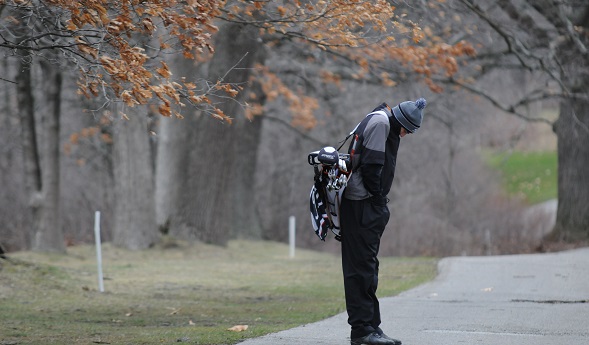
PHOTO: A golfer attempts to keep warm during a round on a dreary day earlier this season. (Click to see more at HighSchoolSportsScene.com.)
MHSAA Provides Reopening Guidelines
May 29, 2020
By Geoff Kimmerly
Second Half editor
The Michigan High School Athletic Association today submitted to its member schools a series of updated timelines and recommendations to guide the return of sports, which have been suspended since mid-March to alleviate the potential spread of COVID-19.
The state’s current “Safer-at-Home” order runs through Friday, June 12. There can be no use of any school facilities (indoor and outdoor) and there can be no organized on-site athletic activity, including conditioning or competition, until the current stay-at-home order expires or is lifted by Governor Gretchen Whitmer. When the “Safer-at-Home” order expires or is lifted, the return-to-activity recommendations may be implemented locally by school district leadership, provided the district declares its facilities open to students and staff and the 2019-20 school year has ended for that district (based on its last originally-scheduled school day).
The “MHSAA/NFHS Guidance for Re-Opening School Sports” is based primarily on direction provided by the MHSAA and National Federation of State High School Associations’ (NFHS) Sports Medicine Advisory Committees, in addition to reopening plans provided by the Michigan and federal governments and recommendations from the Center for Disease Control and Prevention (CDC). Concepts from the United States Olympic & Paralympic Committee also were consulted.
The MHSAA/NFHS plan recommends a three-step process to returning to full athletic participation, and for each step outlines actions to be taken in five major areas: pre-workout/contest screening of athletes and coaches for sickness, limitations of the number of participants who may be involved in a gathering, proper cleaning for facilities, the use of equipment during activity and best practices for keeping participants safely hydrated. The plan also places sports into categories based on risk for transmitting the virus (low/moderate/high), with adjusted return-to-activity steps based on that level of risk.
The MHSAA serves more than 1,500 public and private schools, including 750 high schools.
“The MHSAA and its Representative Council believe restarting school sports is essential to the physical and mental well-being of students, and the guidelines outlined for schools today provide the ‘How’ for schools to return to athletics when they’ve received the go-ahead from state and county health officials,” MHSAA Executive Director Mark Uyl said. “We are thankful for our state government, state education and health departments, our medical partners and the NFHS for their guidance these last few months, and we will continue to follow and pass on their recommendations as we prepare our schools to bring back this part of student life that’s been sorely missed.”
At the present time, the only activity allowed continues to be individual, outdoor recreational activity including walking, hiking, running, etc. (as announced in Executive Order 2020-96). If this type of conditioning activity takes place with more than one person present, it must be in groups of fewer than 10 people with social distancing followed, and the activity cannot involve school coaches, be school sponsored or occur at any school facility (indoor or outdoor) until at least June 13.
Voluntary virtual (not in-person) communication and instruction from coaches to any number of students is permitted under MHSAA rules in all sports during the summer.
“The concept is that students can continue to individually condition themselves (by walking, hiking, running), but there should be no organized, group activity by any person until at least June 13. We must all continue do our part to flatten the curve in hopes of increased activity over the coming weeks,” Uyl said. “Again, it is important to note that this document addresses ‘How’ schools can return to activity; the decision on ‘When’ schools can return to activity will be done under the direction of state government and health department officials. As government actions impact this timeline, the MHSAA will continue to update all involved.”
The return-to-activity guidelines are aimed to provide direction for schools as they continue to limit potential exposure to respiratory droplets, the primary avenue for transferring COVID-19. Specifically, the MHSAA/NFHS plan addresses social distancing, use of cloth and other face coverings, event scheduling and transportation, and the possibility that schools may have to break from or completely discontinue activity including competition during the fall or winter because of recurrent outbreaks of the coronavirus.
School district administrators will determine at which step in the MHSAA/NFHS plan their schools are operating based on the number of people allowed to gather by state medical officials.
The document in full is available from the MHSAA Website. Further guidance will be provided over the weeks ahead as new information is available and the prevalence of COVID-19 changes. Updates to the MHSAA/NFHS guidelines will continue to be in accordance with those published by the Governor’s office.
The MHSAA has remained in regular contact with the Governor’s office, Michigan Department of Health & Human Services and Michigan Department of Education throughout the pandemic, in addition to leadership from the state’s superintendents, school principals, athletic administrators and school boards associations.
The MHSAA is a private, not-for-profit corporation of voluntary membership by more than 1,500 public and private senior high schools and junior high/middle schools which exists to develop common rules for athletic eligibility and competition. No government funds or tax dollars support the MHSAA, which was the first such association nationally to not accept membership dues or tournament entry fees from schools. Member schools which enforce these rules are permitted to participate in MHSAA tournaments, which attract more than 1.4 million spectators each year.