

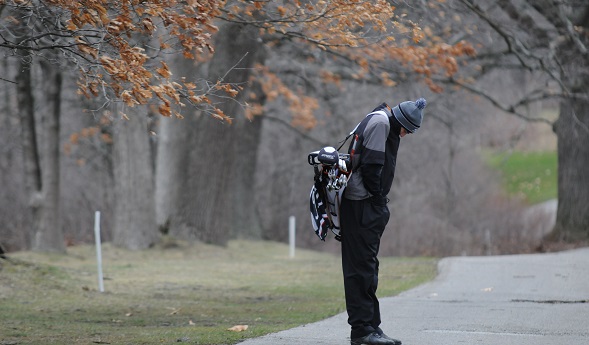
Eventually, the sun will shine ...
April 25, 2013
By Geoff Kimmerly
Second Half editor
 We all believe that, right?
Rain – and snow for some – has been the buzzword of this spring sports season. Just about every newspaper is writing about it and every athletic director, coach, player and parent is dreading it on a now-daily basis.
But eventually, we expect the weather to clear up and teams to play catch-up. To that end, there are limitations teams in some sports face when attempting to make up their games – but also opportunities to take advantage of while trying to fill out their regular-season schedules.
- Girls soccer and girls and boys lacrosse teams may play only three games during a week, Monday through Sunday. A weekend tournament – which generally includes 2 to 3 shortened games – counts as only one in this equation.
- Baseball and softball teams can play as many games as they want in a week, but no more than two on a school day – and baseball pitchers must not pitch for two days following their 30th out in a week.
- For tennis, an individual may not play more than three matches in one day – unless she or he is playing in a league championship tournament featuring more than eight schools for which a fourth match would decide the championship. That player also could not have played more than six sets that day heading into that fourth and final match.
- Golf and Track and Field do not have weekly contest limitations. Track and field athletes can compete in only four events per day.
As expected, a number of teams – especially for baseball and softball – are scheduling to smash in as many contests as possible into the next four weeks. Postseason play for tennis and lacrosse begins May 16 – three weeks from today.
But teams do have options.
One rarely used but anticipated to be used more this spring is an opportunity to continue playing regular-season contests through the final day of the MHSAA tournament in that sport. For example, a baseball team can continue making up games through June 15, the day of the MHSAA Finals in Battle Creek. A tennis team can play regular-season matches through June 1, etc.
Also, the MHSAA Executive Committee approved Thursday to allow for this spring two additional multi-team tournament dates for soccer and lacrosse, which will give those teams an opportunity to get in a few more games. That means soccer teams will be allowed to play in four multi-team tournaments instead of two, boys lacrosse four instead of two and girls lacrosse five instead of three.
Teams will have to do some juggling, no doubt, and all other tournament stipulations still apply (games generally are shortened so more can be played, etc.). But with a little creativity, teams could at least get in a few of their make-up games in this way.
Also, the Executive Committee approved a motion to waive the four-contest MHSAA tournament entry requirement for all Upper Peninsula schools in all sports this spring. As of the weekend, snow still covered parts of the U.P.
Gaps shrinking
Much has been discussed about minimums for all four MHSAA classes for 2013-14, and how they are the lowest student totals in at least a decade.
It’s true. The floor in Class A is 893 (down from 911 this school year), Class B starts at 429 (down from 449), Class C at 207 (down from 217) and Class D at 206 (down from 216).
However, there is a better way to crunch the numbers: Consider the shrinking gaps between the largest and smallest schools in each class.
For 2013-14, the gap in Class A is 1,888 students – 261 students fewer than 2007-08 and nearly 900 students fewer than in 2005-06. The gaps between largest and smallest in Classes B, C and D also are trending smaller – which means each class actually includes schools more similar in size, instead of a perceived other way around.
SAC 2013-14 on the way
We’re thankful for a valuable group of students who help us throughout the school year – our 16-member Student Advisory Council, made up of eight seniors and eight juniors from all over the state who are charged with providing feedback on issues impacting educational athletics from a student’s perspective, while also assisting at MHSAA championships and with special projects like the “Battle of the Fans.”
Selecting the next class to join is a highlight of every spring – but hardly an easy process.
A six-member selection committee, myself included, considered 62 sophomore applicants today from all over the Lower and Upper Peninsulas, representing all four of our classes and nearly every sport we sponsor.
Every candidate is impressive for a variety of reasons. That’s what makes this difficult – we could pick any number of combinations to make up our new SAC class, and no doubt leaders galore will emerge from another impressive group.
But there are only eight spots on the council. And we’ll announce who received them later next week.
PHOTO: A golfer attempts to keep warm during a round on a dreary day earlier this season. (Click to see more at HighSchoolSportsScene.com.)

Put a Stop to Recurring Injuries
May 5, 2020
 By Nick Parkinson, M.Ed., AT, ATC, TSAC-F
Henry Ford Health System
Recurring injuries happen — and they're especially common among single-sport athletes or people who focus on one type of exercise, like runners. The reason: You're working the same muscles repeatedly. The end result: Your joints, muscles and tissues get worn out.
Breaking Down Recurring Injuries
Overuse injuries are a big deal. Continuing to re-injure the same muscle groups can take you out of the game entirely and limit your ability to participate in other activities. Here's what you need to know about these all-to-common ailments:
What are Recurring Injuries?
Recurring injuries, also called repetitive and overuse injuries, are injuries that happen repeatedly in the same location. Think along the lines of tendinitis, stress fractures, shin splints and even carpal tunnel syndrome. Common sites include ankles, knees, hips and shoulders.
Who is at Risk for Repetitive Injuries?
Overuse injuries can happen to anyone, but they're more likely to occur among workers who do repetitive motions and single-sport athletes. The risk of these injuries also increases with age. They're more likely to occur if you don't recognize the impact aging can have on your muscles, joints and tissues and modify your activities accordingly.
Why Do Recurring Injuries Happen?
Recurring injuries happen when you overuse the same muscles without sufficient recovery. It's simple body mechanics: If you continue using compromised muscles, you're more likely to get reinjured. And once you get stuck in that same biomechanic loop, it's nearly impossible to recover without changing your routine and learning new techniques.
How Can You Prevent Recurring Injuries?
All sports have a risk of injury. The key is paying attention to your body and taking the appropriate steps to minimize your risk. Here's how:
• Use appropriate gear. Make sure you're wearing appropriate protective gear for the activity you're participating in and choose the right footwear.
• Alternate muscle groups. Instead of focusing on one type of exercise, switch things up. Incorporate low-impact activities, such as swimming, biking and water sports, and make sure you're not overloading any particular muscle group.
• Take rest days. It's important to give your muscles, joints and tissues time to recover. Two days of rest each week is best. If you play a sport, plan to have at least one off day per week and at least one month off per year.
• Strengthen muscles. Conditioning exercises can help strengthen the muscles you need to perform various activities.
• Use proper form. Overuse injuries are sometimes related to improper form during activity. Work with a professional to ensure you're using proper body mechanics and get back to your usual activities gradually.
Play it Safe
The best way to avoid recurrent injuries is to not get injured in the first place. Recover during the season — even if it means missing out on some play. It's better to show up to a game healthy but undertrained than to power through an injury and risk reinjury.
Talk to your doctor before starting a new activity or ramping up your current routine. If you're at risk of developing a recurrent injury, a professional can provide you with a workout regimen that can help prevent injury.
Most important: Don't let an overuse injury prevent you from being physically active. Instead, listen to your body, consult a professional and pace yourself. Treatment may involve avoiding a specific activity for a period of time, along with hot and cold therapy, massage and focused rehabilitation.
Nick Parkinson, M.Ed., AT, ATC, TSAC-F, is the Supervisor of Athletic Training with Henry Ford Sports Medicine and also leads Sports Performance training at the William Clay Ford Center for Athletic Medicine. Learn more about Nick.
Want to learn more? Henry Ford Health System sports medicine experts are treating the whole athlete, in a whole new way. From nutrition to neurology, and from injury prevention to treatment of sports-related conditions, they can give your athlete a unique game plan.
Visit henryford.com/sports or call (313) 972-4216 for an appointment within 24 business hours.