

Eventually, the sun will shine ...
April 25, 2013
By Geoff Kimmerly
Second Half editor
 We all believe that, right?
Rain – and snow for some – has been the buzzword of this spring sports season. Just about every newspaper is writing about it and every athletic director, coach, player and parent is dreading it on a now-daily basis.
But eventually, we expect the weather to clear up and teams to play catch-up. To that end, there are limitations teams in some sports face when attempting to make up their games – but also opportunities to take advantage of while trying to fill out their regular-season schedules.
- Girls soccer and girls and boys lacrosse teams may play only three games during a week, Monday through Sunday. A weekend tournament – which generally includes 2 to 3 shortened games – counts as only one in this equation.
- Baseball and softball teams can play as many games as they want in a week, but no more than two on a school day – and baseball pitchers must not pitch for two days following their 30th out in a week.
- For tennis, an individual may not play more than three matches in one day – unless she or he is playing in a league championship tournament featuring more than eight schools for which a fourth match would decide the championship. That player also could not have played more than six sets that day heading into that fourth and final match.
- Golf and Track and Field do not have weekly contest limitations. Track and field athletes can compete in only four events per day.
As expected, a number of teams – especially for baseball and softball – are scheduling to smash in as many contests as possible into the next four weeks. Postseason play for tennis and lacrosse begins May 16 – three weeks from today.
But teams do have options.
One rarely used but anticipated to be used more this spring is an opportunity to continue playing regular-season contests through the final day of the MHSAA tournament in that sport. For example, a baseball team can continue making up games through June 15, the day of the MHSAA Finals in Battle Creek. A tennis team can play regular-season matches through June 1, etc.
Also, the MHSAA Executive Committee approved Thursday to allow for this spring two additional multi-team tournament dates for soccer and lacrosse, which will give those teams an opportunity to get in a few more games. That means soccer teams will be allowed to play in four multi-team tournaments instead of two, boys lacrosse four instead of two and girls lacrosse five instead of three.
Teams will have to do some juggling, no doubt, and all other tournament stipulations still apply (games generally are shortened so more can be played, etc.). But with a little creativity, teams could at least get in a few of their make-up games in this way.
Also, the Executive Committee approved a motion to waive the four-contest MHSAA tournament entry requirement for all Upper Peninsula schools in all sports this spring. As of the weekend, snow still covered parts of the U.P.
Gaps shrinking
Much has been discussed about minimums for all four MHSAA classes for 2013-14, and how they are the lowest student totals in at least a decade.
It’s true. The floor in Class A is 893 (down from 911 this school year), Class B starts at 429 (down from 449), Class C at 207 (down from 217) and Class D at 206 (down from 216).
However, there is a better way to crunch the numbers: Consider the shrinking gaps between the largest and smallest schools in each class.
For 2013-14, the gap in Class A is 1,888 students – 261 students fewer than 2007-08 and nearly 900 students fewer than in 2005-06. The gaps between largest and smallest in Classes B, C and D also are trending smaller – which means each class actually includes schools more similar in size, instead of a perceived other way around.
SAC 2013-14 on the way
We’re thankful for a valuable group of students who help us throughout the school year – our 16-member Student Advisory Council, made up of eight seniors and eight juniors from all over the state who are charged with providing feedback on issues impacting educational athletics from a student’s perspective, while also assisting at MHSAA championships and with special projects like the “Battle of the Fans.”
Selecting the next class to join is a highlight of every spring – but hardly an easy process.
A six-member selection committee, myself included, considered 62 sophomore applicants today from all over the Lower and Upper Peninsulas, representing all four of our classes and nearly every sport we sponsor.
Every candidate is impressive for a variety of reasons. That’s what makes this difficult – we could pick any number of combinations to make up our new SAC class, and no doubt leaders galore will emerge from another impressive group.
But there are only eight spots on the council. And we’ll announce who received them later next week.
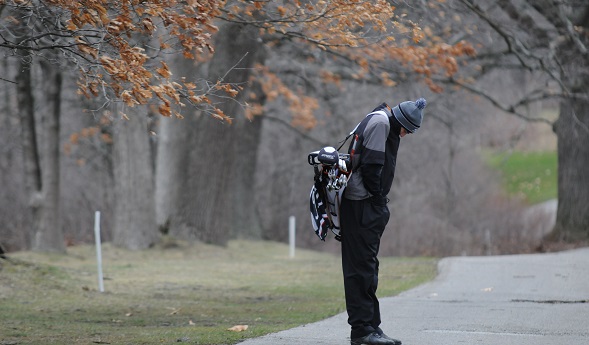
PHOTO: A golfer attempts to keep warm during a round on a dreary day earlier this season. (Click to see more at HighSchoolSportsScene.com.)

NFHS Voice: Good Time to Appreciate Officials
April 9, 2020
By Karissa Niehoff
NFHS Executive Director
During this shutdown of normal life in our nation, we are learning to deal with a new challenge – how to handle the unexpected time on our hands at home. Simply keeping up with the days of the week is a major accomplishment!
While we anxiously await the re-opening of schools and a return of high school sports and performing arts, this down time can be used in positive ways to take advantage of educational opportunities. And kudos to some individuals who already are seizing those opportunities – men and women who officiate high school sports.
Two weeks ago, we began to offer the 11 officiating courses on the NFHS Learning Center free of charge, and the response has been nothing short of amazing. By the end of March – merely a week into this new opportunity – more than 5,200 courses had been taken.
In addition to veteran officials fine-tuning techniques in one or more of the seven sports featured in these courses, this has been a great opportunity for individuals interested in officiating to take a free course to determine their interest level.
Those of us in leadership positions are so appreciative of these individuals who give freely of their free time to officiate high school sports or adjudicate music contests. We would suggest that everyone – student-athletes, coaches, parents and other fans – use this down time to do the same.
At various times this year before the shutdown of schools, officials have been the victim of verbal and physical abuse. Inappropriate behavior by parents and other fans was causing officials to quit before they even reached two years on the job.
And yet, in the past three years, more than 35,000 individuals have signed up to become officials through the NFHS’ #BecomeAnOfficial campaign and 5,200 courses that have been taken in the past couple of weeks by men and women who want to give back to high school sports. These are good signs more people will continue to be involved in officiating when the games return.
But what about the parents and other fans in the stands? Will their behavior be changed upon return? The conclusion of the New Mexico Activities Association’s state basketball tournament last month provided an interesting perspective on the impact of fans to the atmosphere at high school sporting events.
After completing the first two days of its state tournament with fans in the stands, the NMAA conducted the final three days without fans because of concerns about the spread of the COVID-19 virus. Dana Pappas, commissioner of officials for the NMAA, noted the following about the final three days of competition:
“Officials would make a call and if coaches had a question about it, they asked – calmly and respectfully. In huddles during time-outs, coaches just talked to their players, without raised voices. The behavior of coaches on the sidelines from Thursday through Saturday was in stark contrast to what we witnessed on Tuesday and Wednesday. Perhaps they did not feel the need to be overly emotional for the benefit of their fans.
“My hope is that the absence of sport throughout the world gives us all a moment to gain perspective and do a ‘gut check’ as to the kind of fans we are at contests. If the quality of the game is unchanged (or even better) without fans there to scream at the coaches, officials and players, then is that behavior really necessary when the games resume?”
The message here is that while the games can continue without fans, the ideal situation is for stands full of fans positively cheering for their teams.
Dr. Karissa L. Niehoff is in her second year as executive director of the National Federation of State High School Associations (NFHS) in Indianapolis, Indiana. She is the first female to head the national leadership organization for high school athletics and performing arts activities and the sixth full-time executive director of the NFHS, which celebrated its 100th year of service during the 2018-19 school year. She previously was executive director of the Connecticut Association of Schools-Connecticut Interscholastic Athletic Conference for seven years.