

Eventually, the sun will shine ...
April 25, 2013
By Geoff Kimmerly
Second Half editor
 We all believe that, right?
Rain – and snow for some – has been the buzzword of this spring sports season. Just about every newspaper is writing about it and every athletic director, coach, player and parent is dreading it on a now-daily basis.
But eventually, we expect the weather to clear up and teams to play catch-up. To that end, there are limitations teams in some sports face when attempting to make up their games – but also opportunities to take advantage of while trying to fill out their regular-season schedules.
- Girls soccer and girls and boys lacrosse teams may play only three games during a week, Monday through Sunday. A weekend tournament – which generally includes 2 to 3 shortened games – counts as only one in this equation.
- Baseball and softball teams can play as many games as they want in a week, but no more than two on a school day – and baseball pitchers must not pitch for two days following their 30th out in a week.
- For tennis, an individual may not play more than three matches in one day – unless she or he is playing in a league championship tournament featuring more than eight schools for which a fourth match would decide the championship. That player also could not have played more than six sets that day heading into that fourth and final match.
- Golf and Track and Field do not have weekly contest limitations. Track and field athletes can compete in only four events per day.
As expected, a number of teams – especially for baseball and softball – are scheduling to smash in as many contests as possible into the next four weeks. Postseason play for tennis and lacrosse begins May 16 – three weeks from today.
But teams do have options.
One rarely used but anticipated to be used more this spring is an opportunity to continue playing regular-season contests through the final day of the MHSAA tournament in that sport. For example, a baseball team can continue making up games through June 15, the day of the MHSAA Finals in Battle Creek. A tennis team can play regular-season matches through June 1, etc.
Also, the MHSAA Executive Committee approved Thursday to allow for this spring two additional multi-team tournament dates for soccer and lacrosse, which will give those teams an opportunity to get in a few more games. That means soccer teams will be allowed to play in four multi-team tournaments instead of two, boys lacrosse four instead of two and girls lacrosse five instead of three.
Teams will have to do some juggling, no doubt, and all other tournament stipulations still apply (games generally are shortened so more can be played, etc.). But with a little creativity, teams could at least get in a few of their make-up games in this way.
Also, the Executive Committee approved a motion to waive the four-contest MHSAA tournament entry requirement for all Upper Peninsula schools in all sports this spring. As of the weekend, snow still covered parts of the U.P.
Gaps shrinking
Much has been discussed about minimums for all four MHSAA classes for 2013-14, and how they are the lowest student totals in at least a decade.
It’s true. The floor in Class A is 893 (down from 911 this school year), Class B starts at 429 (down from 449), Class C at 207 (down from 217) and Class D at 206 (down from 216).
However, there is a better way to crunch the numbers: Consider the shrinking gaps between the largest and smallest schools in each class.
For 2013-14, the gap in Class A is 1,888 students – 261 students fewer than 2007-08 and nearly 900 students fewer than in 2005-06. The gaps between largest and smallest in Classes B, C and D also are trending smaller – which means each class actually includes schools more similar in size, instead of a perceived other way around.
SAC 2013-14 on the way
We’re thankful for a valuable group of students who help us throughout the school year – our 16-member Student Advisory Council, made up of eight seniors and eight juniors from all over the state who are charged with providing feedback on issues impacting educational athletics from a student’s perspective, while also assisting at MHSAA championships and with special projects like the “Battle of the Fans.”
Selecting the next class to join is a highlight of every spring – but hardly an easy process.
A six-member selection committee, myself included, considered 62 sophomore applicants today from all over the Lower and Upper Peninsulas, representing all four of our classes and nearly every sport we sponsor.
Every candidate is impressive for a variety of reasons. That’s what makes this difficult – we could pick any number of combinations to make up our new SAC class, and no doubt leaders galore will emerge from another impressive group.
But there are only eight spots on the council. And we’ll announce who received them later next week.
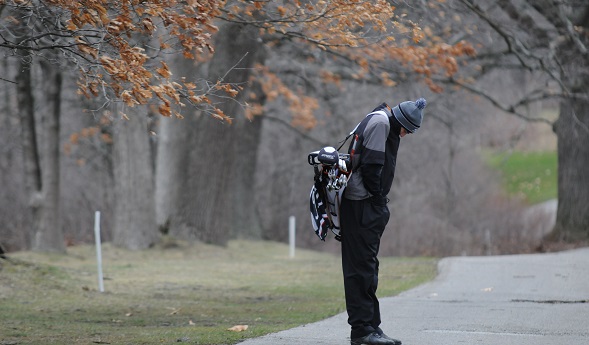
PHOTO: A golfer attempts to keep warm during a round on a dreary day earlier this season. (Click to see more at HighSchoolSportsScene.com.)
Adjust Your Workout When Gym Isn't Option
April 6, 2020

Henry Ford Health System
Feeling at a loss about not being able to stick to your normal workout routine? You’re not alone.
Social distancing during the COVID-19 outbreak has resulted in people all over the world having to adjust their schedules to accommodate working from home, schooling and caring for kids, and finding ways to maintain as much of a “normal” schedule as possible.
As a result, many people are struggling to figure out how to get a good workout in without the help of gym equipment or a personal trainer.
“Anxiety over the current situation can add to a lack of motivation to work out,” says Brianna Gauna, an athletic trainer for Henry Ford Health System. “But just remember how beneficial it is to move your body, even if it is just around the house.”
How a Routine Change Affects Your Body
If you are used to working out every day or going hard at the gym on a regular basis, a short rest period from your routine might have its advantages.
“Taking time to rest can actually be a really good thing because it allows your body to recover,” says Gauna. “You might even start to see more muscle tone set in as you give your body a break.”
On the other hand, if you usually work out a few times throughout the week and suddenly stop, the results may cause negative effects. You may experience:
- Increased resting heart rate
- Less energy
- Change in mood or emotions
- Loss of sleep
How to Work Out at Home
Being stuck at home is not an excuse to skip a daily workout. Everyone works out a little differently, and there are plenty of options for you to stay active and try out new forms of exercise.
“Whether you are used to strength training or cardio, think about what your fitness goals are and choose activities based on what you’d like to achieve,” says Gauna.
Here are some ideas to keep you and your family active:
1. Yoga. Practicing yoga requires a great deal of muscle strength and balance. It is best for a full body workout. Look to YouTube or free apps on your phone for beginner workout videos that you can follow along.
2. HIIT workouts. These workouts are best for getting your heart pumping and increasing your stamina. Try choosing four exercises from the following list. (Search YouTube or Google for examples if you are not sure what each of these entails.) Do one exercise at a time for 30 seconds and then give yourself 20 seconds of rest before moving on to the next exercise. After you get through one rotation of those exercises, repeat three more times.
- Squats
- Push-ups
- Lunges
- Burpees
- Mountain climbers
- Glute bridges
3. Running or walking. Many apps allow you to track your run on a map, so you can plan out your route in your own neighborhood. This allows you to adjust how far you run or how much time you have for a run. A brisk walk through the neighborhood also works.
4. Biking. Biking is a great low-impact workout that works to engage and tone leg muscles. (Remember to wear a helmet!)
5. Team sports. If you are looking for something to engage you and your family, team sports are the way to go. Kick a soccer ball around, try to race through an obstacle course while dribbling a basketball or take turns throwing a football. If you don’t have the equipment, try playing keep-away with a stuffed animal or set up a relay race.
Exercise by Age and Fitness Level
The younger you are, chances are you have a faster metabolism. If you can’t get to a gym, think about how active you usually are and gauge the length of your workout from there.
If you are using this time to get started on your fitness journey, use these recommendations as a starting point:
Ages 7-17: 1-2 hours. Athletes that are used to going to weekly practices may find that two-hour workouts are more suitable.
Ages 18-30: About an hour. Look for times throughout the day that you can squeeze in workouts. Maybe you do yoga in the morning, a HIIT workout in the afternoon and a walk after dinner.
Ages 31-49: About a half hour. If you have children or a pet, you may find that you are already spending more time being active than this!
Ages 50 and up: At least 10-15 minutes. Gauge this based on your own abilities. You may live a more active lifestyle that allows you to be very active throughout the day. If you find yourself struggling to meet this mark, consider a walk during the day or stretches in the morning.
Once you get a regular fitness routine in place, work your way up to longer or more intense workouts to keep yourself challenged.
Making Your Own Equipment
If you have a treadmill, stationary bike or elliptical machine at home, now is the time to clear off the laundry it may have been collecting. If you don’t have access to weights or other gym equipment, though, that doesn’t mean you have to miss out on a quality workout. Look for things around your house that you can use in their place – get creative!
- Bags of beans, rice or pet food as added weight for squats or lunges
- Old books/textbooks as dumbbells
- A chair for triceps dips, calf raises or for stability during yoga
- Stairs to run sprints or to help you stretch out leg muscles
When your day-to-day routine is shaken up, do what you can to create normalcy in your life. If you find you have more free time throughout the day, take that time to get moving – even if it’s running up and down the stairs or going for a walk around the block.
“Don’t worry about feeling silly for switching up your routine,” adds Gauna. “Whether that’s using a random object for added weight during a workout or trying to remember how to ride a bike again on your street, think about yourself and your fitness goals first. Don’t let thoughts of what other people think of you get in the way of you reaching your goals!”
Want to learn more? Henry Ford Health System sports medicine experts are treating the whole athlete, in a whole new way. From nutrition to neurology, and from injury prevention to treatment of sports-related conditions, they can give your athlete a unique game plan.
Visit henryford.com/sports or call (313) 972-4216 for an appointment within 24 business hours.
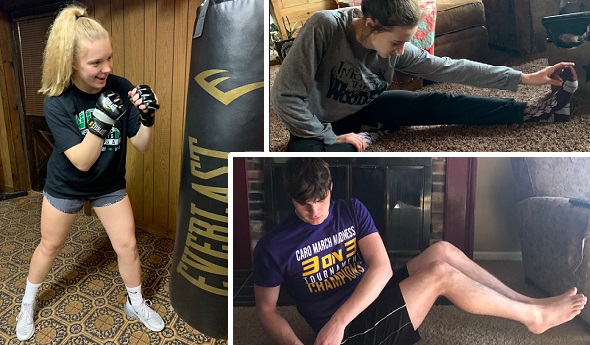
PHOTOS: (Clockwise from left) MHSAA Student Advisory Council members Abigail Pheiffer of Novi, Lydia Davenport of Ithaca and Trevin Phillips of Caro will be working to stay in shape while staying home these next many weeks.