

Eventually, the sun will shine ...
April 25, 2013
By Geoff Kimmerly
Second Half editor
 We all believe that, right?
Rain – and snow for some – has been the buzzword of this spring sports season. Just about every newspaper is writing about it and every athletic director, coach, player and parent is dreading it on a now-daily basis.
But eventually, we expect the weather to clear up and teams to play catch-up. To that end, there are limitations teams in some sports face when attempting to make up their games – but also opportunities to take advantage of while trying to fill out their regular-season schedules.
- Girls soccer and girls and boys lacrosse teams may play only three games during a week, Monday through Sunday. A weekend tournament – which generally includes 2 to 3 shortened games – counts as only one in this equation.
- Baseball and softball teams can play as many games as they want in a week, but no more than two on a school day – and baseball pitchers must not pitch for two days following their 30th out in a week.
- For tennis, an individual may not play more than three matches in one day – unless she or he is playing in a league championship tournament featuring more than eight schools for which a fourth match would decide the championship. That player also could not have played more than six sets that day heading into that fourth and final match.
- Golf and Track and Field do not have weekly contest limitations. Track and field athletes can compete in only four events per day.
As expected, a number of teams – especially for baseball and softball – are scheduling to smash in as many contests as possible into the next four weeks. Postseason play for tennis and lacrosse begins May 16 – three weeks from today.
But teams do have options.
One rarely used but anticipated to be used more this spring is an opportunity to continue playing regular-season contests through the final day of the MHSAA tournament in that sport. For example, a baseball team can continue making up games through June 15, the day of the MHSAA Finals in Battle Creek. A tennis team can play regular-season matches through June 1, etc.
Also, the MHSAA Executive Committee approved Thursday to allow for this spring two additional multi-team tournament dates for soccer and lacrosse, which will give those teams an opportunity to get in a few more games. That means soccer teams will be allowed to play in four multi-team tournaments instead of two, boys lacrosse four instead of two and girls lacrosse five instead of three.
Teams will have to do some juggling, no doubt, and all other tournament stipulations still apply (games generally are shortened so more can be played, etc.). But with a little creativity, teams could at least get in a few of their make-up games in this way.
Also, the Executive Committee approved a motion to waive the four-contest MHSAA tournament entry requirement for all Upper Peninsula schools in all sports this spring. As of the weekend, snow still covered parts of the U.P.
Gaps shrinking
Much has been discussed about minimums for all four MHSAA classes for 2013-14, and how they are the lowest student totals in at least a decade.
It’s true. The floor in Class A is 893 (down from 911 this school year), Class B starts at 429 (down from 449), Class C at 207 (down from 217) and Class D at 206 (down from 216).
However, there is a better way to crunch the numbers: Consider the shrinking gaps between the largest and smallest schools in each class.
For 2013-14, the gap in Class A is 1,888 students – 261 students fewer than 2007-08 and nearly 900 students fewer than in 2005-06. The gaps between largest and smallest in Classes B, C and D also are trending smaller – which means each class actually includes schools more similar in size, instead of a perceived other way around.
SAC 2013-14 on the way
We’re thankful for a valuable group of students who help us throughout the school year – our 16-member Student Advisory Council, made up of eight seniors and eight juniors from all over the state who are charged with providing feedback on issues impacting educational athletics from a student’s perspective, while also assisting at MHSAA championships and with special projects like the “Battle of the Fans.”
Selecting the next class to join is a highlight of every spring – but hardly an easy process.
A six-member selection committee, myself included, considered 62 sophomore applicants today from all over the Lower and Upper Peninsulas, representing all four of our classes and nearly every sport we sponsor.
Every candidate is impressive for a variety of reasons. That’s what makes this difficult – we could pick any number of combinations to make up our new SAC class, and no doubt leaders galore will emerge from another impressive group.
But there are only eight spots on the council. And we’ll announce who received them later next week.
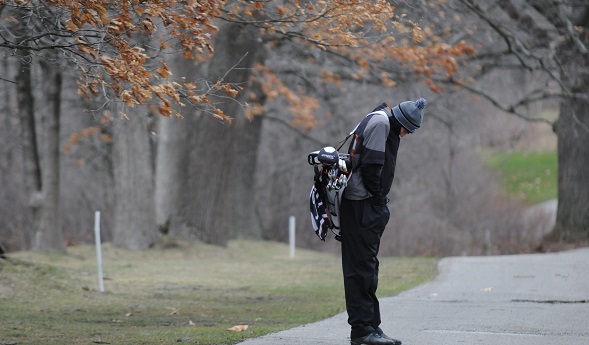
PHOTO: A golfer attempts to keep warm during a round on a dreary day earlier this season. (Click to see more at HighSchoolSportsScene.com.)
After Enjoying Pro Golf Stardom, Flynn Relishing Roles as Instructor, Sports Mom
By
Dean Holzwarth
Special for MHSAA.com
July 31, 2025
GRAND RAPIDS – Kristina (Langton) Flynn recently arrived at a flag football tournament in Canton, Ohio, before the Hall of Fame game and was busy monitoring a group of her son’s teammates as they enjoyed themselves in a hotel pool.
 It’s been a busy sports life for the past Grand Rapids Catholic Central golf standout and MHSAA Finals individual champion, but she wouldn’t want it any other way as she is currently relishing her role as a sports parent to her two young children, Knox (8) and Palmer (6).
“Being a sports mom is truly what I was meant to be,” Flynn said. “It’s amazing watching them work hard and work to improve in their sports. I’ll always be the loudest and biggest supporter of theirs.”
As a high school senior, Flynn won the medalist honor at the 2007 Lower Peninsula Division 3 Final at Eastern Michigan University’s Eagle Crest Golf Club.
She shot rounds of 79 and 74 for a 153 total and two-shot victory while helping lead her team to a sixth-place finish.
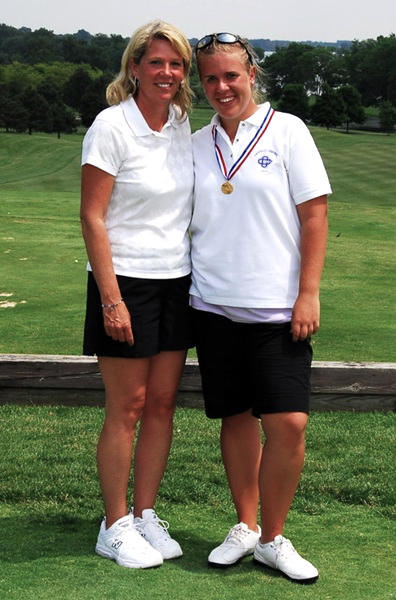
Flynn’s mother, Tammy Langton, was Catholic Central’s coach.
“As I get older, it’s been one of my most favorite memories in my golfing career to look back on,” Flynn said. “To have had my mom as my coach and to be there putting the medal around my neck – that’s a memory I will never forget. And as I get older and have kids of my own now, it’s even more special to have had that memory with her. It was just as much hers as it was mine.”
Flynn’s victory capped the last girls golf season played in the spring before the sport was switched to fall.
Now 36, she made giant strides during her high school career and improved immensely before capping it off with a state championship.
She was an individual qualifier as a sophomore before placing seventh as a junior.
“The progress from freshman to senior year just shows what can happen when you keep working hard and trust the process,” Flynn said.
After high school graduation, Flynn played at Grand Valley State and earned Freshman of the Year and first-team all-league honors in the Great Lakes Intercollegiate Athletic Association her first season. As a college sophomore, she was selected as a first-team All-American.
Her success at the collegiate level and life-long ambition prompted her to make a major decision.
With the support of her parents, she turned professional in the summer of 2009.
“I had a great experience in college that gave me an avenue to practice and prepare for where I wanted to be while being surrounded by a lot of amazing people,” Flynn said. “Going into college, my goal always was to play professionally. Everything I did was to prepare to be able to play on tour.”
 Flynn went to LPGA Qualifying School and earned full-time status.
“After that, I decided not to go back to school,” Flynn said. “I never had a plan B for my career or in my mind – it was always to play professionally.”
Flynn earned status on the Futures Tour, which at the time was an LPGA developmental circuit, and played for two seasons.
“No regrets on the experience because golf has literally given me everything in my life,” Flynn said. “I’m super grateful to have had the opportunity to make my dream a reality.
“Mini-tour golf is a grind, and looking back, I would have done things differently for sure. I was so young and had a lot to learn.”
After Flynn stopped playing professionally, she received Class A PGA certification and started working as a club professional. She still competed for several years in tournaments, including at Michigan PGA and Mid-Atlantic PGA events.
Flynn has been the lead instructor at Kent Country Club the past nine years.
“I love being able to give back to the game that has given me so much,” Flynn said. “To be able to make a positive impact in my student’s game and life.”
Flynn, and her husband, Dan, married in 2016. He was a PGA head professional at Midland Country Club and she was at Cascade Hills Country Club when they met.
They started a family and have been engulfed in youth sports with Knox playing golf, flag football, baseball and basketball and Palmer participating in soccer, basketball and golf.
Knox has competed in the Drive, Putt and Chip junior skills competition.
“They both love to play golf,” Kristina Flynn said, “and it’s been amazing to be able to see it bring them as much joy as it has Dan and I.”
2025 Made In Michigan
July 29: Marckel Supplies Marketing Magic to Hunter's Heisman-Winning Campaign - Report
July 28: Union City to Omaha: Skirka Takes Murray State Baseball to 1st College World Series - Report
July 22: TC West's Wheelock Still 'Living My Dreams' as CMU Assistant Soccer Coach - Report
July 17: Stevenson's Travels Following Lake Orion Success Include Space Force, Penn, NYC - Report
July 15: 'Who Will Cheer for the Nimrods?' Peterson IV, Watersmeet Found Fans Worldwide - Report
July 10: Feeding 'Drive to Win,' Loy Norrix Grad Morgan Impresses with Strong USBC Showing - Report
July 9: After Blazing Multiple Volleyball Trails, Bastianelli Charting Next Career Path - Report
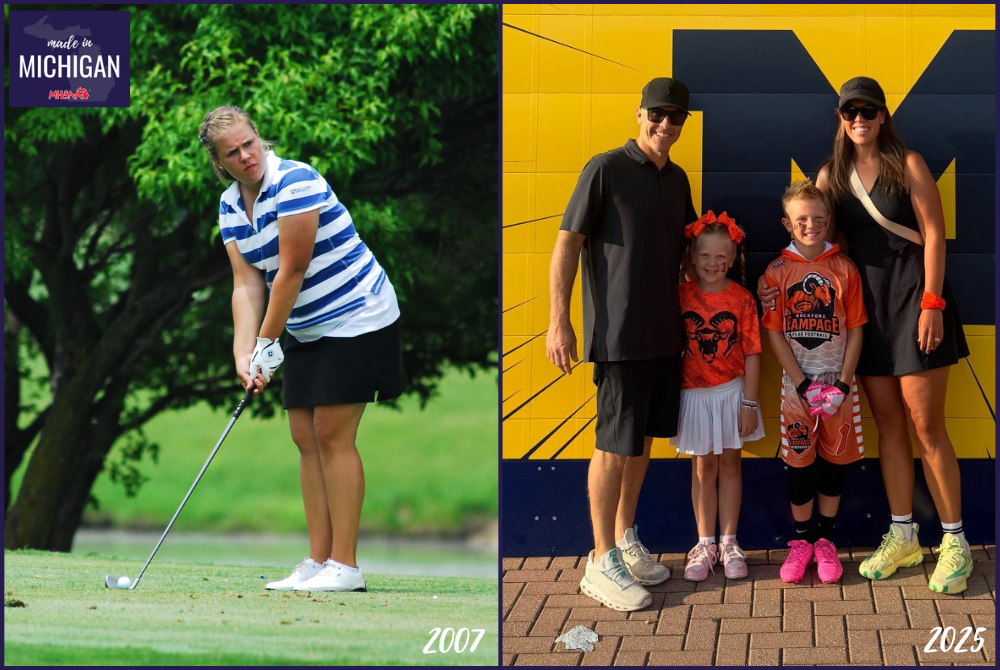
PHOTOS (Top) At left, Kristina Langton tees off during the 2007 Lower Peninsula Division 3 Final. At right, Langton takes a photo with husband Dan and children Knox and Palmer. (Middle) Kristina Langton takes a photo with her mother and high school coach, Tammy Langton, after receiving her medal for winning the 2007 LPD3 individual title. (High school photos from MHSAA archives. Current photo courtesy of the Flynn family.)