

Eventually, the sun will shine ...
April 25, 2013
By Geoff Kimmerly
Second Half editor
 We all believe that, right?
Rain – and snow for some – has been the buzzword of this spring sports season. Just about every newspaper is writing about it and every athletic director, coach, player and parent is dreading it on a now-daily basis.
But eventually, we expect the weather to clear up and teams to play catch-up. To that end, there are limitations teams in some sports face when attempting to make up their games – but also opportunities to take advantage of while trying to fill out their regular-season schedules.
- Girls soccer and girls and boys lacrosse teams may play only three games during a week, Monday through Sunday. A weekend tournament – which generally includes 2 to 3 shortened games – counts as only one in this equation.
- Baseball and softball teams can play as many games as they want in a week, but no more than two on a school day – and baseball pitchers must not pitch for two days following their 30th out in a week.
- For tennis, an individual may not play more than three matches in one day – unless she or he is playing in a league championship tournament featuring more than eight schools for which a fourth match would decide the championship. That player also could not have played more than six sets that day heading into that fourth and final match.
- Golf and Track and Field do not have weekly contest limitations. Track and field athletes can compete in only four events per day.
As expected, a number of teams – especially for baseball and softball – are scheduling to smash in as many contests as possible into the next four weeks. Postseason play for tennis and lacrosse begins May 16 – three weeks from today.
But teams do have options.
One rarely used but anticipated to be used more this spring is an opportunity to continue playing regular-season contests through the final day of the MHSAA tournament in that sport. For example, a baseball team can continue making up games through June 15, the day of the MHSAA Finals in Battle Creek. A tennis team can play regular-season matches through June 1, etc.
Also, the MHSAA Executive Committee approved Thursday to allow for this spring two additional multi-team tournament dates for soccer and lacrosse, which will give those teams an opportunity to get in a few more games. That means soccer teams will be allowed to play in four multi-team tournaments instead of two, boys lacrosse four instead of two and girls lacrosse five instead of three.
Teams will have to do some juggling, no doubt, and all other tournament stipulations still apply (games generally are shortened so more can be played, etc.). But with a little creativity, teams could at least get in a few of their make-up games in this way.
Also, the Executive Committee approved a motion to waive the four-contest MHSAA tournament entry requirement for all Upper Peninsula schools in all sports this spring. As of the weekend, snow still covered parts of the U.P.
Gaps shrinking
Much has been discussed about minimums for all four MHSAA classes for 2013-14, and how they are the lowest student totals in at least a decade.
It’s true. The floor in Class A is 893 (down from 911 this school year), Class B starts at 429 (down from 449), Class C at 207 (down from 217) and Class D at 206 (down from 216).
However, there is a better way to crunch the numbers: Consider the shrinking gaps between the largest and smallest schools in each class.
For 2013-14, the gap in Class A is 1,888 students – 261 students fewer than 2007-08 and nearly 900 students fewer than in 2005-06. The gaps between largest and smallest in Classes B, C and D also are trending smaller – which means each class actually includes schools more similar in size, instead of a perceived other way around.
SAC 2013-14 on the way
We’re thankful for a valuable group of students who help us throughout the school year – our 16-member Student Advisory Council, made up of eight seniors and eight juniors from all over the state who are charged with providing feedback on issues impacting educational athletics from a student’s perspective, while also assisting at MHSAA championships and with special projects like the “Battle of the Fans.”
Selecting the next class to join is a highlight of every spring – but hardly an easy process.
A six-member selection committee, myself included, considered 62 sophomore applicants today from all over the Lower and Upper Peninsulas, representing all four of our classes and nearly every sport we sponsor.
Every candidate is impressive for a variety of reasons. That’s what makes this difficult – we could pick any number of combinations to make up our new SAC class, and no doubt leaders galore will emerge from another impressive group.
But there are only eight spots on the council. And we’ll announce who received them later next week.
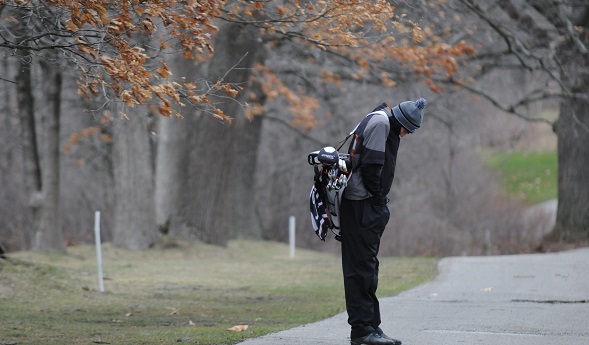
PHOTO: A golfer attempts to keep warm during a round on a dreary day earlier this season. (Click to see more at HighSchoolSportsScene.com.)

Century of School Sports: Top Performers Tell Us What High School Sports Mean to Them
By
Geoff Kimmerly
MHSAA.com senior editor
June 17, 2025
As we move into the final installments of our MHSAA 100th-anniversary "Century of School Sports" celebration, we present a project we've been working on this entire school year -- an opportunity for some of the state's highest achievers from 2025-26 to explain how school sports have played an important role in their lives.
Following is a collection of answers from athletes we recognized with our "Performance of the Week" over the last 11 months, as we asked all of them: "What has participating in high school sports meant to you?"
@mhsaasports What do high school sports mean to you? Student-athletes like you share their take on high school sports. Stay tuned as we share our #HighSchoolSportsMeanToMe series starting in July🔥🚨📢 #MHSAA ♬ Inspirational - neozilla
Be sure to check out the MHSAA's TikTok channel starting on July 8 to see more answers to the question "What does high school sports mean to you?" Search the hashtag #HighSchoolSportsMeantoMe.
Video transcription:
Asher Clark – Bay City John Glenn: [00:00:00] Every time I step on the field, I get to wear the name of my high school on my jersey, which is an honor.
Aubrey Hillard - Rochester: [00:00:05] It's basically shaped me into the person I am today. It's brought me closer to some of my favorite people, like with my team and my coaches.
Chloe Qin – Bloomfield Hills Cranbrook Kingswood: [00:00:11] It like helps you figure out how to manage your time better and how to, like, cooperate on a team and how to, like, push yourself past your limits.
Izzy Horvath – Bangor: [00:00:23] It's also a stress reliever for me, playing with my friends.
Kate Simon – East Grand Rapids: [00:00:26] I love competing and pushing myself, and they've taught me how to set goals and stay focused and work hard.
Katie Spicer – Fowler: [00:00:32] To me, high school sports are kind of like an escape from reality, and they brought me friendships that I'll have forever and memories that I'll hold on for my whole life.
Alex Graham – Detroit Cass Tech: [00:00:40] You build real good, strong relationships with the coaches, and even after football they'll be there for you and everything.
Asher Clark – Bay City John Glenn: [00:00:46] It's very unique in that you're playing with kids who are older than you that you can learn from, and kids that are younger than you, who you can pass on your knowledge to.
Brock Morris – Southfield Christian: [00:00:54] Being an athlete has taught me discipline, mental toughness, and it's taught me how to push past my limits. I've learned how to lose. I've learned how to win. I've learned how to lead my team through all of that and support my teammates through all of that.
Hunter Lemmon - Fraser: [00:01:06] There's a lot of people that like, I don't know if I ever would have talked to them, and they're like my best friends to this day.
Maggie Buurma - Fowlerville: [00:01:12] The team atmosphere that you get out of high school sports is not really comparable to anything else I've ever experienced. Whether I won or I lost, they were there for me the next day. They didn't base my worth off of my wins and losses.
McRecco McFadden III – Burton Bentley: [00:01:26] It's definitely a learning experience to watch yourself grow. Throughout this whole experience, it made me who I am, if I'm being honest.
Olivia Flynn – Harbor Springs: [00:01:32] Being on a team has had a huge impact on my confidence. It's bringing and embracing the leadership roles on and off the court. And then, just like I said, playing with girls from all different backgrounds, just being together to accomplish one goal, it's so fun and I love it.
Wyatt Spalo – Reed City: [00:01:47] It's become my home away from home in a sense. High school sports has definitely been like a key factor in not only who I've become today, but like, also how I've grown.
Victoria Garces – Midland Dow: [00:01:57] Every school day, no matter if it's good or bad, you always have your practice after school. And it's just such a fun way to see all your friends and then also get to focus on something that you love.
Shaelyn Perry – South Lyon United: [00:02:08] And all those lessons are so applicable in other areas of my life, and they've enabled me to be successful in other areas of my life, and it opens up so many other doors and other relationships that without it, I wouldn't have.
Previous "Century of School Sports" Spotlights
June 10: 'The Mitten' Becomes Sought-After Symbol of MHSAA Greatness - Read
June 3: MHSAA's Move to TV, Now Internet, 60 Years Old & Growing - Read
May 27: Upper Peninsula Helps Make Michigan's School Sports Story Unique - Read
May 20: From Nearly A to Z, Schools Repped by 221 Nicknames - Read
May 13: These Record-Setters were Nearly Impossible to Defeat - Read
May 6: 200+ Representatives Fill All-Time Council Roster - Read
April 29: MHSAA Programs Prioritize Health & Safety - Read
April 23: Patches Signify Registered Officials' Role in MHSAA Story - Read
April 16: Student Advisory Council Gives Voice to Athletes - Read
April 9: State's Storytellers Share Spring Memories - Read
April 2: Sharp Leadership Synonymous with MHSAA Success - Read
March 25: Athletic Directors Indispensable to Mission of School Sports - Read
March 18: 2025 Finals Begin Next Half-Century of Girls Hoops Championships - Read
March 11: Boys Basketball's Best 1st to Earn MHSAA Finals Titles - Read
March 5: Everything We Do Begins with Participation - Read
Feb. 25: Slogans & Logos Remain Unforgettable Parts of MHSAA History - Read
Feb. 19: MHSAA Tickets Continue to Provide Fan-Friendly Value - Read
Feb. 11: We Recognize Those Who Make Our Games Go - Read
Feb. 4: WISL Conference Continues to Inspire Aspiring Leaders - Read
Jan. 28: Michigan's National Impact Begins at NFHS' Start - Read
Jan. 21: Awards Celebrate Well-Rounded Educational Experience - Read
Jan. 14: Predecessors Laid Foundation for MHSAA's Formation - Read
Jan. 9: MHSAA Blazes Trail Into Cyberspace - Read
Dec. 31: State's Storytellers Share Winter Memories - Read
Dec. 17: MHSAA Over Time - Read
Dec. 10: On This Day, December 13, We Will Celebrate - Read
Dec. 3: MHSAA Work Guided by Representative Council - Read
Nov. 26: Finals Provide Future Pros Early Ford Field Glory - Read
Nov. 19: Connection at Heart of Coaches Advancement Program - Read
Nov. 12: Good Sports are Winners Then, Now & Always - Read
Nov. 5: MHSAA's Home Sweet Home - Read
Oct. 29: MHSAA Summits Draw Thousands to Promote Sportsmanship - Read
Oct. 23: Cross Country Finals Among MHSAA's Longest Running - Read
Oct. 15: State's Storytellers Share Fall Memories - Read
Oct. 8: Guided by 4 S's of Educational Athletics - Read
Oct. 1: Michigan Sends 10 to National Hall of Fame - Read
Sept. 25: MHSAA Record Books Filled with 1000s of Achievements - Read
Sept. 18: Why Does the MHSAA Have These Rules? - Read
Sept. 10: Special Medals, Patches to Commemorate Special Year - Read
Sept. 4: Fall to Finish with 50th Football Championships - Read
Aug. 28: Let the Celebration Begin - Read