

Get Prepped for a Fantastic Finale
May 24, 2013
By Geoff Kimmerly
Second Half editor
We love this time of year. And not just because school is nearly out for summer.
There’s little argument that the week ahead is the most exciting of each MHSAA school year. And you’ll want to set your bookmarks for MHSAA.com and Second Half for updated results and coverage not just next week – but through the rest of this spring season.
 The MHSAA.com Score Center is our home for scores from all District softball, baseball and soccer games, which begin Tuesday. You also can view real-time brackets for every District by going to the “Sports” page for each, and updated brackets for lacrosse by visiting our girls and boys pages for that sport as well.
In the Lower Peninsula, we’ll have same day or next morning results as golf Districts are played, and first-day results from next weekend’s Girls Tennis Finals on May 31 – followed by final results at the conclusion of play June 1. We’ll post Finals results for Upper Peninsula golf and tennis as we receive them Wednesday and Thursday, and then results for all seven Lower and Upper Peninsula Track and Field Finals as they come in June 1.
But results are only the start. As we have during the fall and winter, Second Half will provide coverage including photos from every MHSAA Final – beginning with Wednesday’s Upper Peninsula Girls and Boys Golf and Boys Tennis Finals. Keep an eye on Second Half throughout the week, or follow the Second Half feed on the cover page of MHSAA.com.
Transfer rule clarification
We released Monday the actions our Representative Council took earlier this month at its Spring Meeting, including an addition to the athletics-related portion of our transfer rule. Based on some questions we’ve received and read, here’s some further explanation of what will be installed for 2014-15:
The longer period of ineligibility for athletes who transfer because of athletics is not new. This has previously existed for cases in which a school could prove that it lost a student to another school purely for sports-related reasons.
What’s new is what must be proven and by whom for the longer ineligibility period to take effect. Now, a school that lost a student does not have to file a report with the MHSAA for the case to be considered. As long as one of a set of offending activities can be verified – including practicing, competing or training with a member of the new school’s coaching staff during summer or non-school sports activities or seasons – that student will have to sit 180 days instead of the usual period of roughly a semester. The 15 exemptions that allow a student to be eligible immediately – like making a full move to a new district or a student’s school closing – may still apply.
So, to conclude: The longer athletics-related ineligibility period is not new, just how athletics-related transfers are considered and reported. Click to read the full release.
Kickoff is coming
And that means we’re collecting varsity football schedules.
In fact, we have most of them thanks to our athletic directors, their secretaries, coaches and many others who chip in to help us keep complete and accurate information throughout the season.
But there are still plenty of steps in getting ready for August – and a huge one is locking down correct leagues for our teams this season, especially as schools continue to switch things up.
Check out your school’s schedule page by click on the “Schools” button in the menu bar at the top of MHSAA.com and searching for your school. Once on the school page, click the blue “Boys” button next to football. The schedule will appear in the middle of the page, with standings to the left.
See an error in a schedule or the standings? Email me at [email protected]. I thank you in advance.
Kramer’s words of wisdom
Long before Roy Kramer served as athletic director at Vanderbilt University, commissioner of the Southeastern Conference and creator of the Bowl Championship Series (BCS) for Division I college football, he coached multiple sports at East Lansing High School.
He recently was named winner of this year’s Duffy Daugherty Award, given in honor of the former Michigan State University coach to a valued coach or contributor to college football. The award, presented in East Lansing, is among those recognized by the College Football Hall of Fame.
Kramer finished his acceptance speech with a stirring endorsement of the sport that brought the crowd of more than 300 to its feet. If you’re a fan, former or current player or coach, see below.
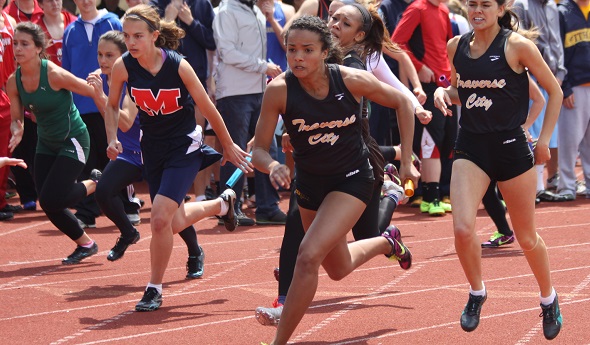
PHOTO: Athletes race toward the finish of a relay during this spring's Alma College Invitational. (Click to see more at HighSchoolsSportsScene.com.)
How Can COVID-19 Impact Student-Athletes' Return-To-Play?
October 5, 2021

COVID-19 And Student Athletes: How Can the Virus Impact Return-To-Play?
The end of summer marked the start of the school year, and for student athletes, the kickoff of the fall sports season. For many, COVID-19 sidelined practices, team gatherings and games to some extent last year. And while there is still hope that young athletes will have more opportunity to play this season despite rising cases of the Delta variant, there are other factors causing concern among athletes and their parents.
According to Ramsey Shehab, M.D., a sports medicine physician for Henry Ford Health System, many athletes are concerned about reaching peak performance after a long time off or after they have recovered from a COVID diagnosis. He reassures students that the feeling of exhaustion or even underperformance compared to past years is to be expected when you take time off or after fighting an illness.
“When you are infected with a virus, it taxes your immune system, and all of your energy goes towards fighting off that infection,” says Dr. Shehab. “You’ll likely feel weak and more tired during this time.”
Fortunately, as the body begins to recover, you’ll start to feel more like yourself again as you get your energy back. But this doesn’t mean that you won’t lose some of that fitness and endurance you’ve built up.
“It only takes about a week of deconditioning to set you back from peak athletic abilities,” says Dr. Shehab. “It is completely expected that your body will need time to get back to performing at your best.”
Playing Sports After Recovering From COVID-19
The unfortunate news: COVID-19 affects people differently in the long term. Some people are able to recover and get back to their routine without delay, whereas others see further complications months after an infection.
Akshay Khandelwal, M.D., a cardiologist with Henry Ford Health System, breaks down some of the more serious findings regarding COVID-19 and your heart health.
“With COVID-19, there is a risk of direct injury like heart failure or an arrhythmia due to the stress your body is under while fighting off the virus,” says Dr. Khandelwal. “As a result, having the virus can cause inflammation of the heart, a condition called myocarditis.”
Because of this, talking to your doctor before returning to a sport is a must if you had COVID or are recovering from the virus. It is important to make sure there are no systemic changes to your body such as overall heart health and lung function. They will be able to rule out any long-term effects that could impact your fitness output.
Expert-Recommended Steps for Return-To-Play
As you get back to your game, both experts share their insights for a healthy recovery:
1. Take quarantine periods seriously. If you are sick, even if you don’t necessarily feel sick, make sure you are taking time to rest and recover properly. “Don’t try to push or overexert yourself,” says Dr. Khandelwal. “It could prolong your recovery.”
2. Get back to training slowly. “Start using low-exertion activities to get your body used to working out again,” says Dr. Shehab. “Once you are able to handle each activity, you can push ahead to something more challenging.” Realistically, it may take a couple of weeks before you are able to get back to your peak.
3. Listen to your body. If workouts seem increasingly difficult, talk with your doctor or trainer before pushing yourself further. You can also help your body recover by making healthy, thoughtful choices:
► Get plenty of sleep
► Warm up and cool down before and after workouts
► Stay hydrated
► Take breaks when you’re tired
► Practice injury prevention
► Make smart food choices
4. Get vaccinated. If medical or religious reasons, or age requirements aren’t stopping you from getting the vaccine, consider getting the shot for yourself and those around you. The Delta variant is highly transmittable, meaning that, it is much easier for it to spread to teammates and family members than the original strain of the virus. To learn more about the COVID-19 vaccine, visit our Vaccine FAQs page.
Talk to your doctor to learn more about safely returning to a sport. To find a doctor, visit henryford.com or call 1-800-436-7936.
Dr. Ramsey Shehab is the deputy chief of Sports Medicine at Henry Ford Health System. He sees patients at the Henry Ford Center for Athletic Medicine and Henry Ford Medical Center - Bloomfield Township.
Dr. Akshay Khandelwal is an interventional cardiologist who sees patients at Henry Ford Medical Center – Second Avenue.