

Get Prepped for a Fantastic Finale
May 24, 2013
By Geoff Kimmerly
Second Half editor
We love this time of year. And not just because school is nearly out for summer.
There’s little argument that the week ahead is the most exciting of each MHSAA school year. And you’ll want to set your bookmarks for MHSAA.com and Second Half for updated results and coverage not just next week – but through the rest of this spring season.
 The MHSAA.com Score Center is our home for scores from all District softball, baseball and soccer games, which begin Tuesday. You also can view real-time brackets for every District by going to the “Sports” page for each, and updated brackets for lacrosse by visiting our girls and boys pages for that sport as well.
In the Lower Peninsula, we’ll have same day or next morning results as golf Districts are played, and first-day results from next weekend’s Girls Tennis Finals on May 31 – followed by final results at the conclusion of play June 1. We’ll post Finals results for Upper Peninsula golf and tennis as we receive them Wednesday and Thursday, and then results for all seven Lower and Upper Peninsula Track and Field Finals as they come in June 1.
But results are only the start. As we have during the fall and winter, Second Half will provide coverage including photos from every MHSAA Final – beginning with Wednesday’s Upper Peninsula Girls and Boys Golf and Boys Tennis Finals. Keep an eye on Second Half throughout the week, or follow the Second Half feed on the cover page of MHSAA.com.
Transfer rule clarification
We released Monday the actions our Representative Council took earlier this month at its Spring Meeting, including an addition to the athletics-related portion of our transfer rule. Based on some questions we’ve received and read, here’s some further explanation of what will be installed for 2014-15:
The longer period of ineligibility for athletes who transfer because of athletics is not new. This has previously existed for cases in which a school could prove that it lost a student to another school purely for sports-related reasons.
What’s new is what must be proven and by whom for the longer ineligibility period to take effect. Now, a school that lost a student does not have to file a report with the MHSAA for the case to be considered. As long as one of a set of offending activities can be verified – including practicing, competing or training with a member of the new school’s coaching staff during summer or non-school sports activities or seasons – that student will have to sit 180 days instead of the usual period of roughly a semester. The 15 exemptions that allow a student to be eligible immediately – like making a full move to a new district or a student’s school closing – may still apply.
So, to conclude: The longer athletics-related ineligibility period is not new, just how athletics-related transfers are considered and reported. Click to read the full release.
Kickoff is coming
And that means we’re collecting varsity football schedules.
In fact, we have most of them thanks to our athletic directors, their secretaries, coaches and many others who chip in to help us keep complete and accurate information throughout the season.
But there are still plenty of steps in getting ready for August – and a huge one is locking down correct leagues for our teams this season, especially as schools continue to switch things up.
Check out your school’s schedule page by click on the “Schools” button in the menu bar at the top of MHSAA.com and searching for your school. Once on the school page, click the blue “Boys” button next to football. The schedule will appear in the middle of the page, with standings to the left.
See an error in a schedule or the standings? Email me at [email protected]. I thank you in advance.
Kramer’s words of wisdom
Long before Roy Kramer served as athletic director at Vanderbilt University, commissioner of the Southeastern Conference and creator of the Bowl Championship Series (BCS) for Division I college football, he coached multiple sports at East Lansing High School.
He recently was named winner of this year’s Duffy Daugherty Award, given in honor of the former Michigan State University coach to a valued coach or contributor to college football. The award, presented in East Lansing, is among those recognized by the College Football Hall of Fame.
Kramer finished his acceptance speech with a stirring endorsement of the sport that brought the crowd of more than 300 to its feet. If you’re a fan, former or current player or coach, see below.
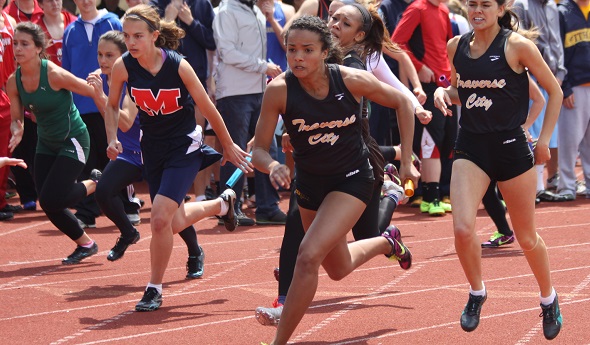
PHOTO: Athletes race toward the finish of a relay during this spring's Alma College Invitational. (Click to see more at HighSchoolsSportsScene.com.)

NFHS Voice: Committed to HS Football
February 12, 2020
By Karissa Niehoff
NFHS Executive Director
The enduring popularity of football in the United States was celebrated in the past year at all levels of the sport.
The NFHS celebrated its 100th year of service in all areas of high school sports, including the writing of football playing rules, although the first-known games date to the 1870s.
This past year, the NCAA recognized the 150th anniversary of college football which started in 1869 when Princeton and Rutgers met for the first time. And the National Football League just closed its 100th season, which started with a 1919 game between Dayton and Columbus.
From those beginnings to today, the impact of football on life in America is incalculable. From the youth leagues, through high school and college, and on to the NFL, football is the runaway leader as this country’s most popular sport – both from a participant standpoint with about three million players annually at all levels, to the millions of fans who attend or watch games.
Every fall, millions of families spend a portion of their weekends supporting their grade-school kids in youth football programs. Through these programs, kids are exposed to the basics of the sport and, more importantly, they begin to learn teamwork, sportsmanship and how to win and lose in a proper manner.
On Friday nights, beyond the one million high school students – boys and girls – actually playing football, there are more than 150 million fans who attend games each year. Parents are involved in booster club activities, and homecoming activities occur during one football game every year. In many communities – particularly smaller cities and towns – Friday night football is often the most anticipated event of the week.
Another 50,000-plus players are involved in college football on Saturdays. As is the case at the high school level, homecoming events are tied to one football game every fall. Postseason bowl games have been a part of American culture for decades, and the new College Football Playoff has brought even more excitement to the end of the season.
NFL games on Sunday complete the three-day weekend focus on the country’s favorite sport. Thanks, in part, to the singular weekly focus as opposed to multiple games each week in the other three major professional sports, football dwarfs its competitors.
The interest level in playing football – and following the sport at all levels – has never been higher. With that continued interest in the sport comes the expectation that everything possible is being done – at all levels – to ensure that the safety of each and every participant is of the upmost concern.
With that backdrop, last week we met with leaders from USA Football, several state high school association executive directors and high school coaches and athletic directors representing the National High School Football Coaches Alliance and the National Interscholastic Athletic Administrators Association, respectively.
Collectively, these groups are committed to consistent messaging and support to ensure the ongoing popularity of the sport for the next 100 years. We believe the Football Development Model (FDM) enacted by USA Football will re-invigorate interest in the sport at the youth levels. The FDM reduces contact in youth football and advances the game through comprehensive education, game progressions and safety standards.
There was also agreement about the importance of high school football coaches. By connecting with coaches of youth football programs in their communities, high school football coaches can spur excitement on the part of youth players and their parents and improve chances of kids continuing to play the sport. Without a doubt, high school football coaches can be the focal point to success of programs in communities across the nation.
Working together, we can count on a continuation of the sport’s popularity at the high school level.
Dr. Karissa L. Niehoff is in her second year as executive director of the National Federation of State High School Associations (NFHS) in Indianapolis, Indiana. She is the first female to head the national leadership organization for high school athletics and performing arts activities and the sixth full-time executive director of the NFHS, which celebrated its 100th year of service during the 2018-19 school year. She previously was executive director of the Connecticut Association of Schools-Connecticut Interscholastic Athletic Conference for seven years.