

Get Prepped for a Fantastic Finale
May 24, 2013
By Geoff Kimmerly
Second Half editor
We love this time of year. And not just because school is nearly out for summer.
There’s little argument that the week ahead is the most exciting of each MHSAA school year. And you’ll want to set your bookmarks for MHSAA.com and Second Half for updated results and coverage not just next week – but through the rest of this spring season.
 The MHSAA.com Score Center is our home for scores from all District softball, baseball and soccer games, which begin Tuesday. You also can view real-time brackets for every District by going to the “Sports” page for each, and updated brackets for lacrosse by visiting our girls and boys pages for that sport as well.
In the Lower Peninsula, we’ll have same day or next morning results as golf Districts are played, and first-day results from next weekend’s Girls Tennis Finals on May 31 – followed by final results at the conclusion of play June 1. We’ll post Finals results for Upper Peninsula golf and tennis as we receive them Wednesday and Thursday, and then results for all seven Lower and Upper Peninsula Track and Field Finals as they come in June 1.
But results are only the start. As we have during the fall and winter, Second Half will provide coverage including photos from every MHSAA Final – beginning with Wednesday’s Upper Peninsula Girls and Boys Golf and Boys Tennis Finals. Keep an eye on Second Half throughout the week, or follow the Second Half feed on the cover page of MHSAA.com.
Transfer rule clarification
We released Monday the actions our Representative Council took earlier this month at its Spring Meeting, including an addition to the athletics-related portion of our transfer rule. Based on some questions we’ve received and read, here’s some further explanation of what will be installed for 2014-15:
The longer period of ineligibility for athletes who transfer because of athletics is not new. This has previously existed for cases in which a school could prove that it lost a student to another school purely for sports-related reasons.
What’s new is what must be proven and by whom for the longer ineligibility period to take effect. Now, a school that lost a student does not have to file a report with the MHSAA for the case to be considered. As long as one of a set of offending activities can be verified – including practicing, competing or training with a member of the new school’s coaching staff during summer or non-school sports activities or seasons – that student will have to sit 180 days instead of the usual period of roughly a semester. The 15 exemptions that allow a student to be eligible immediately – like making a full move to a new district or a student’s school closing – may still apply.
So, to conclude: The longer athletics-related ineligibility period is not new, just how athletics-related transfers are considered and reported. Click to read the full release.
Kickoff is coming
And that means we’re collecting varsity football schedules.
In fact, we have most of them thanks to our athletic directors, their secretaries, coaches and many others who chip in to help us keep complete and accurate information throughout the season.
But there are still plenty of steps in getting ready for August – and a huge one is locking down correct leagues for our teams this season, especially as schools continue to switch things up.
Check out your school’s schedule page by click on the “Schools” button in the menu bar at the top of MHSAA.com and searching for your school. Once on the school page, click the blue “Boys” button next to football. The schedule will appear in the middle of the page, with standings to the left.
See an error in a schedule or the standings? Email me at [email protected]. I thank you in advance.
Kramer’s words of wisdom
Long before Roy Kramer served as athletic director at Vanderbilt University, commissioner of the Southeastern Conference and creator of the Bowl Championship Series (BCS) for Division I college football, he coached multiple sports at East Lansing High School.
He recently was named winner of this year’s Duffy Daugherty Award, given in honor of the former Michigan State University coach to a valued coach or contributor to college football. The award, presented in East Lansing, is among those recognized by the College Football Hall of Fame.
Kramer finished his acceptance speech with a stirring endorsement of the sport that brought the crowd of more than 300 to its feet. If you’re a fan, former or current player or coach, see below.
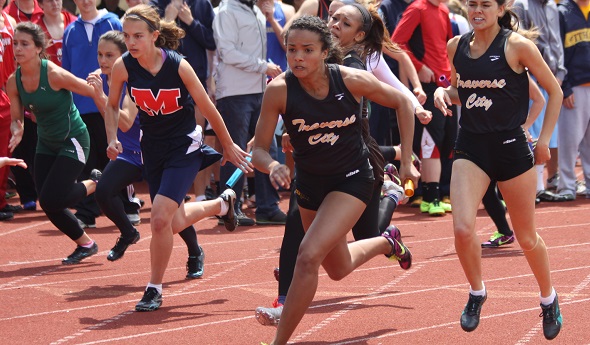
PHOTO: Athletes race toward the finish of a relay during this spring's Alma College Invitational. (Click to see more at HighSchoolsSportsScene.com.)

NFHS Voice: MLK Provides Reminder
January 22, 2020
By Karissa Niehoff
NFHS Executive Director
On Monday, the nation observed Martin Luther King Jr. Day for the 35th time. This annual remembrance of the civil rights leader and his remarkable efforts in the 1950s and 1960s to combat racism in the United States continues as one of the most significant days on the calendar every year.
King’s “I Have a Dream” speech in Washington, D.C. in 1963 – one of the most iconic speeches in history – was the defining moment of the civil rights movement and led to the Civil Rights Act of 1964, which made desegregation a prerequisite to school funding and further strengthened the Supreme Court’s 1954 ruling in Brown v. Board of Education of Topeka.
As a result, separate schools for African Americans ended and King’s dream of equality for everyone began to occur.
Thanks, in part, to the efforts of King, who was a member of his school’s debate team at Booker T. Washington High School in Atlanta, blacks and whites were assimilated in schools and in athletics and other activities such as speech and debate.
A few years later in the early 1970s with the passage of Title IX, girls – both white and black – were provided the opportunity to participate in high school sports. With this landmark legislation on the heels of the civil rights movement, high school sports and activities were for EVERYONE.
Amazingly, participation in high school sports increased from 3.9 million to 6.4 million in seven years between 1971-72 and 1977-78 – a jump of about 2.5 million. Why? The opportunity to participate was now available to all.
High school athletes – male and female, black and white and other races – began to work together and excel both individually and as teams. Many have seized these opportunities and had a profound impact within their communities and nationally.
In the past five classes of the NFHS National High School Hall of Fame, 13 of the 22 athletes were minority males and females, including the likes of Derrick Brooks, Dusty Baker, Seimone Augustus, Nicole Powell, Lisa Fernandez, Nikki McCray and Marlin Briscoe. Other females were Tracey Fuchs, Carrie Tollefson, Missy West, Joni Huntley, Jackie Stiles and Cindy Brogdon.
In previous classes, there were Ozzie Newsome, Chauncey Billups, Kevin Johnson, Janet Evans, Sean Elliott, Cheryl Miller, Archie Griffin, Jackie Joyner-Kersee and Kim Mulkey.
Can you imagine the storied history of high school sports without these individuals?
Thanks to the efforts of many people in the 1960s and 1970s, there are more women and minorities in leadership positions today. Nine of our member state high school associations are led by minorities, including three females – Que Tucker of North Carolina, Sally Marquez of New Mexico and Rhonda Blanford-Green of Colorado.
Despite these advances in opportunities the past 50-plus years, the late Dr. King would be disappointed to hear about some of the disrespectful behavior in and around high school sports the past few years. Since our column in late October, we have heard of other racially-related incidents. Indeed, pain still occurs.
As we reflect on the tremendous efforts of Dr. Martin Luther King Jr. to bring everyone together, let it be a further reminder that all student activity participants – regardless of race, religion, political views or gender identity – should be treated with respect.
Dr. Karissa L. Niehoff is in her second year as executive director of the National Federation of State High School Associations (NFHS) in Indianapolis, Indiana. She is the first female to head the national leadership organization for high school athletics and performing arts activities and the sixth full-time executive director of the NFHS, which celebrated its 100th year of service during the 2018-19 school year. She previously was executive director of the Connecticut Association of Schools-Connecticut Interscholastic Athletic Conference for seven years.