

Get Prepped for a Fantastic Finale
May 24, 2013
By Geoff Kimmerly
Second Half editor
We love this time of year. And not just because school is nearly out for summer.
There’s little argument that the week ahead is the most exciting of each MHSAA school year. And you’ll want to set your bookmarks for MHSAA.com and Second Half for updated results and coverage not just next week – but through the rest of this spring season.
 The MHSAA.com Score Center is our home for scores from all District softball, baseball and soccer games, which begin Tuesday. You also can view real-time brackets for every District by going to the “Sports” page for each, and updated brackets for lacrosse by visiting our girls and boys pages for that sport as well.
In the Lower Peninsula, we’ll have same day or next morning results as golf Districts are played, and first-day results from next weekend’s Girls Tennis Finals on May 31 – followed by final results at the conclusion of play June 1. We’ll post Finals results for Upper Peninsula golf and tennis as we receive them Wednesday and Thursday, and then results for all seven Lower and Upper Peninsula Track and Field Finals as they come in June 1.
But results are only the start. As we have during the fall and winter, Second Half will provide coverage including photos from every MHSAA Final – beginning with Wednesday’s Upper Peninsula Girls and Boys Golf and Boys Tennis Finals. Keep an eye on Second Half throughout the week, or follow the Second Half feed on the cover page of MHSAA.com.
Transfer rule clarification
We released Monday the actions our Representative Council took earlier this month at its Spring Meeting, including an addition to the athletics-related portion of our transfer rule. Based on some questions we’ve received and read, here’s some further explanation of what will be installed for 2014-15:
The longer period of ineligibility for athletes who transfer because of athletics is not new. This has previously existed for cases in which a school could prove that it lost a student to another school purely for sports-related reasons.
What’s new is what must be proven and by whom for the longer ineligibility period to take effect. Now, a school that lost a student does not have to file a report with the MHSAA for the case to be considered. As long as one of a set of offending activities can be verified – including practicing, competing or training with a member of the new school’s coaching staff during summer or non-school sports activities or seasons – that student will have to sit 180 days instead of the usual period of roughly a semester. The 15 exemptions that allow a student to be eligible immediately – like making a full move to a new district or a student’s school closing – may still apply.
So, to conclude: The longer athletics-related ineligibility period is not new, just how athletics-related transfers are considered and reported. Click to read the full release.
Kickoff is coming
And that means we’re collecting varsity football schedules.
In fact, we have most of them thanks to our athletic directors, their secretaries, coaches and many others who chip in to help us keep complete and accurate information throughout the season.
But there are still plenty of steps in getting ready for August – and a huge one is locking down correct leagues for our teams this season, especially as schools continue to switch things up.
Check out your school’s schedule page by click on the “Schools” button in the menu bar at the top of MHSAA.com and searching for your school. Once on the school page, click the blue “Boys” button next to football. The schedule will appear in the middle of the page, with standings to the left.
See an error in a schedule or the standings? Email me at [email protected]. I thank you in advance.
Kramer’s words of wisdom
Long before Roy Kramer served as athletic director at Vanderbilt University, commissioner of the Southeastern Conference and creator of the Bowl Championship Series (BCS) for Division I college football, he coached multiple sports at East Lansing High School.
He recently was named winner of this year’s Duffy Daugherty Award, given in honor of the former Michigan State University coach to a valued coach or contributor to college football. The award, presented in East Lansing, is among those recognized by the College Football Hall of Fame.
Kramer finished his acceptance speech with a stirring endorsement of the sport that brought the crowd of more than 300 to its feet. If you’re a fan, former or current player or coach, see below.
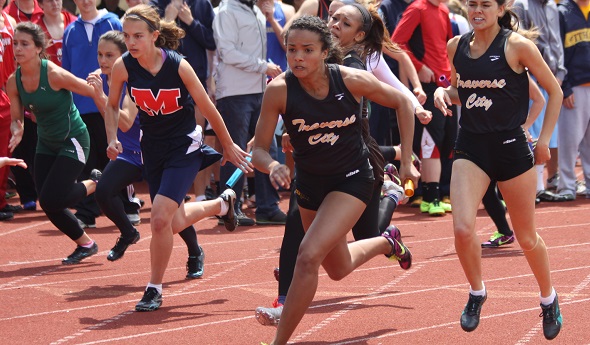
PHOTO: Athletes race toward the finish of a relay during this spring's Alma College Invitational. (Click to see more at HighSchoolsSportsScene.com.)

NFHS Voice: Amateurism Benefits
October 9, 2019
By Karissa Niehoff
NFHS Executive Director
While we addressed a number of important issues with our member state associations at section meetings the past month, perhaps none of the topics are as significant as the tremor that occurred in California on September 30 – the signing of the “Fair Pay to Play Act” by California Governor Gavin Newsom.
Although there are more questions than answers at this point, this ruling would allow college athletes in the state of California to make money from their name, image and likeness through endorsement deals, sponsorships, autograph signings and other opportunities. The legislation is due to take effect in 2023.
Obviously, the NCAA opposes this legislation and is working through its governance structure to address the issue. As Mark Emmert, NCAA president, told the Indianapolis Star, “for all intents and purposes, athletes become employees of the schools. This is just a new form of professionalism and a different way of converting students into employees.”
And since it would not work for athletes in one state to be receiving money legally while athletes in the other 49 could not, a national bill similar to California’s is already being considered by U. S. Representative Anthony Gonzalez of Ohio.
Needless to say, the NFHS and its member state associations oppose the California ruling as it could further erode the concept of amateurism in the United States. At the high school level, current issues with parents pushing their kids into specialization in the fight for scholarships would only be exacerbated as they considered the “best offer” from colleges.
In the aforementioned Indianapolis Star article, Emmert noted the following: “Under the California law, there would be complete elimination of all of those rules (regulations related to shoe companies). It would also include the use of agents in that process and the agent could represent high school students.”
There is nothing more sacred and fundamental to the past – and future – history of high school sports in the United States than the concept of amateurism. While this California ruling addresses college sports directly, it undoubtedly would have an impact on sports at the high school level as well.
The signing of the “Fair Pay to Play Act” comes on the heels of the Alston v. NCAA case earlier this year in which a federal judge in California found the NCAA’s scholarship rules to be illegal – to a point. The NFHS filed an amicus curiae brief in support of the NCAA noting the following:
“Amateurism in athletics is not only valuable for its own sake, but also is a key aspect of a well-rounded education. The NFHS is concerned that the district court’s opinion does not fully appreciate either the concept of amateurism or the many benefits it brings to college and high school sports – and to American sports in general.
“... If amateurism were to give way to professionalism at the collegiate level ... high schools would struggle to fulfill their ultimate goal of preparing large numbers of well-rounded individuals for futures beyond athletics. … The NCAA should be afforded the freedom to define amateurism in a way that preserves the ideal of the student-athlete in higher education which would protect important values of education-based sports at all levels.”
The NFHS will continue to support the NCAA in its efforts to preserve amateurism as it is our belief that paying student-athletes – whether it is in the form of selling one’s name, image or likeness, or whether it eventually becomes a paycheck – will erode the spirit of sport at all levels in this country.
Dr. Karissa L. Niehoff is in her second year as executive director of the National Federation of State High School Associations (NFHS) in Indianapolis, Indiana. She is the first female to head the national leadership organization for high school athletics and performing arts activities and the sixth full-time executive director of the NFHS, which celebrated its 100th year of service during the 2018-19 school year. She previously was executive director of the Connecticut Association of Schools-Connecticut Interscholastic Athletic Conference for seven years.