

Get Prepped for a Fantastic Finale
May 24, 2013
By Geoff Kimmerly
Second Half editor
We love this time of year. And not just because school is nearly out for summer.
There’s little argument that the week ahead is the most exciting of each MHSAA school year. And you’ll want to set your bookmarks for MHSAA.com and Second Half for updated results and coverage not just next week – but through the rest of this spring season.
 The MHSAA.com Score Center is our home for scores from all District softball, baseball and soccer games, which begin Tuesday. You also can view real-time brackets for every District by going to the “Sports” page for each, and updated brackets for lacrosse by visiting our girls and boys pages for that sport as well.
In the Lower Peninsula, we’ll have same day or next morning results as golf Districts are played, and first-day results from next weekend’s Girls Tennis Finals on May 31 – followed by final results at the conclusion of play June 1. We’ll post Finals results for Upper Peninsula golf and tennis as we receive them Wednesday and Thursday, and then results for all seven Lower and Upper Peninsula Track and Field Finals as they come in June 1.
But results are only the start. As we have during the fall and winter, Second Half will provide coverage including photos from every MHSAA Final – beginning with Wednesday’s Upper Peninsula Girls and Boys Golf and Boys Tennis Finals. Keep an eye on Second Half throughout the week, or follow the Second Half feed on the cover page of MHSAA.com.
Transfer rule clarification
We released Monday the actions our Representative Council took earlier this month at its Spring Meeting, including an addition to the athletics-related portion of our transfer rule. Based on some questions we’ve received and read, here’s some further explanation of what will be installed for 2014-15:
The longer period of ineligibility for athletes who transfer because of athletics is not new. This has previously existed for cases in which a school could prove that it lost a student to another school purely for sports-related reasons.
What’s new is what must be proven and by whom for the longer ineligibility period to take effect. Now, a school that lost a student does not have to file a report with the MHSAA for the case to be considered. As long as one of a set of offending activities can be verified – including practicing, competing or training with a member of the new school’s coaching staff during summer or non-school sports activities or seasons – that student will have to sit 180 days instead of the usual period of roughly a semester. The 15 exemptions that allow a student to be eligible immediately – like making a full move to a new district or a student’s school closing – may still apply.
So, to conclude: The longer athletics-related ineligibility period is not new, just how athletics-related transfers are considered and reported. Click to read the full release.
Kickoff is coming
And that means we’re collecting varsity football schedules.
In fact, we have most of them thanks to our athletic directors, their secretaries, coaches and many others who chip in to help us keep complete and accurate information throughout the season.
But there are still plenty of steps in getting ready for August – and a huge one is locking down correct leagues for our teams this season, especially as schools continue to switch things up.
Check out your school’s schedule page by click on the “Schools” button in the menu bar at the top of MHSAA.com and searching for your school. Once on the school page, click the blue “Boys” button next to football. The schedule will appear in the middle of the page, with standings to the left.
See an error in a schedule or the standings? Email me at [email protected]. I thank you in advance.
Kramer’s words of wisdom
Long before Roy Kramer served as athletic director at Vanderbilt University, commissioner of the Southeastern Conference and creator of the Bowl Championship Series (BCS) for Division I college football, he coached multiple sports at East Lansing High School.
He recently was named winner of this year’s Duffy Daugherty Award, given in honor of the former Michigan State University coach to a valued coach or contributor to college football. The award, presented in East Lansing, is among those recognized by the College Football Hall of Fame.
Kramer finished his acceptance speech with a stirring endorsement of the sport that brought the crowd of more than 300 to its feet. If you’re a fan, former or current player or coach, see below.
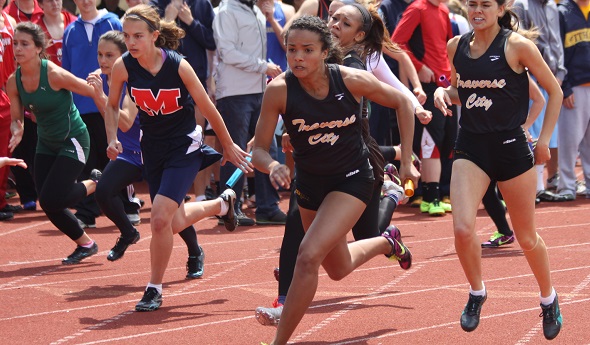
PHOTO: Athletes race toward the finish of a relay during this spring's Alma College Invitational. (Click to see more at HighSchoolsSportsScene.com.)

Health Tip: Game Day Nutrition
September 24, 2019
 By Nick Parkinson, M.Ed., ATC, AT
Henry Ford Health System
Parents, you know how important it is for your student athlete to be well-rested, well-fueled and well-hydrated. Just like a car needs gas, their bodies needs food.
So, whether they’re doing an intense workout during practice or competing in a strenuous game, it’s crucial for them to be properly hydrated and nourished, both before and after, so they can perform their best and recover properly.
Pre-Training Nutrition
The most important part of pre-training nutrition is making sure your child’s food choices give them the healthy energy boost they need for the type of physical activity they’re engaged in, and not a just quick sugar rush.
Carbohydrates may have a bad reputation, but they’re actually the body’s main source of energy. Before a workout, a healthy snack is a great idea. The trick is to eat far enough in advance to be able to digest before being active.
To ensure proper digestion while fueling up, follow these tips:
If there’s less than two hours until go time, try a quick snack like a banana, apple, or a small bowl of Greek yogurt with granola and fruit.
Have a little time to spare? You could try a brown rice bowl with sautéed vegetables or a cup of oatmeal topped with fruit.
Either way, carbs will fuel the body so your child can perform at his or her peak.
Post-Training Nutrition
After an intense workout or game, your child’s body is depleted of its nutrients. It needs to be recharged, which means eating carbs, fats and proteins. The word “fats” tends to scare people, but they’re actually a crucial component in building muscle and recovering.
After an event where your athlete worked out hard, encourage your child to eat something that includes multiples food groups. Try something simple like avocado or peanut butter toast, hummus with veggies and whole-wheat pita, or even a smoothie.
Hydration No Matter What
Regardless of the intensity of the workout, the most important thing is to keep your kid hydrated before, during and after.
It is recommended to top off water intake approximately two hours before any physical activity. Then, athletes should continue hydrating throughout. And while there are many sports drinks to choose from, the healthiest option is water. If you want to add some fun (and natural) flavors to them, try infusing with fruits and/or veggies.
Want to learn more? Henry Ford Health System sports medicine experts are treating the whole athlete, in a whole new way. From nutrition to neurology, and from injury prevention to treatment of sports-related conditions, they can give your athlete a unique game plan.
Visit henryford.com/sports or call (313) 972-4216 for an appointment within 24 business hours.