

Get Prepped for a Fantastic Finale
May 24, 2013
By Geoff Kimmerly
Second Half editor
We love this time of year. And not just because school is nearly out for summer.
There’s little argument that the week ahead is the most exciting of each MHSAA school year. And you’ll want to set your bookmarks for MHSAA.com and Second Half for updated results and coverage not just next week – but through the rest of this spring season.
 The MHSAA.com Score Center is our home for scores from all District softball, baseball and soccer games, which begin Tuesday. You also can view real-time brackets for every District by going to the “Sports” page for each, and updated brackets for lacrosse by visiting our girls and boys pages for that sport as well.
In the Lower Peninsula, we’ll have same day or next morning results as golf Districts are played, and first-day results from next weekend’s Girls Tennis Finals on May 31 – followed by final results at the conclusion of play June 1. We’ll post Finals results for Upper Peninsula golf and tennis as we receive them Wednesday and Thursday, and then results for all seven Lower and Upper Peninsula Track and Field Finals as they come in June 1.
But results are only the start. As we have during the fall and winter, Second Half will provide coverage including photos from every MHSAA Final – beginning with Wednesday’s Upper Peninsula Girls and Boys Golf and Boys Tennis Finals. Keep an eye on Second Half throughout the week, or follow the Second Half feed on the cover page of MHSAA.com.
Transfer rule clarification
We released Monday the actions our Representative Council took earlier this month at its Spring Meeting, including an addition to the athletics-related portion of our transfer rule. Based on some questions we’ve received and read, here’s some further explanation of what will be installed for 2014-15:
The longer period of ineligibility for athletes who transfer because of athletics is not new. This has previously existed for cases in which a school could prove that it lost a student to another school purely for sports-related reasons.
What’s new is what must be proven and by whom for the longer ineligibility period to take effect. Now, a school that lost a student does not have to file a report with the MHSAA for the case to be considered. As long as one of a set of offending activities can be verified – including practicing, competing or training with a member of the new school’s coaching staff during summer or non-school sports activities or seasons – that student will have to sit 180 days instead of the usual period of roughly a semester. The 15 exemptions that allow a student to be eligible immediately – like making a full move to a new district or a student’s school closing – may still apply.
So, to conclude: The longer athletics-related ineligibility period is not new, just how athletics-related transfers are considered and reported. Click to read the full release.
Kickoff is coming
And that means we’re collecting varsity football schedules.
In fact, we have most of them thanks to our athletic directors, their secretaries, coaches and many others who chip in to help us keep complete and accurate information throughout the season.
But there are still plenty of steps in getting ready for August – and a huge one is locking down correct leagues for our teams this season, especially as schools continue to switch things up.
Check out your school’s schedule page by click on the “Schools” button in the menu bar at the top of MHSAA.com and searching for your school. Once on the school page, click the blue “Boys” button next to football. The schedule will appear in the middle of the page, with standings to the left.
See an error in a schedule or the standings? Email me at [email protected]. I thank you in advance.
Kramer’s words of wisdom
Long before Roy Kramer served as athletic director at Vanderbilt University, commissioner of the Southeastern Conference and creator of the Bowl Championship Series (BCS) for Division I college football, he coached multiple sports at East Lansing High School.
He recently was named winner of this year’s Duffy Daugherty Award, given in honor of the former Michigan State University coach to a valued coach or contributor to college football. The award, presented in East Lansing, is among those recognized by the College Football Hall of Fame.
Kramer finished his acceptance speech with a stirring endorsement of the sport that brought the crowd of more than 300 to its feet. If you’re a fan, former or current player or coach, see below.
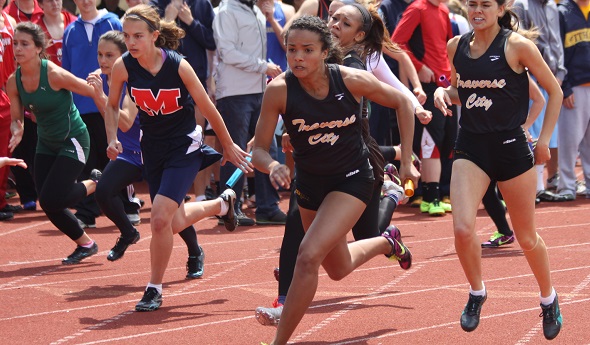
PHOTO: Athletes race toward the finish of a relay during this spring's Alma College Invitational. (Click to see more at HighSchoolsSportsScene.com.)
Participation Again Outpaces Population
August 26, 2019
By Geoff Kimmerly
Second Half editor
For the third straight school year, Michigan in 2018-19 had the eighth-most participants in high school sports nationally according to statistics recently released by the National Federation of State High School Associations, again outpacing the state’s national ranking of 10th for total number of residents of high school age.
Michigan’s participation ranking was based on a number of 292,947, with 126,342 girls and 166,605 boys taking part in high school athletics, and included sports in which the Michigan High School Athletic Association does not conduct postseason tournaments. The totals count students once for each sport in which he or she participates, meaning students who are multiple-sport athletes are counted more than once.
The state’s girls participation ranked eighth nationally for the third straight year, while boys participation fell back to eighth, after moving up one spot to seventh during 2017-18. However, as with overall population, Michigan continued to rank 10th for both females and males ages 14-17 according to the latest U.S. Census Bureau estimates from 2018.
A total of 19 sports bested the state’s overall national participation ranking of eighth by placing seventh or higher on their respective lists. Four Michigan sports improved in national ranking during 2018-19, while the state fell in the rankings of five sports.
Perhaps the most notable improvement among Michigan sports came in boys bowling, where Michigan moved up one spot to second – its highest ranking in any of the 28 sports under MHSAA administration. Michigan previously ranked second nationally in boys bowling as recently as 2013-14 before falling to third for the last four years. Michigan’s boys tennis participation moved up one spot as well to fifth on its ranking list, while girls track & field moved up one spot to seventh and girls lacrosse moved up one spot to 13th after a one-year drop back in 2017-18.
Three of five sports that fell on participation lists still outpaced Michigan’s overall participation rank – girls volleyball fell one spot to fifth, while girls golf and girls competitive cheer both fell one spot to sixth on their respective rankings lists. Other Michigan sports that ranked eighth or higher in 2018-19 were baseball (eighth), girls basketball (sixth), boys basketball (seventh), girls bowling (fourth), girls and boys cross country (both seventh), 11 and 8-player football (sixth and seventh, respectively), boys golf (sixth), boys ice hockey (fourth), girls and boys skiing (both third), girls softball (seventh), girls tennis (third) and boys track & field (seventh).
Boys lacrosse, girls soccer and boys and girls swimming & diving participation all slotted ninth on their respective lists, holding to their 2017-18 rankings and placing still ahead of where Michigan slotted for high school-aged population. Michigan wrestling participation fell two spots to ninth nationally, but still outpaced population, and boys soccer fell one spot to 10th. Girls gymnastics participation ranked 11th nationally for the second straight year.
National participation in high school sports in 2018-19 declined for the first time in 30 years – but the total of 7,937,491 participants still ranked third highest all-time, consisting of 4,534,758 boys and 3,402,733 girls.
Girls volleyball saw the largest increase in participants nationally with 6,225 more this past year over 2017-18, followed by boys track & field (+5,257), girls soccer (+3,623) and girls lacrosse (+3,164).
Football, despite a 5.8-percent decrease from 2017-18, remained the most-played high school sport nationally with 1,006,013 participants. Boys track & field (605,354), boys basketball (540,769), girls track & field (488,267), baseball (482,740), boys soccer (459,077) and girls volleyball (452,808) all saw at least 400,000 participants, while girls basketball (399,067) and girls soccer (394,105) approached that total.
The top 10 states by participants remained the same in 2018-19. Texas and California topped the list again with 825,924 and 824,709 participants, respectively, followed by New York (369,266), Ohio (339,158), Illinois (333,838), Pennsylvania (316,429), Florida (308,173), Michigan (292,947), New Jersey (281,058) and Minnesota (240,487). Only Texas, California and Minnesota reported higher figures than the previous year.
The participation survey has been compiled in its current form by the NFHS since 1971 through numbers it receives from its 51 member state associations, including the District of Columbia. Click to see the complete 2018-19 High School Athletics Participation Survey.
The NFHS, based in Indianapolis, Indiana, is the national leadership organization for high school sports and performing arts activities. Since 1920, the NFHS has led the development of education-based interscholastic sports and performing arts activities that help students succeed in their lives. The NFHS sets direction for the future by building awareness and support, improving the participation experience, establishing consistent standards and rules for competition, and helping those who oversee high school sports and activities. The NFHS writes playing rules for 16 sports for boys and girls at the high school level. Through its 50 member state associations and the District of Columbia, the NFHS reaches more than 19,500 high schools and 12 million participants in high school activity programs, including almost 8 million in high school sports. As the recognized national authority on interscholastic activity programs, the NFHS conducts national meetings, sanctions interstate events, offers online publications and services for high school coaches and officials, sponsors professional organizations for high school coaches, officials, speech and debate coaches, and music adjudicators; serves as the national source for interscholastic coach training and serves as a national information resource of interscholastic athletics and activities.
The MHSAA is a private, not-for-profit corporation of voluntary membership by more than 1,500 public and private senior high schools and junior high/middle schools which exists to develop common rules for athletic eligibility and competition. No government funds or tax dollars support the MHSAA, which was the first such association nationally to not accept membership dues or tournament entry fees from schools. Member schools which enforce these rules are permitted to participate in MHSAA tournaments, which attract more than 1.4 million spectators each year.