

Get Prepped for a Fantastic Finale
May 24, 2013
By Geoff Kimmerly
Second Half editor
We love this time of year. And not just because school is nearly out for summer.
There’s little argument that the week ahead is the most exciting of each MHSAA school year. And you’ll want to set your bookmarks for MHSAA.com and Second Half for updated results and coverage not just next week – but through the rest of this spring season.
 The MHSAA.com Score Center is our home for scores from all District softball, baseball and soccer games, which begin Tuesday. You also can view real-time brackets for every District by going to the “Sports” page for each, and updated brackets for lacrosse by visiting our girls and boys pages for that sport as well.
In the Lower Peninsula, we’ll have same day or next morning results as golf Districts are played, and first-day results from next weekend’s Girls Tennis Finals on May 31 – followed by final results at the conclusion of play June 1. We’ll post Finals results for Upper Peninsula golf and tennis as we receive them Wednesday and Thursday, and then results for all seven Lower and Upper Peninsula Track and Field Finals as they come in June 1.
But results are only the start. As we have during the fall and winter, Second Half will provide coverage including photos from every MHSAA Final – beginning with Wednesday’s Upper Peninsula Girls and Boys Golf and Boys Tennis Finals. Keep an eye on Second Half throughout the week, or follow the Second Half feed on the cover page of MHSAA.com.
Transfer rule clarification
We released Monday the actions our Representative Council took earlier this month at its Spring Meeting, including an addition to the athletics-related portion of our transfer rule. Based on some questions we’ve received and read, here’s some further explanation of what will be installed for 2014-15:
The longer period of ineligibility for athletes who transfer because of athletics is not new. This has previously existed for cases in which a school could prove that it lost a student to another school purely for sports-related reasons.
What’s new is what must be proven and by whom for the longer ineligibility period to take effect. Now, a school that lost a student does not have to file a report with the MHSAA for the case to be considered. As long as one of a set of offending activities can be verified – including practicing, competing or training with a member of the new school’s coaching staff during summer or non-school sports activities or seasons – that student will have to sit 180 days instead of the usual period of roughly a semester. The 15 exemptions that allow a student to be eligible immediately – like making a full move to a new district or a student’s school closing – may still apply.
So, to conclude: The longer athletics-related ineligibility period is not new, just how athletics-related transfers are considered and reported. Click to read the full release.
Kickoff is coming
And that means we’re collecting varsity football schedules.
In fact, we have most of them thanks to our athletic directors, their secretaries, coaches and many others who chip in to help us keep complete and accurate information throughout the season.
But there are still plenty of steps in getting ready for August – and a huge one is locking down correct leagues for our teams this season, especially as schools continue to switch things up.
Check out your school’s schedule page by click on the “Schools” button in the menu bar at the top of MHSAA.com and searching for your school. Once on the school page, click the blue “Boys” button next to football. The schedule will appear in the middle of the page, with standings to the left.
See an error in a schedule or the standings? Email me at [email protected]. I thank you in advance.
Kramer’s words of wisdom
Long before Roy Kramer served as athletic director at Vanderbilt University, commissioner of the Southeastern Conference and creator of the Bowl Championship Series (BCS) for Division I college football, he coached multiple sports at East Lansing High School.
He recently was named winner of this year’s Duffy Daugherty Award, given in honor of the former Michigan State University coach to a valued coach or contributor to college football. The award, presented in East Lansing, is among those recognized by the College Football Hall of Fame.
Kramer finished his acceptance speech with a stirring endorsement of the sport that brought the crowd of more than 300 to its feet. If you’re a fan, former or current player or coach, see below.
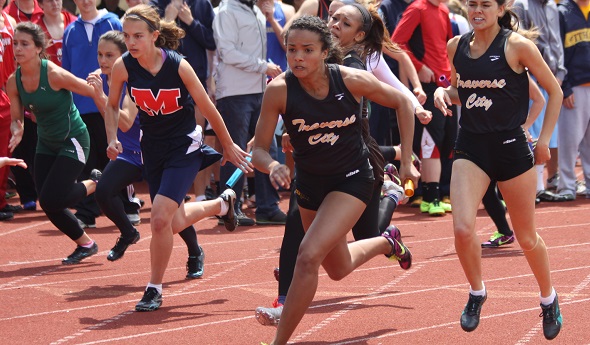
PHOTO: Athletes race toward the finish of a relay during this spring's Alma College Invitational. (Click to see more at HighSchoolsSportsScene.com.)
Officials Eager for New Hockey Format
July 12, 2019
By Rob Kaminski
MHSAA benchmarks editor
Tuesday, Feb. 26, was a particularly busy day on the ice as the 2019 MHSAA Ice Hockey Tournament reached just its second day around the state.
On the slate that night were 27 Regional games, bringing the two-day total to 48 on the heels of Monday’s busy calendar.
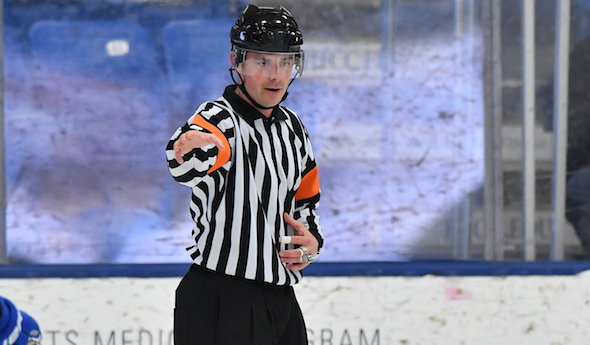
As teams were busy setting their sights on the ultimate goal, so, too, was another group of accomplished skaters who toil with much less fanfare. Nonetheless, the games can’t start without them – the folks in the striped shirts who call the games.
Just as players and coaches will welcome the expanded playoff format in 2020, the officials are looking forward to the change as well.
“When we got to the first week of the tournament, it seemed like we were going every day,” said Jim Gagleard, who assigns officials for the Livonia Ice Hockey Officials Association. “There are only so many officials to go around in any sport. By allowing us as officials a day or two to catch our breath, it’s good. Good for us, and good for players more than anything.”
If it seemed like every day, well, it was. A total of 66 games were played over the first three days, and 89 over the first four. Considering each game at the Regional level has three officials, that computes to 267 officials needed during that span. On the busiest day, 81 had to take to the ice.
Given that there were a total of 302 playoff-eligible officials in 2019, filling those slots can be a logistical nightmare for assigners at times.
“Regional week will see a huge burden alleviated for officials and especially assigners. There will be so much more flexibility under the new format,” said Dan DiCristofaro, President of the Northeast Hockey Referees Association. “Last year, we were faced with so many doubleheaders at single sites, and the first games needed an early start so that the second games would not last late into the evening on school nights.
“At times, the most important factor for the assigner was scheduling those officials who could get to the arena for the early start times. Merit and ability sometimes had to take a back seat.”
Gagleard agrees, saying, “Assigning-wise, early games are the toughest to fill. Everyone has a job, and in order to work a game they have to tell the boss they’re leaving at 2:30 for a 5 o’clock game. You start to look for officials who are retired, or can get out of work, instead of the most qualified. That’s not fair to the teams playing.”
In the northern reaches of the Upper Peninsula, the problem is more acute.
Sean Jacques is the athletic director at Calumet, and also an experienced official, having skated the Division 2 Final in Plymouth in 2016.
“Not enough,” Jacques said, in reference to the number of playoff officials in the UP. “Not enough. When I get the list of eligible officials that is sent to tournament managers, I have to search and scramble to find three people within an 80-mile radius.”
Moving the Quarterfinals to the weekend will definitely help matters, and eliminating Regional doubleheaders should ease the scheduling anxiety as well.
 “With Regionals spread out more, without doubleheaders, officials potentially could work more days,” Jacques said. “And there should be more availability for the Quarterfinals. The last few years, it was in the Sault, and getting four guys to the Sault on a weeknight, whether from Escanaba or northern lower Michigan, was difficult. There were times I’d turn down a Quarterfinal because I just couldn’t get there and back and make it to work the next day. Saturday makes it easier.”
On the west side of the Lower Peninsula, assigner Randy Sheahan uses a mathematical approach to illustrate his challenges, even for the regular season. Sheahan calculates that 98.88 percent of all West Michigan games are scheduled for Wednesday, Friday, or Saturday. Breaking it down further, 84.39 percent skip Wednesday and schedule only Friday or Saturday.
With the shortened regular season coming in 2019-20 to allow for a three-week tournament window, Sheahan took a proactive approach.
“When the MHSAA announced the change to a three-week tournament, I emailed all West Michigan coaches, plus a handful of athletic directors and booster leaders who may be involved in team scheduling,” Sheahan said. “I encouraged them if they are having difficulty squeezing all their games into a window which is now one week shorter, to give further consideration to playing on Mondays, Tuesdays, or Thursdays to greatly alleviate some of the stresses we place on the West Michigan officiating staff.”
As for the MHSAA Tournament, Sheahan agrees with his brethren across the state in metro Detroit that the expansion will benefit assigners, officials, and teams.
“I only see positives,” Sheahan said. “This gives me tremendous flexibility with our staff to maneuver around their professional and personal schedules to keep our best officials on the ice every round, which is an expectation teams have for playoffs. It also provides (at times) much needed rest for officials and teams, especially if they are involved in overtime affairs. This could help with the quality of overall game play.”
That’s the goal for everyone. Fresher legs for players and officials alike will provide a better experience for all involved.
“This allows for physical recovery for everyone on the ice,” said DiCristofaro. “It also allows for better time management for student-athletes, officials and coaches. Even at the Quarterfinal offerings with four officials for each game, we’d run into issues as far as which people could get to places, or wanted to travel and skate late on a work night. Saturday give us much more flexibility and should create more interest in the state tournament.”
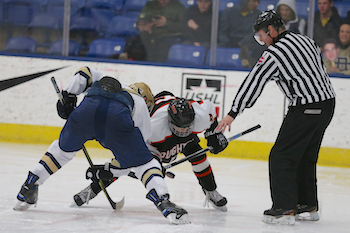
The Quarterfinals, Semifinals and Finals have employed a four-official system in recent years, affording an extra position each game for deserving officials while adding to the quality of the game for participants at the highest level.
Sheahan plans to utilize the new format to continue to reward those among his troops who have earned their stripes for such contests.
“In theory, I may have opportunities to increase game counts for some of our perennial playoff officials, but I have no plans to do that,” Sheahan said. “We have other officials every season who are good enough to skate playoffs and have earned it, but simply couldn’t quite break the playoff bubble. Now the opportunity presents itself to reward some of those officials. It would be counterproductive to officiating development if fewer officials are getting opportunities for important games.”
Similarly, DiCristofaro is hoping the time will come when four officials will be assigned to skate Regional Finals, and perhaps the new length of the postseason will open the door.
“Some of most important games are the Regional Finals. Maybe this new schedule can help,” DiCristofaro said. “Four officials offer teams the best possible ice coverage, and they deserve that.”