


Class D Schools Set Multi-Sport Participation Record, Overall Rate Remains Steady
By
Geoff Kimmerly
MHSAA.com senior editor
September 22, 2026
The MHSAA's eighth Multi-Sport Participation Survey, conducted last spring for the 2025-26 school year, showed just more than 45 percent of athletes at member high schools participated in more than one sport – for the most part consistent with past findings although the state’s smallest schools posted a record high rate of athletes playing more than one sport.
The annual Multi-Sport Participation Survey was inspired by the MHSAA’s Task Force on Multi-Sport Participation, which was appointed in 2016 to study early and intense sport specialization – a serious issue related to health and safety at all levels of youth sports – and to promote multi-sport participation as a way to help stave off overuse injuries and burnout among athletes that have been tied to chronic injuries and health-related problems later in life.
The 2025-26 Multi-Sport Participation Survey received responses from 73.8 percent of member high schools and showed 45.3 percent of athletes at those MHSAA member high schools participating in two or more sports, an almost identical percentage as in 2024-25. For 2025-26, 47.5 percent of male athletes and 42.6 percent of female athletes played multiple sports, again percentages nearly identical to the previous school year. The percentage of multi-sport athletes remains inversely proportional to schools’ enrollments, as Class D schools – the state's smallest – again enjoyed the highest percentage of multi-sport athletes at 64.2 percent, followed by Class C schools (59.5), Class B (49.0) and Class A (38.4).
Results for Class A, B and C schools have remained consistent over the lifetime of the multi-sport participation survey, showing small increases over the years but not overwhelming changes. However, Class D multi-sport participation reached a high in 2025-26, with that 64.2 percent of athletes participating in at least two sports an increase of 6.1 percent since 2017-18. During that time, Class A multi-sport participation is up 3.0 percent, Class B is up 2.3 and Class C is up 4.3.
Battle Creek Harper Creek and Grand Rapids Northview have appeared among the top 10 percent of their respective Classes (A/B/C/D) for multi-sport participation seven of the eight years the survey has been conducted. Three more schools have appeared among the top 10 percent of their respective Classes six of the eight years – Decatur, Detroit Cody and Warren Michigan Collegiate – while East Grand Rapids, Lake Leelanau St. Mary, Manton and Parma Western have appeared among the top 10 percent of their Classes five times apiece.
In Class A, Harper Creek (73.2 percent) posted the highest percentage of multi-sport athletes for 2025-26, followed by Saginaw United (72.7), Harper Woods (72.1) and Macomb L’Anse Creuse North (65.9) also reporting at least 65 percent of athletes playing multiple sports.
Detroit Denby led Class B schools at 83.6 percent of athletes playing more than one sport, followed by Warren Michigan Collegiate (83.3), Ecorse (78.1), Detroit Osborn (75.6), Dearborn Heights Robichaud (76.2) and Flint Hamady (76.1) all topping 75 percent. In Class C, Detroit Community reported all 72 of its athletes played multiple sports during the 2025-26 school year, followed by Galesburg-Augusta (82.7 percent), Kingston (82.1), Niles Brandywine (80.7) and Martin (80.4) reaching 80 percent.
Watersmeet also reported all 27 of its athletes were multi-sport participants, followed in Class D by Lake Leelanau St. Mary (95.5 percent), Carney-Nadeau (94.8), Onekama (92.5) and Atlanta (90.9) reaching 90 percent.
The full summary report on the Multi-Sport Participation Survey is available on the “Multi-Sports Benefits” page.
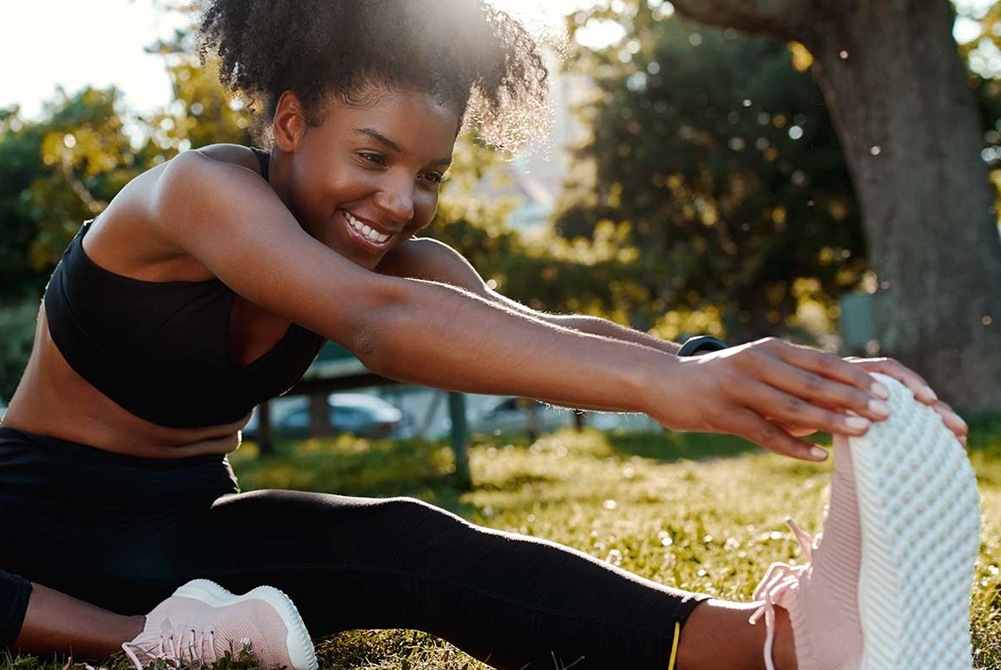
Stretching Done Right: Easy Tips To Stay Limber
By
Christina Chapski, Ed.D., AT, ATC
Henry Ford Health
November 7, 2023
Stretching is more than just a workout suggestion – it's a vital way to avoid injury and get the most out of your activity. You wouldn’t take your car on a long drive without making sure it’s in tip-top shape, right? So before you work up a sweat, work up a stretch.
 One important thing to keep in mind is that dynamic stretching is best. It uses momentum to propel your muscles into an extended range of motion. Unlike static stretching, where you remain in an almost still position, a dynamic warm up is the best way to get your blood flowing and your heart rate pumping.
To get your muscles primed for activity, high knees, "butt kicks" and side shuffling are more effective than standing quad stretches. If you are doing an upright quad stretch, it's best to lean back a little to get the full benefit, since your quads originate from above the hip. Also, remember to always grab the ankle and not the toe.
Here are some other helpful hints on how to warm up the right way:
- For hamstrings: The hamstring muscle attaches to your bones below the knee at the back of the leg, so you want to avoid bending them (which ultimately shortens the muscle you’re trying to stretch). When bending at your back, make sure to keep your spine straight like a table to elongate those muscles. Keep your chin up. If you bend down to touch your toes, there’s no need to hover closer than six inches above the ground – unless you’re able to comfortably do so.
- For pectoral muscles: "Door stretches” offer the best stretch. Simply place your arms out on either side of you as if you were making a “T” with your body. Then, bend your arms up at your elbows so they each form a 90-degree angle. In this position, put your arms on either side of a door frame, with your body within the frame’s opening and walk forward slowly to open up the chest.
- For triceps: Make a gesture like you’re scratching your upper back and be sure to keep your elbows in for maximum benefit.
- For the torso: The iron cross stretch involves putting your arms out at your sides like a “T” and then rotating at your waist side to side. You can also drop down toward the floor and reach for your toes, one side at a time.
Other great tips to add to your stretching repertoire include:
- Don’t forget to keep breathing throughout your stretch. It will help keep your muscle tissue oxygenated.
- Hold each stretch for 10 to 20 seconds, aiming for three repetitions of each. If you prefer, you can split up your stretching throughout the day, or use props like foam rollers to help ease tension in your muscles and break up knots.
- Listen to your body while stretching. Slight pain is acceptable, but if your muscles start shaking, it's a warning for you to stop.
- Don't give up. Stretching progress can be slow, so comparing your progress to that of others will only discourage you. Pay attention to your own progress. Seeing your body become more flexible when you previously weren’t limber will help keep you motivated and is the ultimate reward.
To find a sports medicine doctor or athletic trainer at Henry Ford, visit henryford.com/athletes. Christina Chapski, Ed.D., AT, ATC, is the director of athletic training and community outreach at Henry Ford Health. Read more of Chapski's articles.