

MHSAA Provides Heat & Hydration Reminders with 2026 Fall Practices Soon to Begin
By
Geoff Kimmerly
MHSAA.com senior editor
August 3, 2026
Multiple regions across Michigan approached record-high temperatures this summer, just another reminder of the importance of adhering to hot-weather precautions as schools and families prepare for the start of fall sports practices and competitions this month at Michigan High School Athletic Association member schools.
Each year, the MHSAA provides information to its member schools to help them prepare for hot-weather practice and game conditions during the late summer and early fall. Practices for all Fall 2026 sports – cross country, field hockey, football, Lower Peninsula girls golf, boys soccer, Lower Peninsula girls swimming & diving, Lower Peninsula boys and Upper Peninsula girls tennis, and girls volleyball – may begin Monday, Aug. 10.
The “Health & Safety” page of MHSAA.com has links to several information sources, including the MHSAA preseason publication Heat Ways, which is available for download and includes valuable information on heat management in addition to requirements and resources regarding head injuries, sudden cardiac arrest and emergency action plans.
Heat Ways also again includes a statement on air quality and its potential effects on activity, given conditions across the state especially over the last month resulting from wildfires and smoke they have created.
The first days of formal practices in hot weather should be more for heat acclimatization and instruction than the conditioning of athletes, and practices in such conditions need planning to become longer and more strenuous over a gradual progression of time. Schools also must consider moving practices to different locations or different times of day, or changing practice plans to include different activities depending on the conditions. Furthermore, football practice rules allow for only helmets to be worn during the first two days, only shoulder pads to be added on the third and fourth days, and full pads to not be worn until the fifth day of team practice.
The MHSAA advises student-athletes to make sure to hydrate all day long – beginning before practice, continuing during and also after practice is done. Water and properly-formulated sports drinks are the best choices for hydration. The National Federation of State High School Associations (NFHS) advises that a 6-to-8 percent carbohydrate formulation is the maximum that should be utilized in a sports drink, while fruit juices with greater than 8-percent carbohydrate content and carbonated soda can both result in a bloated feeling and abdominal cramping.
A number of member schools follow the MHSAA’s Model Policy for Managing Heat & Humidity, which while not mandated for member schools was adopted as a rule for MHSAA postseason competition in 2013. The plan directs schools to begin monitoring the heat index at the activity site once the air temperature reaches 80 degrees and provides recommendations when the heat index reaches certain points, including ceasing activities when it rises above 104 degrees. (When the temperature is below 80 degrees, there is no combination of heat and humidity that will result in a need to curtail activity.)
The model heat & humidity policy is outlined in a number of places on the MHSAA Website, including as part of Heat Ways and the football-focused Safety Blitz preseason guide.
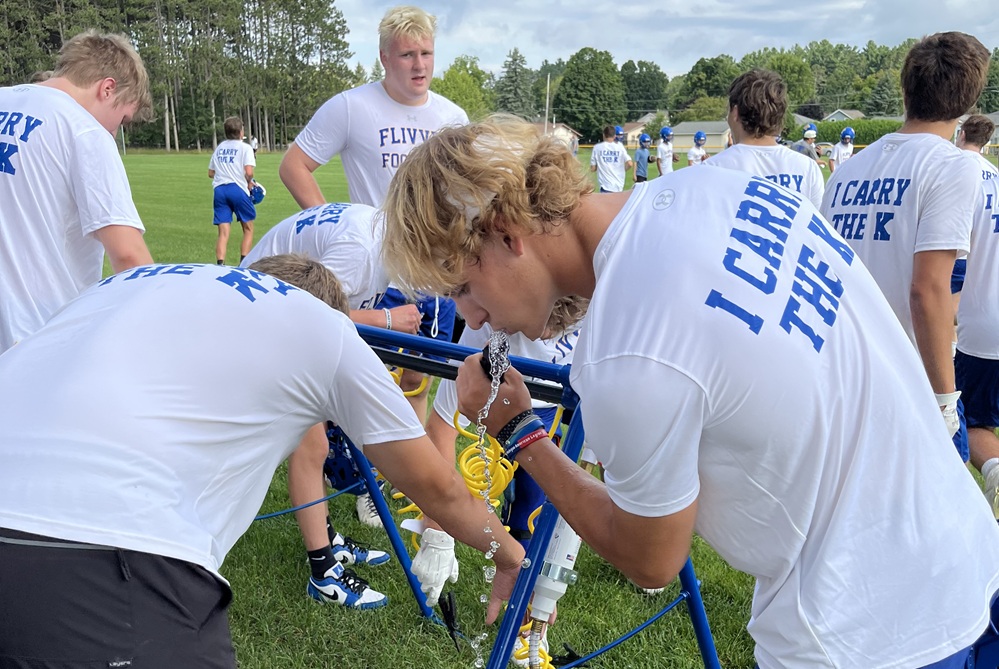
PHOTO Kingsford football players hydrate during last season's first day of practice. (Photo by Keith Dunlap.)

East Kentwood’s Brumels, Gull Lake’s Furlong, East Lansing’s Norris Selected for Bush Awards
By
Geoff Kimmerly
MHSAA.com senior editor
May 23, 2025
East Kentwood athletic director Blaine Brumels, Richland Gull Lake athletic director Karyn Furlong and East Lansing athletic director Nikki Norris are widely regarded as exemplary event hosts after decades of managing countless Michigan High School Athletic Association tournament competitions at their respective schools – and also thriving in leadership positions at the Finals championship level.
Their expertise in fulfilling this essential role in MHSAA postseason play is among several reasons Brumels, Furlong and Norris have been honored as the 2025 recipients of the MHSAA’s Allen W. Bush Award.
Al Bush served as executive director of the MHSAA for 10 years. The award honors individuals for past and continuing service to school athletics as a coach, administrator, official, trainer, doctor or member of the media. The award was developed to bring recognition to people who are giving and serving locally, regionally or statewide without a lot of attention. This is the 34th year of the award.
 For 20 years, Brumels has directed the athletic department for what is currently the largest (by enrollment) school in the MHSAA high school membership with nearly 3,000 students and 30 varsity athletic teams. This is his 34th year total with Kentwood schools and 40th in education.
Brumels came to his longtime district after six years at Fremont, where he taught and coached track & field, football and junior varsity basketball. He spent his first year in Kentwood at the middle school level before moving to the high school as a teacher, and he later assisted in managing athletic events before eventually becoming the athletic director.
Under Brumels’ leadership, East Kentwood has hosted several MHSAA postseason events including Track & Field and Soccer Finals; this season’s Lower Peninsula Division 1 Track & Field Finals will be competed there on May 31. Brumels also has served on several MHSAA committees over his tenure, assisting with selection of basketball and volleyball sites, competitive cheer judges and annual awards. He was named the Regional 4 Athletic Director of the Year in 2016 by the Michigan Interscholastic Athletic Administrators Association (MIAAA).
Brumels has filled several more roles at East Kentwood, including as department chair and MEAP coordinator for mathematics, curriculum council representative, intramural and KIDS program director and senior class advisor, and he has also served on the board for Byron Center Christian School. Brumels earned his bachelor’s degree in mathematics with an emphasis on education from Hope College in 1985 and his master’s in educational leadership from Grand Valley State University in 1992.
“Blaine Brumels is a consummate professional who embraces the philosophy of educational athletics as well as any athletic director in the state – that sports can provide lifelong lessons whether students are state champions or role players on a team,” MHSAA Executive Director Mark Uyl said. “Blaine has been a significant part of passing on those lessons not just through athletics but in several roles as a champion of Kentwood Public Schools and loyal member of the Kentwood community for more than three decades.”
 Furlong has served as athletic director at Richland Gull Lake High School for 11 years and has contributed to her district for nearly three decades, as she also served as varsity volleyball coach for 19 seasons before stepping down after the 2014 season.
As athletic director, Furlong has served on several MHSAA committees including those for officials and site selection for various sports, and she’s part of the administrative teams at the Girls Volleyball and Team Wrestling Finals. She’s currently serving as the MIAAA Region 5 representative, and she’s served as Southwestern Michigan Athletic Conference (SMAC) chairperson for volleyball, competitive cheer, golf, wrestling and basketball. Furlong was named Michigan Wrestling Coaches Athletic Director of the Year in 2023 and Region 5 Athletic Director of the Year by the MIAAA in 2024.
As a coach, Furlong was named Wolverine Conference Coach of the Year multiple seasons and twice Regional Coach of the Year by the Michigan Interscholastic Volleyball Coaches Association (MIVCA). She also has been a registered official the last two school years, currently in volleyball, cross country and track & field.
Prior to taking over at Gull Lake, Furlong served as director of volleyball for nearly 12 years at Courthouse Athletic Center in Kalamazoo and was an event coordinator for the Gull Lake athletic department for two years. She has helped coordinate youth wrestling and basketball programs in the Gull Lake community and worked with the Gull Lake Area Rotary on several events. She earned her bachelor’s degree in finance and business law in 1997 and master’s in sport and fitness administration management in 2003, both from Western Michigan University.
“Karyn Furlong genuinely cares about enriching her community and the kids growing up in Gull Lake. Whether it’s in the building of facilities or managing of programs or hiring of personnel, she always has the end goal of helping students in her school become better people,” Uyl said. “She’s also become a go-to voice in the athletic director community, especially in southwestern Michigan, on how to host events and provide great hospitality to visiting teams and their spectators. It’s that dedication and care that has made her an admired leader locally and across the state.”
 Norris is completing her seventh year as athletic director at East Lansing High School after eight in that position for Corunna Public Schools. She previously taught for six years at Carson City-Crystal and then 11 at Corunna before taking over the Cavaliers’ athletic department during the summer of 2010. She also coached volleyball at multiple levels over more than 15 years including Corunna’s varsity for seven seasons over two tenures, and coached high school basketball for a combined eight years during her time at the two schools where she taught. Additionally, she has served as an MHSAA registered volleyball official for a total of 15 years.
Her schools have hosted various MHSAA Tournament events in multiple sports, and she’s served on every type of MHSAA Committee, providing input on a variety of sports and selection of tournament sites, officials and Scholar-Athlete Award honorees. She also annually contributes as a tournament administrator at the Girls Volleyball and Softball/Baseball/Girls Soccer Finals.
Norris served as MIAAA president in 2021 and 2022 and was named Region 7 Athletic Director of the Year in 2016. She has received “Certified Athletic Administrator” designation from the National Interscholastic Athletic Administrators Association (NIAAA) and was honored with the MHSAA Women In Sports Leadership Award in 2020.
A 1987 graduate of Ithaca High School, Norris received her bachelor’s degree in biology from Alma College and then earned master’s degrees in biological sciences from Michigan State University and educational leadership from American College of Education.
“Nikki Norris is the ultimate utility player in athletic administration. She knows the ins and outs of every sporting event and understands which problems are unique to high school athletics and how to solve them,” Uyl said. “She’s a school-first, sports-second type of athletic director who prioritizes the development of the whole student, and that philosophy and knowledge have made her very well-respected in her field.”
The MHSAA is a private, not-for-profit corporation of voluntary membership by more than 1,500 public and private senior high schools and junior high/middle schools which exists to develop common rules for athletic eligibility and competition. No government funds or tax dollars support the MHSAA, which was the first such association nationally to not accept membership dues or tournament entry fees from schools. Member schools which enforce these rules are permitted to participate in MHSAA tournaments, which attract more than 1.4 million spectators each year.