

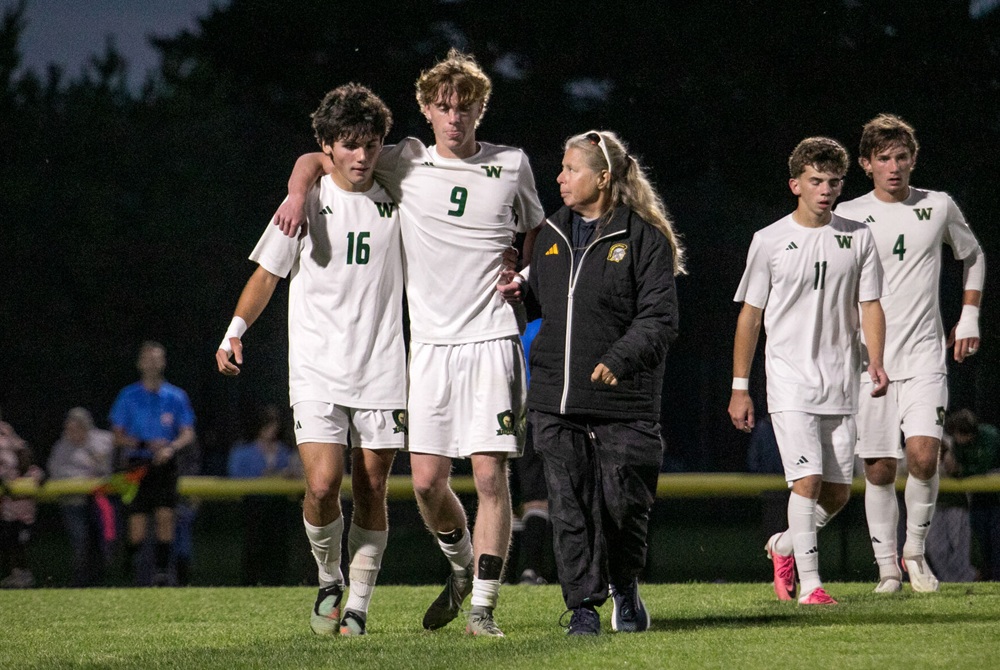
'Trojan Legend' Ream in 37th Year Providing Care as TC Central's Athletic Trainer
By
Tom Spencer
Special for MHSAA.com
September 25, 2026
Traverse City Central’s athletic trainer Amy Ream is exemplary – if not becoming the exception.
 “I've been doing it for the 37 years,” Ream said. “It's probably not the norm anymore – especially being at the same location.”
Ream graduated in 1987 from Central Michigan University with a bachelor’s degree in sports medicine. Her first job was with the Trojans, and it likely will be her last.
Ream also has earned a teaching certificate since joining the staff and added teaching sports medicine classes at Central and Traverse City West to her daily duties.
“It’s been very rewarding ... seeing somebody that has torn their ACL and then the next year, they're able to come back … or someone struggling with an ankle sprain and taking them a couple weeks versus a couple days and they come back,” Ream said. “That's part of the reason why we do it. Being around the kids, they bring all the energy and they’re a joy to be around.”
John Sonneman has been near the Trojans for the past 61 years as a teacher, coach, athletic director and administrator. Nowadays, he’s the very recognizable voice of the Trojans as the public address announcer for football, soccer and track.
Sonneman has seen Ream, whose services are contracted through Munson Medical Center, pretty much do it all since she came on board.
“Amy is a real gem – she's a real pro,” said Sonneman. “She handles herself so well with the students. If you need a ‘ball boy’ she's the ball person. If you need somebody in volleyball to run a line or something like that, she'll do it. She isn't just a trainer.”
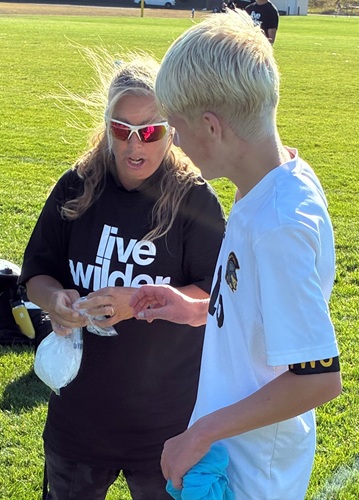
The Central coaching staff agrees. Fourth-year Central soccer coach Gavin Richmond can’t imagine getting through a game without Ream on the sidelines. Ream serves all of Central’s home varsity and junior varsity soccer matches.
“Amy’s always happy, she's always smiling, and the kids all love her, and she's just an incredible human being,” Richmond pointed out. “It's a privilege to work alongside her. I really love it when she's out there on the sidelines with us. It gives me a kind of sense of comfort knowing that anybody that might get hurt is going to get looked after. She's just a true, true, true professional. She’s a Trojan legend.”
Ream has a very busy schedule, attending all Central home football contests, including for freshman and junior varsity. During the same season she’s at Central’s freshman, JV and varsity volleyball home matches.
Ream sees athletic training as one of the best work-life balance careers. “Most of the time you can still have a good work-life balance, which is really nice,” she said.
This winter she’ll support boys and girls wresting, basketball and ice hockey before taking on the Trojans’ lacrosse, baseball, softball and track programs in the spring.
“I don't normally see tennis or golf, but I am there if they need some help,” Ream acknowledged. “I am at the school during sixth hour. There are some kids that come in for treatment if they don't have sixth hour, for taping or whatever, so that they're ready to get out.”
Ream won’t single out a sport as her favorite. But she will admit leans toward football in the fall, hockey in the winter, and softball in the spring.
“Spring depends on the day, but my kids played softball, so its softball,” she admitted. “And, we’re definitely getting more into boys and girls lacrosse.”
Being an athletic trainer has provided Ream opportunities to work at Ford Field, Little Caesars Arena and Comerica Park. Central’s basketball team played an exhibition game at Little Caesars, and West and Central played an outdoor hockey game at Comerica. But the Trojans reaching the MHSAA Division 2 11-Player Football Final at Ford Field in 2021 stands out most.
It happened while COVID-19 restrictions were still in place, and Ream said the pandemic led to schools reducing their athletic training staffs around the state. The sports medicine class she teaches is aimed at recruitment.
“We're trying to recruit – we always already need athletic trainers,” Ream said. “After COVID, athletic trainers were let go and some of them went on to different careers.”
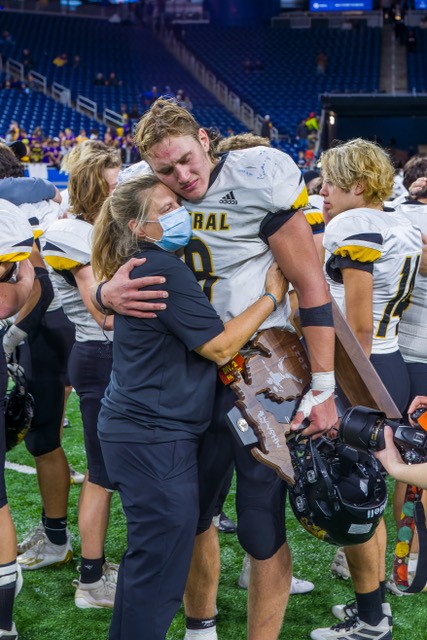
With COVID restrictions in place, Ream was at Ford Field as the Trojans fell to Warren De La Salle Collegiate. That marked the final game of a stellar playing career for Central’s Josh Burnham.
Burnham and Ream embraced after the tough loss during which Burnham had put the Trojans on the board midway through the fourth quarter with a five-yard touchdown run. He also had eight tackles. Burnham went on to play four years at Notre Dame, helping the Irish reach the college football playoffs. He’s using a fifth year of college eligibility to play this season for Indiana, the reigning national champ.
If Ream had a bucket list, getting back to Ford Field would most likely be on it. She has hopes 25-year coach Eric Schugars can lead the Trojans to a return trip. Central did qualify for the playoffs last year and are off to a 2-2 start this fall. The Trojans will look to improve their playoff chances when they host Midland Dow, also 2-2, Friday at Thirlby Field.
Ream has no immediate plans to retire, but the Trojans are nonetheless prepared for it to happen someday. Justin Thorington, the Trojans athletic director, is a 2003 graduate of Central and recalls vividly Ream being a big part of the school’s athletics during his time as a student.
“I love Amy, and I want her to stay as long as she wants to stay and not any longer than she feels like she needs to stay,” Thorington said. “If she told me ‘Hey, I'm hanging ’em up at the end of the year,’ of course we would be like ‘what are we going to do? How are we going to replace her?’ But we would just be so happy for her. I hope she stays another 10 years if she wants to.”
 Tom Spencer is a longtime MHSAA-registered basketball and soccer official, and former softball and baseball official, and he also has coached in the northern Lower Peninsula area. He previously has written for the Saginaw News, Bay County Sports Page and Midland Daily News. He can be reached at [email protected] with story ideas for Manistee, Wexford, Missaukee, Roscommon, Ogemaw, Iosco, Alcona, Oscoda, Crawford, Kalkaska, Grand Traverse, Benzie, Leelanau, Antrim, Otsego, Montmorency, Alpena, Presque Isle, Cheboygan, Charlevoix and Emmet counties.
PHOTOS (Top) Traverse City Central trainer Amy Ream escorts an injured Traverse City West player off the field during Thursday’s game. (Middle) Ream prepares ice for Central’s James Crigier during a junior varsity game at West. (Below) Ream and Josh Burnham embrace after the latter’s final high school football game, at Ford Field. (Top photo by Jan-Michael Stump/Traverse City Record-Eagle. Middle photo by Tom Spencer. Football photo by TC Rick Photo.)
Add Rest Days to Your Workout Routine
June 2, 2020

Henry Ford Health System
Whether you're new to exercise or a seasoned enthusiast, it's tempting to adopt an all-go, no-quit attitude. This is especially common when you're are trying to achieve a fitness goal. Maybe you want to run a 5K, or maybe you have 10 pounds you want to shed before going on vacation.
"Whatever the driver, it's important to remember that scheduling time for rest and rejuvenation is a critical component of any workout regimen," says James Moeller, M.D., a sports medicine specialist at Henry Ford Health System.
Building in Rest Days
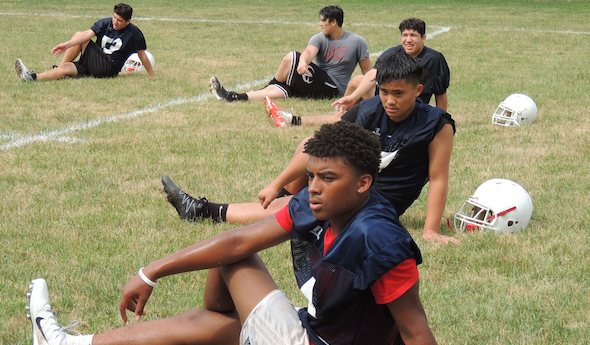
From high-intensity interval training (HIIT) and spin to barre and Zumba, popular workouts increasingly push exercisers to go faster, longer, stronger. This prolonged physical stress can lead to overuse injuries, such as stress fractures, muscle strains and joint pain. Excessive exercise can also lead to hormonal changes, disrupted sleep patterns, decreased immunity and mood swings.
“Working out, especially resistance training, breaks tissues down, causing microscopic damage,” Dr. Moeller says. "Rest days allow your muscles time to rebuild."
So how much rest do you really need? There isn't a one-size-fits-all prescription. Factors like your age, fitness level, the intensity of your workout and the amount of training you do weekly will impact the amount of recovery time you need. But there are some basic guidelines for rest days:
1. Go easy: Rest is a relative term. "It's not just sitting on the couch with an iced tea," says Dr. Moeller. "You may still be exercising on 'rest' days, but at a lower intensity." Maybe you go for a brisk walk or ride your bike to work. Take a yoga class or do some dynamic stretching. The key is to make sure you're not overworking the same body parts.
2. Get sufficient sleep: Sleep is a key component of muscle repair and rebuilding. During sleep, your body’s production of growth hormone increases. Not getting quality shuteye thwarts your body's production of growth hormone and can impact your performance.
3. Give overtaxed muscles a break: You don't need to skip the gym on specific days each week, but you do need to rotate which body parts you're working. The general rule is to give muscles 48 hours to recover after a workout. So it's a good idea to take two to three days off before working the same muscle groups again.
4. Stay hydrated: Make sure to restore lost fluids before, during and after a workout. Dehydration can lead to overheating, headaches and muscle fatigue, among other ailments. You don’t need a sports drink; water is best. "Sports drinks aren't required unless you're getting into very high intensity activity, or exercising for more than one hour at a time," Dr. Moeller says.
5. Pay attention to your body: A lot of people try to work out through pain and fatigue. If there's a heaviness to your movements, or if you feel like your muscles are not responding appropriately to the stress you're providing, take a time out. "It's really about learning to read your body's signals," says Dr. Moeller.
Health authorities and news headlines widely publicize the health benefits of exercise — and the consequences of inactivity. The American Heart Association recommends that adults get at least 150 minutes of moderate-intensity exercise per week, plus strength training two or three days per week. Less discussed are the negative effects of not allowing your body sufficient time to rest.
Getting sufficient rest between workouts is just as important as participating in regular exercise. "Both are part of the total process required to build strength, endurance and muscle mass," Dr. Moeller says.
Want to learn more? Henry Ford Health System sports medicine experts are treating the whole athlete, in a whole new way. From nutrition to neurology, and from injury prevention to treatment of sports-related conditions, they can give your athlete a unique game plan.
Visit henryford.com/sports or call (313) 972-4216 for an appointment within 24 business hours.