

'Trojan Legend' Ream in 37th Year Providing Care as TC Central's Athletic Trainer
By
Tom Spencer
Special for MHSAA.com
September 25, 2026
Traverse City Central’s athletic trainer Amy Ream is exemplary – if not becoming the exception.
 “I've been doing it for the 37 years,” Ream said. “It's probably not the norm anymore – especially being at the same location.”
Ream graduated in 1987 from Central Michigan University with a bachelor’s degree in sports medicine. Her first job was with the Trojans, and it likely will be her last.
Ream also has earned a teaching certificate since joining the staff and added teaching sports medicine classes at Central and Traverse City West to her daily duties.
“It’s been very rewarding ... seeing somebody that has torn their ACL and then the next year, they're able to come back … or someone struggling with an ankle sprain and taking them a couple weeks versus a couple days and they come back,” Ream said. “That's part of the reason why we do it. Being around the kids, they bring all the energy and they’re a joy to be around.”
John Sonneman has been near the Trojans for the past 61 years as a teacher, coach, athletic director and administrator. Nowadays, he’s the very recognizable voice of the Trojans as the public address announcer for football, soccer and track.
Sonneman has seen Ream, whose services are contracted through Munson Medical Center, pretty much do it all since she came on board.
“Amy is a real gem – she's a real pro,” said Sonneman. “She handles herself so well with the students. If you need a ‘ball boy’ she's the ball person. If you need somebody in volleyball to run a line or something like that, she'll do it. She isn't just a trainer.”
The Central coaching staff agrees. Fourth-year Central soccer coach Gavin Richmond can’t imagine getting through a game without Ream on the sidelines. Ream serves all of Central’s home varsity and junior varsity soccer matches.
“Amy’s always happy, she's always smiling, and the kids all love her, and she's just an incredible human being,” Richmond pointed out. “It's a privilege to work alongside her. I really love it when she's out there on the sidelines with us. It gives me a kind of sense of comfort knowing that anybody that might get hurt is going to get looked after. She's just a true, true, true professional. She’s a Trojan legend.”
Ream has a very busy schedule, attending all Central home football contests, including for freshman and junior varsity. During the same season she’s at Central’s freshman, JV and varsity volleyball home matches.
Ream sees athletic training as one of the best work-life balance careers. “Most of the time you can still have a good work-life balance, which is really nice,” she said.
This winter she’ll support boys and girls wresting, basketball and ice hockey before taking on the Trojans’ lacrosse, baseball, softball and track programs in the spring.
“I don't normally see tennis or golf, but I am there if they need some help,” Ream acknowledged. “I am at the school during sixth hour. There are some kids that come in for treatment if they don't have sixth hour, for taping or whatever, so that they're ready to get out.”
Ream won’t single out a sport as her favorite. But she will admit leans toward football in the fall, hockey in the winter, and softball in the spring.
“Spring depends on the day, but my kids played softball, so its softball,” she admitted. “And, we’re definitely getting more into boys and girls lacrosse.”
Being an athletic trainer has provided Ream opportunities to work at Ford Field, Little Caesars Arena and Comerica Park. Central’s basketball team played an exhibition game at Little Caesars, and West and Central played an outdoor hockey game at Comerica. But the Trojans reaching the MHSAA Division 2 11-Player Football Final at Ford Field in 2021 stands out most.
It happened while COVID-19 restrictions were still in place, and Ream said the pandemic led to schools reducing their athletic training staffs around the state. The sports medicine class she teaches is aimed at recruitment.
“We're trying to recruit – we always already need athletic trainers,” Ream said. “After COVID, athletic trainers were let go and some of them went on to different careers.”
With COVID restrictions in place, Ream was at Ford Field as the Trojans fell to Warren De La Salle Collegiate. That marked the final game of a stellar playing career for Central’s Josh Burnham.
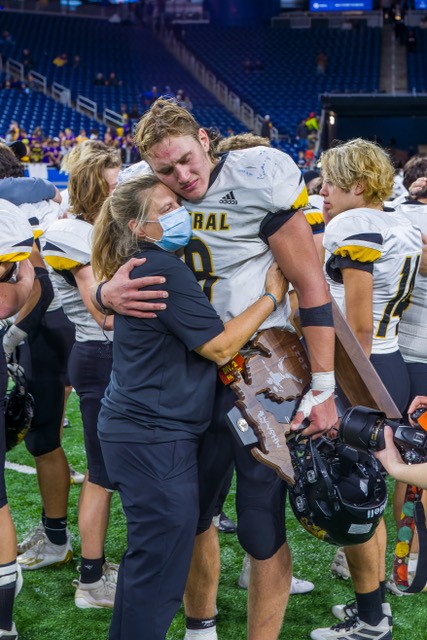
Burnham and Ream embraced after the tough loss during which Burnham had put the Trojans on the board midway through the fourth quarter with a five-yard touchdown run. He also had eight tackles. Burnham went on to play four years at Notre Dame, helping the Irish reach the college football playoffs. He’s using a fifth year of college eligibility to play this season for Indiana, the reigning national champ.
If Ream had a bucket list, getting back to Ford Field would most likely be on it. She has hopes 25-year coach Eric Schugars can lead the Trojans to a return trip. Central did qualify for the playoffs last year and are off to a 2-2 start this fall. The Trojans will look to improve their playoff chances when they host Midland Dow, also 2-2, Friday at Thirlby Field.
Ream has no immediate plans to retire, but the Trojans are nonetheless prepared for it to happen someday. Justin Thorington, the Trojans athletic director, is a 2003 graduate of Central and recalls vividly Ream being a big part of the school’s athletics during his time as a student.
“I love Amy, and I want her to stay as long as she wants to stay and not any longer than she feels like she needs to stay,” Thorington said. “If she told me ‘Hey, I'm hanging ’em up at the end of the year,’ of course we would be like ‘what are we going to do? How are we going to replace her?’ But we would just be so happy for her. I hope she stays another 10 years if she wants to.”
 Tom Spencer is a longtime MHSAA-registered basketball and soccer official, and former softball and baseball official, and he also has coached in the northern Lower Peninsula area. He previously has written for the Saginaw News, Bay County Sports Page and Midland Daily News. He can be reached at [email protected] with story ideas for Manistee, Wexford, Missaukee, Roscommon, Ogemaw, Iosco, Alcona, Oscoda, Crawford, Kalkaska, Grand Traverse, Benzie, Leelanau, Antrim, Otsego, Montmorency, Alpena, Presque Isle, Cheboygan, Charlevoix and Emmet counties.
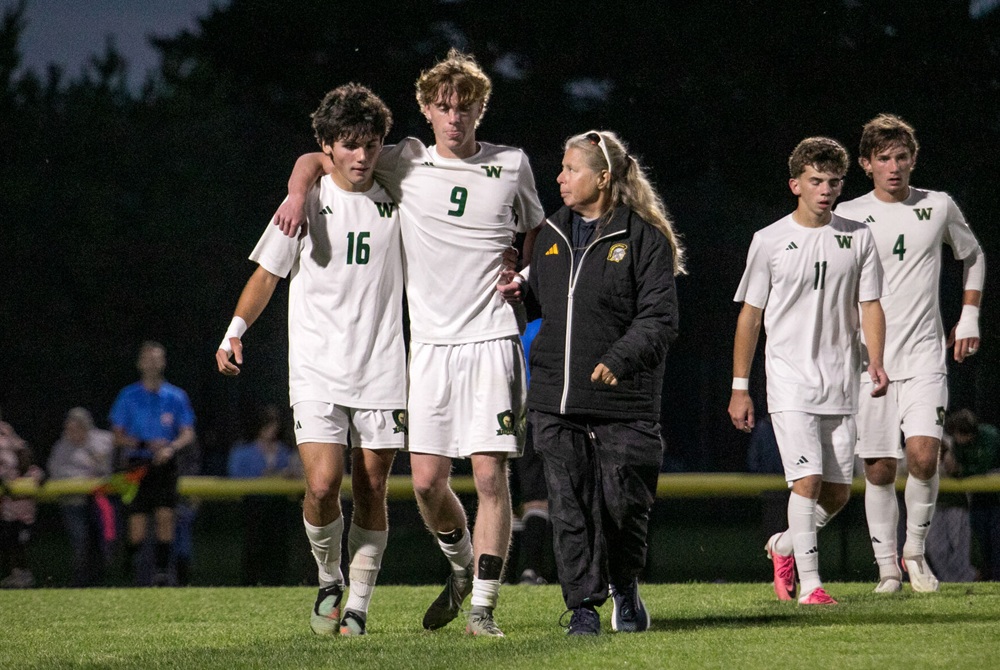
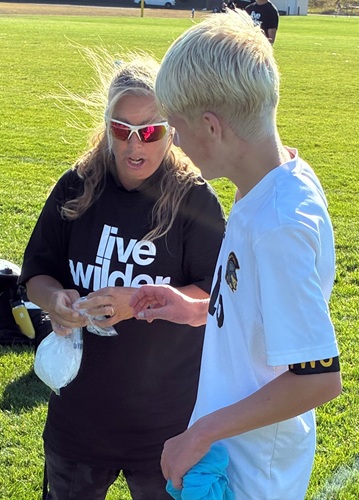
PHOTOS (Top) Traverse City Central trainer Amy Ream escorts an injured Traverse City West player off the field during Thursday’s game. (Middle) Ream prepares ice for Central’s James Crigier during a junior varsity game at West. (Below) Ream and Josh Burnham embrace after the latter’s final high school football game, at Ford Field. (Top photo by Jan-Michael Stump/Traverse City Record-Eagle. Middle photo by Tom Spencer. Football photo by TC Rick Photo.)
5 Tips to Prevent Sports-Related Injuries
December 3, 2019

Henry Ford Health System
Participating in sports provides so many benefits to kids and teens. There are the obvious benefits of physical fitness and promoting regular exercise. Then, there are also the character-building lessons learned from being part of a team, working hard toward a goal, celebrating tough competition and gracefully accepting defeat. But sports don’t come without some risk.
Sports-related injuries are the leading cause of emergency room visits for kids ages 12-17, according to the Centers for Disease Control and Prevention (CDC).
These injuries impact twice as many males as females. Not surprisingly, contact sports also have higher injury rates. Football, basketball, baseball and soccer account for roughly 80 percent of all sports-related emergency room visits for children.
Sports injuries depend on the age of the athlete and the type of sport played, according to Bridget McArdle, D.O., a Henry Ford pediatrician. Generally, she says, sports injuries are divided into two groups: injuries from overuse like strains and tendonitis, and acute injuries such as concussions, fractures and tears.
The teen years pose special hazards, too. The adolescent growth spurt places teens at higher risk for injuries.
“The growth plates could still be open, which increases the risk for damage,” Dr. McArdle says. “This can lead to long-term problems.”
5 Important Injury Prevention Tips
Fortunately, many sports-related injuries can be prevented — the CDC estimates that as many as half of them could be avoided.
Here are Dr. McArdle’s tips for injury prevention for parents and coaches:
1. Ease into training. It’s important to start gradually in order to decrease the chance of sports injuries. “When you train too quickly at full peak, you are more likely to get hurt. Ease into it – and don’t overdo it,” says Dr. McArdle.
2. Cross train. Changing up the way your child trains is one way to help prevent sports injuries. “Taking a break from one sport to play another is important,” she recommends. Training a different way and using different muscles decreases the strain placed on the same body parts. Practicing gentle stretching exercises such as yoga or Pilates can also help, she adds.
3. Use the right equipment. Everything from the proper shoes and appropriate, properly fitted safety gear for the particular sport are essential for minimizing the risk of injury, as well.
4. Avoid excessive heat. The American Academy of Pediatrics (AAP) recommends young athletes avoid heat illness by wearing light clothing and drinking plenty of fluids before, during and after exercise or play. Coaches should decrease or stop practices during high heat or high humidity periods.
5. Take time to recover. If a sports injury does occur, taking time to recover is very important. Returning to play too soon increases the risk of making the injury worse, and increases the chance of long-term consequences. “Make sure the injury is completely healed before returning. Don’t allow your child to play through pain,” advises Dr. McArdle.
If you have questions or concerns about your child’s readiness to play, be sure to get a sports physical and talk with your pediatrician or primary care provider.
Dr. Bridget McArdle is a board-certified pediatrician, seeing patients at Henry Ford Medical Center – Sterling Heights.
Want to learn more? Henry Ford Health System sports medicine experts are treating the whole athlete, in a whole new way. From nutrition to neurology, and from injury prevention to treatment of sports-related conditions, they can give your athlete a unique game plan.
Visit henryford.com/sports or call (313) 972-4216 for an appointment within 24 business hours.