

Why Athletes Should See A Sport Psychologist
By
Elizabeth Swanson
Henry Ford Health
January 9, 2024
Whether at the professional or intramural level, there are so many benefits to being an athlete. Participating in a sport teaches communication skills, how to overcome adversity—and regular exercise has so many incredible health effects on the mind and body.
 But that’s not to say athletes don’t have their own set of challenges. Pressures to perform, physical injuries and intense schedules can take a toll on anyone’s mental health, which is where a sport psychologist comes in.
“It’s helpful that a sport psychologist knows the culture of athletics and the typical stressors that athletes face,” says Seth Swary, Ph.D., a sport psychology clinician at the Henry Ford Center for Athletic Medicine. “We’re familiar with the influence the world of athletics can have on someone and how it can affect their well-being.
“Athletes have a whole team around them to help them perform — athletic trainers, nutritionists, etc.— so why shouldn’t they have an expert who is dedicated to supporting their mental health? A sport psychologist acts as a strength-training coach for the mind.”
Mental Health Challenges That Athletes Face & How Sport Psychology Can Help
Athletes often have a built-in support system: teammates and coaches who know what they’re going through and trainers and physicians who can help manage aches and injuries. But still, it’s not always easy. Some of the difficulties that athletes face include:
- Increased attention on body image. Especially if you play a sport that requires revealing outfits — or a sport with increased focus on weight — it might be difficult to maintain a healthy body image. For some, this can lead to an increased risk of developing an eating disorder.
- The pressure to perform. “If you’re an athlete at the college or professional level and play badly during a game, you get roasted on Twitter,” says Dr. Swary. “But even if you’re not in the public eye, there is pressure to perform — from coaches, teammates, family members.”
- Navigating demanding schedules. “I work with many college athletes and their schedules are packed — practicing at least two hours a day, team meetings, traveling to and from games — and then they’re trying to keep up with school,” says Dr. Swary. “It can be stressful.”
- Debilitating physical injuries. The physical demand of sports can also bring about its own set of challenges — especially when injuries occur. “You’re not only dealing with surgery and rehabilitation, but you’re also out of the game for a while,” says Dr. Swary.
- Making career transitions. “I’ve worked with many athletes who are transitioning from one level of athletics to another (for example, middle school to high school, high school to college, college to professional) along with athletes who are transitioning out of their career,” says Dr. Swary. “They wonder how they can leave this sport they’ve been doing their whole lives — some since they were 3 or 4 years old. It can be a huge part of their identity and a tough transition to make. Even more so if it’s an injury that abruptly derails their career. We can provide them with ways to make a smooth, healthy transition.”
That said, nothing “bad” has to happen to benefit from sport psychology. As Dr. Swary says, you don’t see a personal trainer because you’re not strong, you see a personal trainer because you could benefit from being stronger. It’s the same with sport psychology — and it can help improve your performance.
“We have specific skills we work on for performance optimization,” says Dr. Swary. “How do we talk to ourselves? How do we respond in certain situations? How do we stay in the moment when we’re distracted?
“A high school athlete may have had a rough day at school; then they have to refocus and find energy at the end of the day for their game. It can be helpful for any athlete at any time.”
Reviewed by Seth Swary, Ph.D., a sport psychology clinician at the Henry Ford Center for Athletic Medicine.
To learn more about the sport psychology program at Henry Ford or to request an appointment, visit henryford.com/sportpsychology.
MHSAA Provides Heat & Hydration Reminders with 2026 Fall Practices Soon to Begin
By
Geoff Kimmerly
MHSAA.com senior editor
August 3, 2026
Multiple regions across Michigan approached record-high temperatures this summer, just another reminder of the importance of adhering to hot-weather precautions as schools and families prepare for the start of fall sports practices and competitions this month at Michigan High School Athletic Association member schools.
Each year, the MHSAA provides information to its member schools to help them prepare for hot-weather practice and game conditions during the late summer and early fall. Practices for all Fall 2026 sports – cross country, field hockey, football, Lower Peninsula girls golf, boys soccer, Lower Peninsula girls swimming & diving, Lower Peninsula boys and Upper Peninsula girls tennis, and girls volleyball – may begin Monday, Aug. 10.
The “Health & Safety” page of MHSAA.com has links to several information sources, including the MHSAA preseason publication Heat Ways, which is available for download and includes valuable information on heat management in addition to requirements and resources regarding head injuries, sudden cardiac arrest and emergency action plans.
Heat Ways also again includes a statement on air quality and its potential effects on activity, given conditions across the state especially over the last month resulting from wildfires and smoke they have created.
The first days of formal practices in hot weather should be more for heat acclimatization and instruction than the conditioning of athletes, and practices in such conditions need planning to become longer and more strenuous over a gradual progression of time. Schools also must consider moving practices to different locations or different times of day, or changing practice plans to include different activities depending on the conditions. Furthermore, football practice rules allow for only helmets to be worn during the first two days, only shoulder pads to be added on the third and fourth days, and full pads to not be worn until the fifth day of team practice.
The MHSAA advises student-athletes to make sure to hydrate all day long – beginning before practice, continuing during and also after practice is done. Water and properly-formulated sports drinks are the best choices for hydration. The National Federation of State High School Associations (NFHS) advises that a 6-to-8 percent carbohydrate formulation is the maximum that should be utilized in a sports drink, while fruit juices with greater than 8-percent carbohydrate content and carbonated soda can both result in a bloated feeling and abdominal cramping.
A number of member schools follow the MHSAA’s Model Policy for Managing Heat & Humidity, which while not mandated for member schools was adopted as a rule for MHSAA postseason competition in 2013. The plan directs schools to begin monitoring the heat index at the activity site once the air temperature reaches 80 degrees and provides recommendations when the heat index reaches certain points, including ceasing activities when it rises above 104 degrees. (When the temperature is below 80 degrees, there is no combination of heat and humidity that will result in a need to curtail activity.)
The model heat & humidity policy is outlined in a number of places on the MHSAA Website, including as part of Heat Ways and the football-focused Safety Blitz preseason guide.
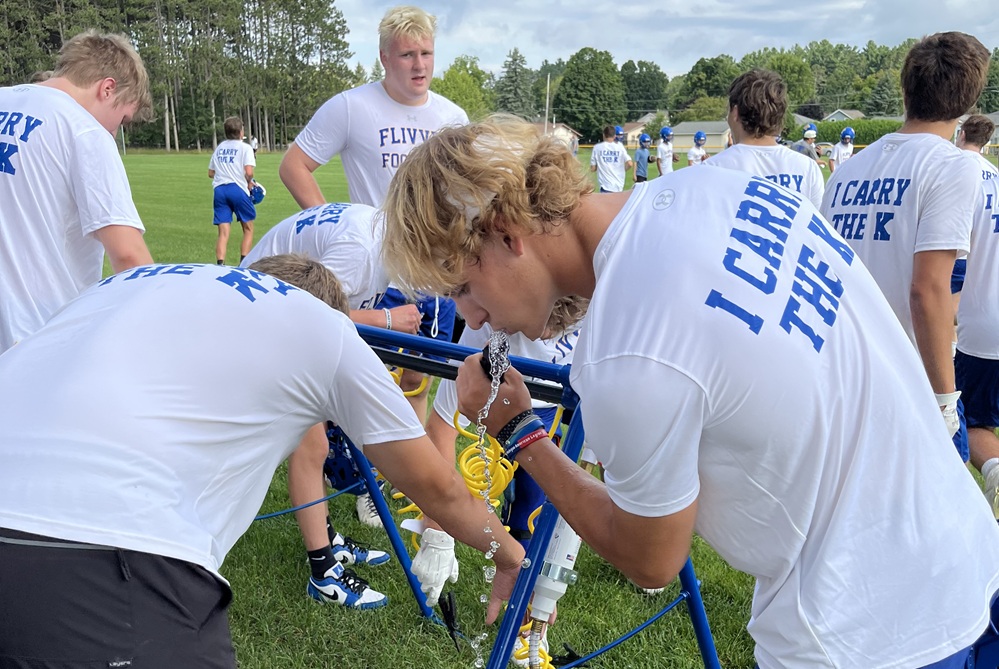
PHOTO Kingsford football players hydrate during last season's first day of practice. (Photo by Keith Dunlap.)