

Howell Puts Heart Into Memorial Meet
August 29, 2013
By Geoff Kimmerly
Second Half editor
An online tribute to Mackenzie Watts describes how she “made the people and world around her better.”
The Howell swimming and diving community continues to work so that her memory makes those who come after her safer as well.
 Watts died in 2005 after suffering a cardiac arrhythmia. She was a 15-year-old sophomore and key cog on her high school team.
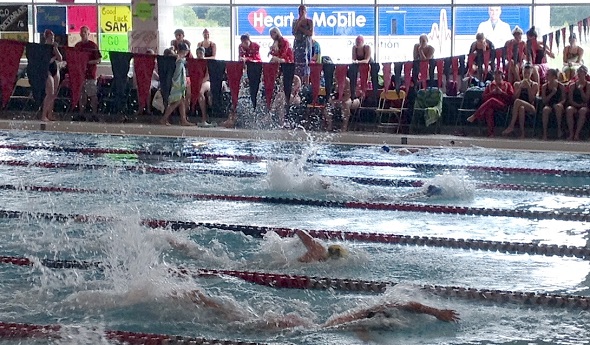
This past weekend, for the sixth straight season, the Highlanders hosted the Kenzie Classic, an invitational that served as a fundraiser for the Howell program and annual Mackenzie Watts scholarship – plus served to promote heart screenings by local National Diagnostic Services in their “HeartMobile” parked outside the pool.
NDS, which also has held screening events at Northville, Canton and Middleville Thornapple Kellogg schools among others, screened 20 students during this Kenzie Classic, said Wellness Director Heidi Enders.
Tests are ultrasound-based and non-invasive, and include an EKG to examine the heart’s electrical system for arrhythmias and an echocardiogram to examine the heart’s structure in case there is a thickening of the muscle (known as hyperthrophic cardiomyopathy). Adults were charged $199 and students $75, with discounted rates for adults in groups and children.
Click to check out coverage of the event from the Livingston County Daily Press & Argus.
Records Revamp
While tracking down 660 football schedules (give or take a few) took up most of the summer, there still was time for a few additions to the MHSAA record book – with more to come.
Track and field fans will notice records from retired yardage events (pre-1982 or earlier depending on the MHSAA class) have been added to the online records here for boys and here for girls.
Cross country fans should check out our lists of top MHSAA Finals times for every division and every class, plus overall top 10 lists for both boys and girls since the race was set to five kilometers in 1980. Click here for girls and here for boys.
Also added or updated were team championship counts for both cross countries, volleyball and girls golf. Click to check out girls golf here and volleyball here.
Fond Football Memories
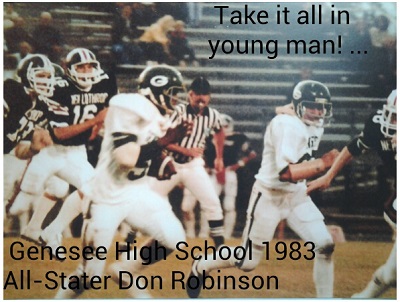
It has been 30 years since former Genesee all-state running back Don Robinson became the fourth player in Genesee County history to run for more than 300 yards in one game – which he did in gaining 317 on Sept. 23, 1983.
 High school football and those memories remain close to his heart even after going on to play at Eastern Michigan University, a stint in the U.S. Navy and a move to Georgia.
He’s paid attention over the years as that “300 club” has grown to 22 players including current New Orleans Saints back Mark Ingram, Jr., and the University of Michigan’s Thomas Rawls.
He’s also a regular reader of Second Half, and asked to send along some words of wisdom to those who will be taking the field to begin the season this weekend:
“When you run out onto the field this season, do me a favor. At least once, pause.
“Look around you. Look at the lights in the sky. See the faces of those that have come to see you play. Listen to the band and the cheerleaders. Look into the eyes of your teammates ...
“Take it all in. When you’re older and miss this amazing game that you are playing, you’ll be glad you did.”
PHOTOS: (Top) A swimmer takes the lead during a race at Saturday's Kenzie Klassic at Howell High School. (Photo courtesy of Howell High School.) (Middle) Genesee graduate Don Robinson runs the ball during the 1983 season. (Photo courtesy of Don Robinson.)
How Acupuncture Can Help Soothe Pregame Anxiety
May 7, 2024
The topic of mental health in sports has been mostly ignored until fairly recently. But thanks to several high-profile athletes’ willingness to open up about their struggles, the topic is no longer quite so taboo.
 “Athletes at all levels are realizing the importance of their overall mental health, mental preparation before an event and mental recovery afterward,” says Thomas R. Betts, DAOM, LAc, a sports medicine acupuncturist at Henry Ford Health. “Having your mind in the right place pays big dividends in terms of sports performance.”
One of the many tools athletes are using to get their minds healthy is acupuncture. It may be an ancient Chinese practice, but it can be useful to help improve the mental health of modern athletes.
What Is Acupuncture?
Acupuncture is a healing technique that has been used in traditional Chinese medicine for thousands of years. Acupuncture practitioners (acupuncturists) insert very fine, thin needles into the skin at various points on the body, depending on what condition they’re treating.
According to traditional Chinese medicine, the insertion points for the needles correspond to specific internal organs or energy channels in the body. “The philosophy behind traditional Chinese medicine is that acupuncture works by manipulating the flow of blood and energy to create balance and harmony in the body,” says Betts.
From a Western medicine perspective, acupuncture works by stimulating the central nervous system and by having some direct effect on the tissues in which needles are placed. Acupuncture also has a balancing effect on hormones within the body. It works well with other treatments for anxiety such as sports psychology, massage therapy, guided visualization and meditation.
How Can Acupuncture Improve Sports Performance?
Acupuncture has long been used to help people relax, reduce stress and cope with anxiety. And it can have that effect even when the acupuncturist is treating a physical problem. “Even when I’m treating an athlete for a sports injury, when I ask how they feel post treatment the overwhelming response I hear is ‘I feel so relaxed,’” says Betts.
This is why acupuncture seems like a natural fit for helping athletes of all levels cope with performance anxiety, pregame jitters or other competition-related fears. “Reducing stress helps athletes perform better,” says Betts. “And more and more athletes are realizing that taking care of their mental health and using tools to stay mentally focused can really enhance their performance.”
When Should Athletes Try Acupuncture?
Since an acupuncture session can leave you feeling super calm and relaxed, you don’t want to try it for the first time right before a game or competition. “The timing is important,” says Betts. “You want the athlete to feel motivated to compete, not totally Zenned out.”
The best approach is to schedule a series of acupuncture sessions in the weeks leading up to a big game, competition or race. Betts says he typically recommends athletes come in twice a week for three weeks to get started. “It’s not about treating their anxiety in the moments before a game,” he says. “It’s about establishing a baseline of calm that they can carry with them into the competition.”
While there’s still some stigma surrounding athletes and mental health, Betts sees the popularity of acupuncture as one sign of a shift. “I think we’re trending in the right direction for mental health,” he says. “Athletes are starting to understand that if they want longevity and success in their sport, they need to take care of their mental and emotional health—not just the physical.”
Reviewed by Thomas Betts, DOAM, RAc, a certified sports acupuncturist who sees patients at the Henry Ford Center for Athletic Medicine in Detroit.
To find a sports medicine provider at Henry Ford Health, visit henryford.com/athletes or call 313-651-1969.