

Howell Puts Heart Into Memorial Meet
August 29, 2013
By Geoff Kimmerly
Second Half editor
An online tribute to Mackenzie Watts describes how she “made the people and world around her better.”
The Howell swimming and diving community continues to work so that her memory makes those who come after her safer as well.
 Watts died in 2005 after suffering a cardiac arrhythmia. She was a 15-year-old sophomore and key cog on her high school team.
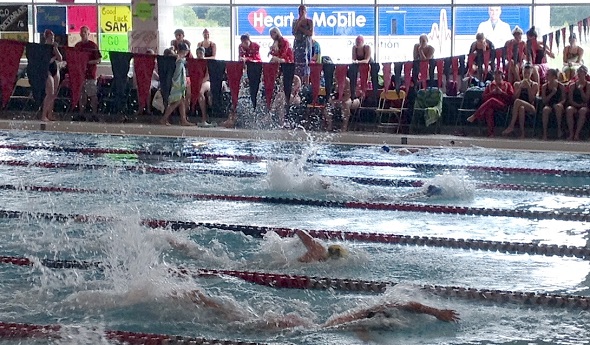
This past weekend, for the sixth straight season, the Highlanders hosted the Kenzie Classic, an invitational that served as a fundraiser for the Howell program and annual Mackenzie Watts scholarship – plus served to promote heart screenings by local National Diagnostic Services in their “HeartMobile” parked outside the pool.
NDS, which also has held screening events at Northville, Canton and Middleville Thornapple Kellogg schools among others, screened 20 students during this Kenzie Classic, said Wellness Director Heidi Enders.
Tests are ultrasound-based and non-invasive, and include an EKG to examine the heart’s electrical system for arrhythmias and an echocardiogram to examine the heart’s structure in case there is a thickening of the muscle (known as hyperthrophic cardiomyopathy). Adults were charged $199 and students $75, with discounted rates for adults in groups and children.
Click to check out coverage of the event from the Livingston County Daily Press & Argus.
Records Revamp
While tracking down 660 football schedules (give or take a few) took up most of the summer, there still was time for a few additions to the MHSAA record book – with more to come.
Track and field fans will notice records from retired yardage events (pre-1982 or earlier depending on the MHSAA class) have been added to the online records here for boys and here for girls.
Cross country fans should check out our lists of top MHSAA Finals times for every division and every class, plus overall top 10 lists for both boys and girls since the race was set to five kilometers in 1980. Click here for girls and here for boys.
Also added or updated were team championship counts for both cross countries, volleyball and girls golf. Click to check out girls golf here and volleyball here.
Fond Football Memories
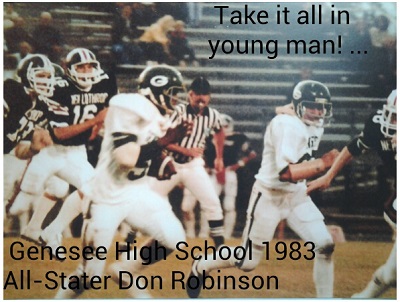
It has been 30 years since former Genesee all-state running back Don Robinson became the fourth player in Genesee County history to run for more than 300 yards in one game – which he did in gaining 317 on Sept. 23, 1983.
 High school football and those memories remain close to his heart even after going on to play at Eastern Michigan University, a stint in the U.S. Navy and a move to Georgia.
He’s paid attention over the years as that “300 club” has grown to 22 players including current New Orleans Saints back Mark Ingram, Jr., and the University of Michigan’s Thomas Rawls.
He’s also a regular reader of Second Half, and asked to send along some words of wisdom to those who will be taking the field to begin the season this weekend:
“When you run out onto the field this season, do me a favor. At least once, pause.
“Look around you. Look at the lights in the sky. See the faces of those that have come to see you play. Listen to the band and the cheerleaders. Look into the eyes of your teammates ...
“Take it all in. When you’re older and miss this amazing game that you are playing, you’ll be glad you did.”
PHOTOS: (Top) A swimmer takes the lead during a race at Saturday's Kenzie Klassic at Howell High School. (Photo courtesy of Howell High School.) (Middle) Genesee graduate Don Robinson runs the ball during the 1983 season. (Photo courtesy of Don Robinson.)

5 Strategies To Improve Range Of Motion
March 6, 2024
When it comes to health and fitness, regular exercise and strength training get the most attention. But it turns out that improving your range of motion may pay greater dividends, particularly over the long haul.
“All kinds of things can impact our range of motion,” says Jennifer Burnham, an athletic trainer at Henry Ford Health. “As we age, our joints become less pliable, but any kind of surgery or injury can also impact our range of motion. And if you're somebody who sits at a desk all day long, that can affect your range of motion as well.”
Why Is Improving Flexibility Important?
Staying active with regular cardiovascular exercise and strength training is a great way to maintain your overall physical health. But it’s important to remember that flexibility exercises come with plenty of perks, too, including:
- Preventing injury
- Staving off arthritis by lubricating joints and tissues
- Improving posture and balance
"Unfortunately, if you have limited range of motion, you may perform tasks incorrectly, causing other muscles and joints to overcompensate for the lack of mobility,” Burnham says. “Over time, that compensation mechanism can increase the risk of injury.”
To complicate matters, our lifestyles often don’t support our range of motion goals. Many of us spend most of our days sitting at a desk or hunched over a screen. And when we’re not sitting still, most of us are slouching.
What Are Some Ways To Improve Range Of Motion?
You don’t have to be able to twist your limbs into a pretzel to achieve full range of motion. Instead, try to improve on your current level of flexibility with these five simple strategies:
- Pay attention to timing. If you’re not ready to add a stretching day to your workout regimen, consider adding a set of flexibility exercises at the end of every session. Pre-workout stretching is helpful, too, but stretching when your muscles are warm is a more effective way to stave off injuries.
- Focus on mobility and stability. Even if you can do the splits or touch your toes to the back of your head, you won’t be able to hold the position if you don’t also have strong core muscles. “Most people do stabilizing exercises such as strength training and lifting weights without paying much attention to mobilizing activities like stretching and yoga,” Burnham says. “But you really need to do both stabilizing and flexibility exercises to get an effective workout.”
- Do a mix of dynamic and static stretches. Two types of stretches can help you gain an edge when it comes to improving range of motion: Dynamic (an active type of stretching where you’re moving within your range of motion) and static stretching (where you hold a stretch). Dynamic stretching with arm and head circles, side stretches, and hip circles before exercise is a good way to warm up cool muscles and help lubricate the joints. With static stretching such as touching your toes to stretch your hamstrings, the goal is to hold a position for 30 seconds or more. Static stretches are often best performed after a workout when your muscles are warm.
- Try foam rolling. Foam rollers act almost like a rolling pin to smooth out tight muscles. Used correctly, they can help improve range of motion — and release stress and tension. You can use foam rollers to prime your body for exercise, or to recover after a workout.
- Aim for balance. If one part of your body is super flexible, focus on increasing range of motion in the opposing muscle group. “So, for example, if your hamstrings are very flexible, make sure to target your quadriceps with flexibility exercises,” Burnham says. “The goal is to make sure you’re aiming for balancing in your body.”
While stretching is an important way to achieve and maintain balance, flexibility and range of motion, it isn’t always intuitive. Not sure where to begin? Consider meeting with a personal trainer or athletic trainer to help you devise a program.
“Watching YouTube videos can be helpful, but if you’ve never done flexibility exercises before, you could overstretch your muscles or find yourself in an incorrect position to stretch,” Burnham says. “And yes, you can create bodily injury by overstretching.”
To find a sports medicine provider at Henry Ford Health, visit henryford.com/sportsmedicine or call 313-651-1969.
Reviewed by Jennifer Burnham, MS, AT, ATC, CSCS, a certified athletic trainer at the Henry Ford Center for Athletic Medicine.