


Howell Puts Heart Into Memorial Meet
August 29, 2013
By Geoff Kimmerly
Second Half editor
An online tribute to Mackenzie Watts describes how she “made the people and world around her better.”
The Howell swimming and diving community continues to work so that her memory makes those who come after her safer as well.
 Watts died in 2005 after suffering a cardiac arrhythmia. She was a 15-year-old sophomore and key cog on her high school team.
This past weekend, for the sixth straight season, the Highlanders hosted the Kenzie Classic, an invitational that served as a fundraiser for the Howell program and annual Mackenzie Watts scholarship – plus served to promote heart screenings by local National Diagnostic Services in their “HeartMobile” parked outside the pool.
NDS, which also has held screening events at Northville, Canton and Middleville Thornapple Kellogg schools among others, screened 20 students during this Kenzie Classic, said Wellness Director Heidi Enders.
Tests are ultrasound-based and non-invasive, and include an EKG to examine the heart’s electrical system for arrhythmias and an echocardiogram to examine the heart’s structure in case there is a thickening of the muscle (known as hyperthrophic cardiomyopathy). Adults were charged $199 and students $75, with discounted rates for adults in groups and children.
Click to check out coverage of the event from the Livingston County Daily Press & Argus.
Records Revamp
While tracking down 660 football schedules (give or take a few) took up most of the summer, there still was time for a few additions to the MHSAA record book – with more to come.
Track and field fans will notice records from retired yardage events (pre-1982 or earlier depending on the MHSAA class) have been added to the online records here for boys and here for girls.
Cross country fans should check out our lists of top MHSAA Finals times for every division and every class, plus overall top 10 lists for both boys and girls since the race was set to five kilometers in 1980. Click here for girls and here for boys.
Also added or updated were team championship counts for both cross countries, volleyball and girls golf. Click to check out girls golf here and volleyball here.
Fond Football Memories
It has been 30 years since former Genesee all-state running back Don Robinson became the fourth player in Genesee County history to run for more than 300 yards in one game – which he did in gaining 317 on Sept. 23, 1983.
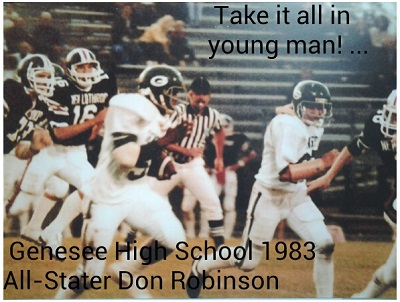 High school football and those memories remain close to his heart even after going on to play at Eastern Michigan University, a stint in the U.S. Navy and a move to Georgia.
He’s paid attention over the years as that “300 club” has grown to 22 players including current New Orleans Saints back Mark Ingram, Jr., and the University of Michigan’s Thomas Rawls.
He’s also a regular reader of Second Half, and asked to send along some words of wisdom to those who will be taking the field to begin the season this weekend:
“When you run out onto the field this season, do me a favor. At least once, pause.
“Look around you. Look at the lights in the sky. See the faces of those that have come to see you play. Listen to the band and the cheerleaders. Look into the eyes of your teammates ...
“Take it all in. When you’re older and miss this amazing game that you are playing, you’ll be glad you did.”
PHOTOS: (Top) A swimmer takes the lead during a race at Saturday's Kenzie Klassic at Howell High School. (Photo courtesy of Howell High School.) (Middle) Genesee graduate Don Robinson runs the ball during the 1983 season. (Photo courtesy of Don Robinson.)
6 Tips for the Best Cold-Weather Workout
December 6, 2022
With temperatures getting colder, it may be tempting to get back to the gym.
 But it’s still possible to get your exercise outdoors if you prepare properly to counter the chillier conditions that accompany living in Michigan this time of year.
Winter Weather Workout Tips
While cold air can make it challenging to breathe, our bodies adjust to reduced temperatures over time. The key thing to watch for is hypothermia (dangerously low body heat).
"Viruses are more likely to attack our bodies if we're in a cold state," says Ramsey Shehab, M.D., a sports medicine specialist at Henry Ford Health. "If your internal body temperature drops significantly, it can suppress your immune system and make you more vulnerable to infection."
The good news: Adopting these six strategies can help ensure your outdoor workouts are safe and effective.
Check the forecast. Know what the outdoor weather is and plan accordingly. Pay attention to the temperature, wind and moisture level. If temps dip below zero, the wind chill is extreme, or it's raining or snowing, exercising outside can be risky.
Dress in layers. Dressing too warmly can increase your risk of overheating (even in frigid air). Instead, dress in layers so you can remove layers as you warm up. "The innermost layer should be made of moisture-wicking material," Dr. Shehab says. "The middle layer should have thermal protection like wool or fleece, and the outermost layer should be waterproof and breathable to protect you from wind, rain and sleet." If you get wet and moisture soaks through your clothing, you may not be able to keep your core body temperature up.
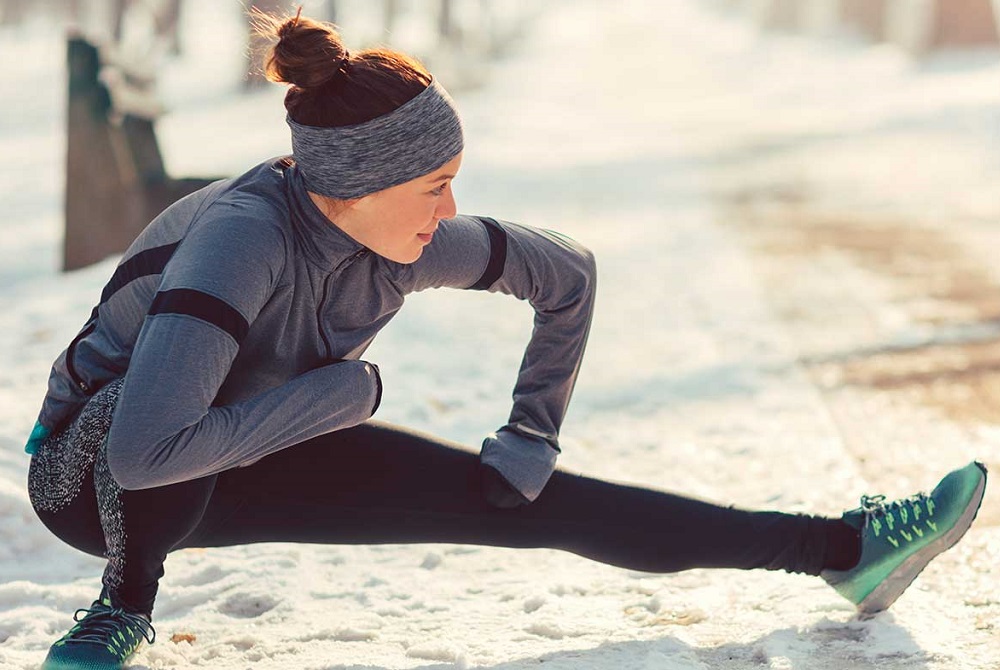
Pay attention to your hands, feet and head. When you're engaged in a heart-pumping workout, blood flows to your core, leaving your fingers, toes and head vulnerable to the cold. Wear a hat, gloves and warm socks. If it's especially chilly, consider wearing a scarf.
Take time to warm up (and cool down). Instead of leaving your cozy house and launching straight into a sprint, take time to warm up your major muscle groups. "Your joints may be stiffer when it's cold, so warming up and stretching out is especially important during the winter months," Dr. Shehab says.
Stay hydrated. People tend to think more about dehydration during the summer months, but you can get dehydrated in the winter, too. "Proper hydration before, during and after exercise is very important, not just to maintain health and well-being, but also to stave off infection," Dr. Shehab says.
Take a vitamin D supplement. Even though you're exercising outdoors, sunlight is in low supply in Michigan during the winter. To keep your immune system humming, consider taking a vitamin D supplement. "Making sure you have sufficient vitamin D can enhance your bone health, boost your immune system and keep your hormones in balance," Dr. Shehab says.
Get Savvy About Outdoor Workouts
Frigid temperatures can create obstacles for even the most enthusiastic exercisers. While it's tempting to table exercise until warmer weather returns, there are things you can do to make outdoor — and indoor — workouts more enjoyable.
You don't have to stick to the same routine of running, walking and circuit training. Take advantage of the winter chill to participate in activities like ice skating, sledding, hiking, skiing and cross-country skiing. You can even take interval workouts outdoors. Climb stairs, hike up hills or just play with a kettlebell in the snow.
"Exercise is medicine," Dr. Shehab says. "It can sometimes replace medication for people who have diabetes, hypertension and other chronic conditions. It's good for the mind and the body, and it can help stave off infections, including COVID-19."
The caveat: Working out, outdoors or indoors, is not recommended for people who are currently battling the coronavirus. Instead, it's important to preserve your energy. Once your symptoms begin to improve, you can gradually increase your exercise level.
To find a doctor or athletic trainer at Henry Ford, visit henryford.com or call 1-800-HENRYFORD (436-7936).
Dr. Ramsey Shehab is the deputy chief of Sports Medicine at Henry Ford Health. He sees patients at the Henry Ford Center for Athletic Medicine and Henry Ford Medical Center - Bloomfield Township.