


Howell Puts Heart Into Memorial Meet
August 29, 2013
By Geoff Kimmerly
Second Half editor
An online tribute to Mackenzie Watts describes how she “made the people and world around her better.”
The Howell swimming and diving community continues to work so that her memory makes those who come after her safer as well.
 Watts died in 2005 after suffering a cardiac arrhythmia. She was a 15-year-old sophomore and key cog on her high school team.
This past weekend, for the sixth straight season, the Highlanders hosted the Kenzie Classic, an invitational that served as a fundraiser for the Howell program and annual Mackenzie Watts scholarship – plus served to promote heart screenings by local National Diagnostic Services in their “HeartMobile” parked outside the pool.
NDS, which also has held screening events at Northville, Canton and Middleville Thornapple Kellogg schools among others, screened 20 students during this Kenzie Classic, said Wellness Director Heidi Enders.
Tests are ultrasound-based and non-invasive, and include an EKG to examine the heart’s electrical system for arrhythmias and an echocardiogram to examine the heart’s structure in case there is a thickening of the muscle (known as hyperthrophic cardiomyopathy). Adults were charged $199 and students $75, with discounted rates for adults in groups and children.
Click to check out coverage of the event from the Livingston County Daily Press & Argus.
Records Revamp
While tracking down 660 football schedules (give or take a few) took up most of the summer, there still was time for a few additions to the MHSAA record book – with more to come.
Track and field fans will notice records from retired yardage events (pre-1982 or earlier depending on the MHSAA class) have been added to the online records here for boys and here for girls.
Cross country fans should check out our lists of top MHSAA Finals times for every division and every class, plus overall top 10 lists for both boys and girls since the race was set to five kilometers in 1980. Click here for girls and here for boys.
Also added or updated were team championship counts for both cross countries, volleyball and girls golf. Click to check out girls golf here and volleyball here.
Fond Football Memories
It has been 30 years since former Genesee all-state running back Don Robinson became the fourth player in Genesee County history to run for more than 300 yards in one game – which he did in gaining 317 on Sept. 23, 1983.
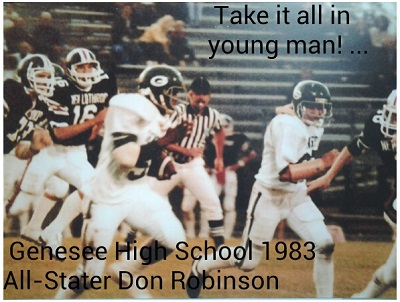 High school football and those memories remain close to his heart even after going on to play at Eastern Michigan University, a stint in the U.S. Navy and a move to Georgia.
He’s paid attention over the years as that “300 club” has grown to 22 players including current New Orleans Saints back Mark Ingram, Jr., and the University of Michigan’s Thomas Rawls.
He’s also a regular reader of Second Half, and asked to send along some words of wisdom to those who will be taking the field to begin the season this weekend:
“When you run out onto the field this season, do me a favor. At least once, pause.
“Look around you. Look at the lights in the sky. See the faces of those that have come to see you play. Listen to the band and the cheerleaders. Look into the eyes of your teammates ...
“Take it all in. When you’re older and miss this amazing game that you are playing, you’ll be glad you did.”
PHOTOS: (Top) A swimmer takes the lead during a race at Saturday's Kenzie Klassic at Howell High School. (Photo courtesy of Howell High School.) (Middle) Genesee graduate Don Robinson runs the ball during the 1983 season. (Photo courtesy of Don Robinson.)
MHSAA Vault: MIS Rose to Challenges to Host 2020 LP Finals
By
Rob Kaminski
MHSAA benchmarks editor
November 12, 2021
The “MHSAA Vault” features stories from past publications and other documents in the MHSAA Library. This issue takes a look at the MHSAA Cross Country Finals at Michigan International Speedway, which celebrated 25 years in 2020 – although it was an event that nearly didn’t happen last fall …
In 1996, the MHSAA and Michigan International Speedway began a partnership the changed the course of the Lower Peninsula Cross Country Finals – quite literally.
The land in and around the track at Brooklyn would host the Finals for all classes of runners in one place on one day, an annual festival of nearly 2,000 runners competing for the MHSAA’s top honors.
Even skeptics – and there were several among running purists who thought the course was too flat, for example – can’t deny the results.
Finals attendance nearly doubled in that first year, and crowds in excess of 10,000 have enjoyed a day of racing several times, including a record 12,153 in 2011.
Enthusiastic crowds were the norm in recent years, with 11,232 in 2017, and nearly 11,000 in 2018 (10,989) and 2019 (10,873).
In fact, attendance failed to reach at least 8,000 only twice since the move to MIS.
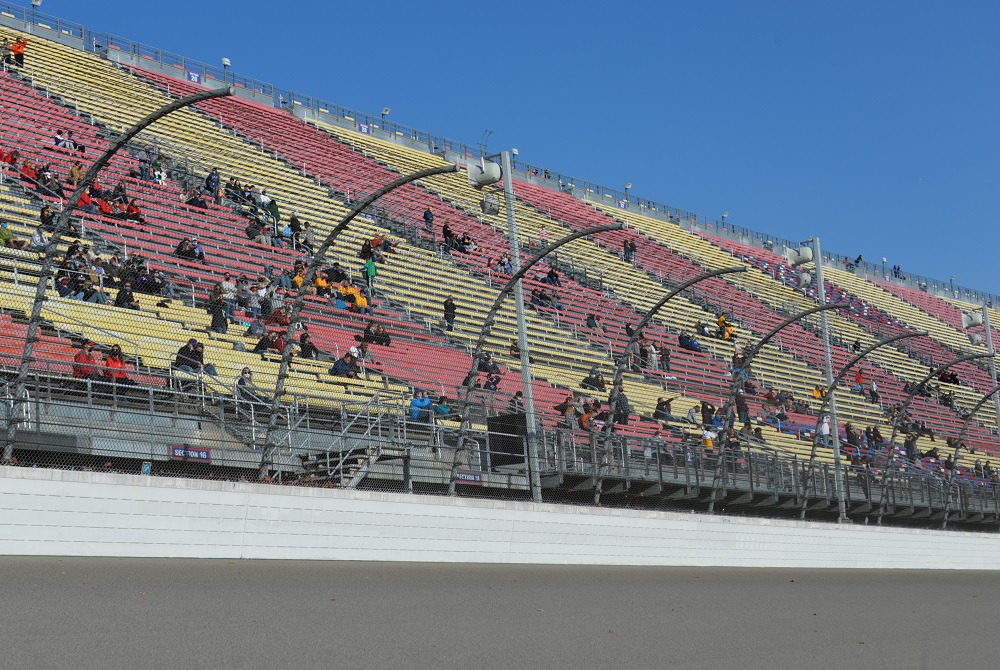
Of course, last year was an exception, when attendance was limited to 1,000 spectators per session due to the COVID-19 Pandemic. Fans also were restricted to the grandstands rather than following the action throughout locations on the course.
To reduce the number of runners in each race, the event was spread over two days, with each Division being run in two separate “sections” with times then combined at the end to determine team and individual champions.
While not ideal, the end result was another year of fantastic efforts at MIS – both from student-athletes and those behind the scenes.
“Even at the last hour, less than a week ahead of the Finals, we were closer to not having the Finals than we were to having them,” said MHSAA Assistant Director Cody Inglis, who coordinates the cross country postseason. “Rumors and challenges of mandated shutdowns, testing and other requirements were being discussed and caused a lot of unknowns. Even at the Regional level, we had schools, Regional courses and hosts shutting down their facilities; we had to relocate four Regionals 48 hours prior to race times. That scenario just could not happen at the Finals level where far more runners and much more travel would be involved.”
Among the many last-minute hurdles was the edict from NASCAR – which owns MIS – that all persons on site be temperature checked upon entry. That meant securing thermometers that were easy to operate in short order, along with personnel necessary to conduct the readings.
The attendance limitations certainly helped to implement the temperature screening, but brought their own issues.
“Limiting spectators was not a popular decision, but it really was the only way to have a race,” Inglis said. “We were taking direction and working with policies and protocols from the MDHHS, the Governor’s office, Lenawee County Health Department, MIS and NASCAR.”
Part of the solution was to utilize the grandstands as a “barrier” between participants and spectators. The reduced number of fans were dispersed over thousands of seats while still allowing them the chance to watch their student-athletes compete.
“It wasn’t the same, it wasn’t easy or perfect, but it was what we had to do to have a race,” Inglis said. “Separating the Finals into two days and different sections also allowed us to spread out the event and limit the number of people on site at any one time. This was a key part of the plan and worked well even though it separated races within a Division.”
The MHSAA, MIS and the cross country community never lost focus of the main goal: a culmination of the season for the student-athletes, who deserved something last year more than ever. And, more than ever, MIS once again displayed its advantage as a venue that could adapt to the fluid nature of the times to pull off the event.
“There were some thoughts of using four different sites, but as we learned during the Regionals, the climate of things was so tenuous from one area of the state to another that we couldn’t be 100-percent certain that there wouldn’t again be last-minute cancelations,” Inglis said. “MIS was wonderful to work and collaborate with, and was the best option to get it done. It was never mentioned once publicly about the possibility of not having the Finals – only how we could best do it under uncharted conditions.”
The moving parts and ever-changing scenarios created more complexity than ever in finalizing a season, but every decision was made with the complete desire to conduct the Finals as close to normal as possible.
“I firmly believe that a finish to the season, no matter the differences in race formatting and fan experience, was something everyone would have taken when the season began in August,” Inglis said.
Indeed, the finish line in Year 25 at MIS might have been the most gratifying of them all.