

Howell Puts Heart Into Memorial Meet
August 29, 2013
By Geoff Kimmerly
Second Half editor
An online tribute to Mackenzie Watts describes how she “made the people and world around her better.”
The Howell swimming and diving community continues to work so that her memory makes those who come after her safer as well.
 Watts died in 2005 after suffering a cardiac arrhythmia. She was a 15-year-old sophomore and key cog on her high school team.
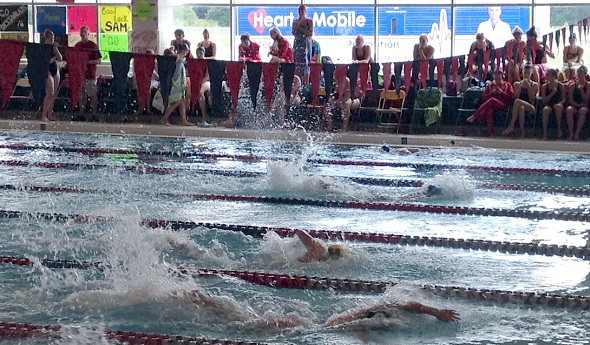
This past weekend, for the sixth straight season, the Highlanders hosted the Kenzie Classic, an invitational that served as a fundraiser for the Howell program and annual Mackenzie Watts scholarship – plus served to promote heart screenings by local National Diagnostic Services in their “HeartMobile” parked outside the pool.
NDS, which also has held screening events at Northville, Canton and Middleville Thornapple Kellogg schools among others, screened 20 students during this Kenzie Classic, said Wellness Director Heidi Enders.
Tests are ultrasound-based and non-invasive, and include an EKG to examine the heart’s electrical system for arrhythmias and an echocardiogram to examine the heart’s structure in case there is a thickening of the muscle (known as hyperthrophic cardiomyopathy). Adults were charged $199 and students $75, with discounted rates for adults in groups and children.
Click to check out coverage of the event from the Livingston County Daily Press & Argus.
Records Revamp
While tracking down 660 football schedules (give or take a few) took up most of the summer, there still was time for a few additions to the MHSAA record book – with more to come.
Track and field fans will notice records from retired yardage events (pre-1982 or earlier depending on the MHSAA class) have been added to the online records here for boys and here for girls.
Cross country fans should check out our lists of top MHSAA Finals times for every division and every class, plus overall top 10 lists for both boys and girls since the race was set to five kilometers in 1980. Click here for girls and here for boys.
Also added or updated were team championship counts for both cross countries, volleyball and girls golf. Click to check out girls golf here and volleyball here.
Fond Football Memories
It has been 30 years since former Genesee all-state running back Don Robinson became the fourth player in Genesee County history to run for more than 300 yards in one game – which he did in gaining 317 on Sept. 23, 1983.
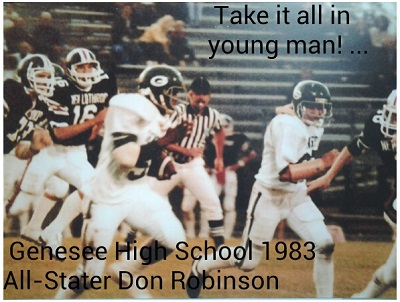 High school football and those memories remain close to his heart even after going on to play at Eastern Michigan University, a stint in the U.S. Navy and a move to Georgia.
He’s paid attention over the years as that “300 club” has grown to 22 players including current New Orleans Saints back Mark Ingram, Jr., and the University of Michigan’s Thomas Rawls.
He’s also a regular reader of Second Half, and asked to send along some words of wisdom to those who will be taking the field to begin the season this weekend:
“When you run out onto the field this season, do me a favor. At least once, pause.
“Look around you. Look at the lights in the sky. See the faces of those that have come to see you play. Listen to the band and the cheerleaders. Look into the eyes of your teammates ...
“Take it all in. When you’re older and miss this amazing game that you are playing, you’ll be glad you did.”
PHOTOS: (Top) A swimmer takes the lead during a race at Saturday's Kenzie Klassic at Howell High School. (Photo courtesy of Howell High School.) (Middle) Genesee graduate Don Robinson runs the ball during the 1983 season. (Photo courtesy of Don Robinson.)

Title IX Continues to Fuel Growth of Girls and Women’s Sports, Olympic Dominance
By
Karissa Niehoff
NFHS Executive Director
September 24, 2021
To say that American female athletes dominated the recent Olympics in Tokyo would be an understatement.
Among the 66 medals earned by American female Olympians – most by any country in the history of the Games – were gold-medal performances by the U.S. basketball, volleyball, water polo and beach volleyball teams. Eighteen medals were earned by the U.S. women swimmers, female track and field athletes claimed 15 medals, and the U.S. women’s softball and soccer teams won silver and bronze medals, respectively.
In the past 30 years of the Olympic Games, the United States has dominated the women’s team sports of basketball (nine golds), soccer (four golds, one silver, one bronze) and softball (three golds, two silvers) — not to mention the untold number of medals in track and field. And this past summer, the U.S. women’s volleyball team claimed its first gold medal.
These performances by some of our nation’s most skilled female athletes never would have been possible without the passage of Title IX and the offerings of these sports through our nation’s schools. With the chance to play afforded by the landmark Title IX legislation in 1972, girls participation in several high school sports skyrocketed in the years that followed.
When the NFHS conducted its first participation survey in 1971, basketball and outdoor track and field were the primary girls sports, comprising about two-thirds of the 294,000 total. However, with the opportunity to play additional sports, girls flocked to volleyball and softball first, along with cross country and eventually soccer.
Soccer, in fact, has had the most remarkable growth. In 1971, only 700 girls were playing high school soccer. Twenty-five years later, that number had climbed to almost 210,000; and as the 50th anniversary of Title IX approaches, there are now almost 400,000 girls playing high school soccer – a staggering 56,200 percentage increase in 50 years. Soccer now ranks fourth in popularity among girls high school sports – all because of that opportunity in 1972.
There are many other success stories, however. The pre-Title IX survey in 1971 indicated that 1,719 girls were participating in cross country. With increases every year until 2015, today, there are 219,345 girls competing in high school programs and the sport ranks sixth in popularity.
Although participation numbers have leveled a bit the past 10 years, fast-pitch softball is another sport that flourished after the passage of Title IX. With fewer than 10,000 participants in 1971, the numbers quickly rose to 220,000 by 1985 and 343,000 by 2000, and softball is currently fifth among girls sports with 362,038 participants.
Since track and field and basketball were the primary sports in the early days of girls sports programs, increases in those sports have not been as dramatic; however, they remain the first and third most-popular sports, respectively, today. Volleyball, however, much like soccer, continues its upward climb.
Without a doubt, volleyball has seen the steadiest increases among girls high school sports the past 50 years. After starting with 17,952 participants in 1971, the numbers jumped to 300,810 by 1990 and 409,332 by 2010 and 452,808 by 2018. During its climb, volleyball surpassed basketball as the No. 2 girls sport.
And among the top six girls sports from 2010 to 2018 (numbers are not available the past two years due to the pandemic), volleyball has gained the most participants (43,476), followed by soccer (32,549). And all of this has occurred thanks to legislation passed in 1972 that was not fundamentally meant to address opportunities for girls to participate in high school sports.
The NFHS is leading a yearlong celebration of the 50th anniversary of Title IX, which officially occurs on June 23, 2022. “Title IX at 50 – Celebrating and Growing Opportunities” is highlighting the law’s impact by celebrating the inspirational individuals and landmark moments in the history of Title IX, and continuing to grow the educational and competitive opportunities for the future.
More information, including a Title IX Timeline, Title IX Milestones, The History and Importance of Title IX, Title IX Fact Sheet, Title IX Frequently Asked Questions and several Title IX videos, can be accessed on the NFHS Website.
Dr. Karissa L. Niehoff is beginning her fourth year as executive director of the National Federation of State High School Associations (NFHS) in Indianapolis. She is the first female to head the national leadership organization for high school athletics and performing arts activities and the sixth full-time executive director of the NFHS. She previously was executive director of the Connecticut Association of Schools-Connecticut Interscholastic Athletic Conference for seven years.