


Howell Puts Heart Into Memorial Meet
August 29, 2013
By Geoff Kimmerly
Second Half editor
An online tribute to Mackenzie Watts describes how she “made the people and world around her better.”
The Howell swimming and diving community continues to work so that her memory makes those who come after her safer as well.
 Watts died in 2005 after suffering a cardiac arrhythmia. She was a 15-year-old sophomore and key cog on her high school team.
This past weekend, for the sixth straight season, the Highlanders hosted the Kenzie Classic, an invitational that served as a fundraiser for the Howell program and annual Mackenzie Watts scholarship – plus served to promote heart screenings by local National Diagnostic Services in their “HeartMobile” parked outside the pool.
NDS, which also has held screening events at Northville, Canton and Middleville Thornapple Kellogg schools among others, screened 20 students during this Kenzie Classic, said Wellness Director Heidi Enders.
Tests are ultrasound-based and non-invasive, and include an EKG to examine the heart’s electrical system for arrhythmias and an echocardiogram to examine the heart’s structure in case there is a thickening of the muscle (known as hyperthrophic cardiomyopathy). Adults were charged $199 and students $75, with discounted rates for adults in groups and children.
Click to check out coverage of the event from the Livingston County Daily Press & Argus.
Records Revamp
While tracking down 660 football schedules (give or take a few) took up most of the summer, there still was time for a few additions to the MHSAA record book – with more to come.
Track and field fans will notice records from retired yardage events (pre-1982 or earlier depending on the MHSAA class) have been added to the online records here for boys and here for girls.
Cross country fans should check out our lists of top MHSAA Finals times for every division and every class, plus overall top 10 lists for both boys and girls since the race was set to five kilometers in 1980. Click here for girls and here for boys.
Also added or updated were team championship counts for both cross countries, volleyball and girls golf. Click to check out girls golf here and volleyball here.
Fond Football Memories
It has been 30 years since former Genesee all-state running back Don Robinson became the fourth player in Genesee County history to run for more than 300 yards in one game – which he did in gaining 317 on Sept. 23, 1983.
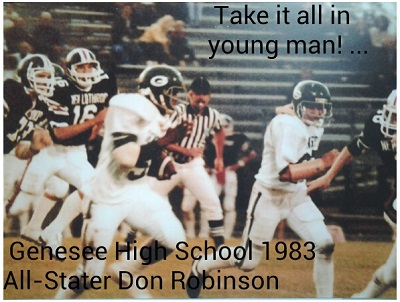 High school football and those memories remain close to his heart even after going on to play at Eastern Michigan University, a stint in the U.S. Navy and a move to Georgia.
He’s paid attention over the years as that “300 club” has grown to 22 players including current New Orleans Saints back Mark Ingram, Jr., and the University of Michigan’s Thomas Rawls.
He’s also a regular reader of Second Half, and asked to send along some words of wisdom to those who will be taking the field to begin the season this weekend:
“When you run out onto the field this season, do me a favor. At least once, pause.
“Look around you. Look at the lights in the sky. See the faces of those that have come to see you play. Listen to the band and the cheerleaders. Look into the eyes of your teammates ...
“Take it all in. When you’re older and miss this amazing game that you are playing, you’ll be glad you did.”
PHOTOS: (Top) A swimmer takes the lead during a race at Saturday's Kenzie Klassic at Howell High School. (Photo courtesy of Howell High School.) (Middle) Genesee graduate Don Robinson runs the ball during the 1983 season. (Photo courtesy of Don Robinson.)
From the Director: Back to School
August 7, 2020
By Mark Uyl
MHSAA Executive Director
Since March 12, our world has been anything but normal. These times have tested most everything in life, and as summer turns toward fall, we find ourselves still with far more questions than answers. It has been said that an abnormal reaction to an abnormal situation is normal behavior.
Let me start with these abnormal times. I’ve had many conversations with administrators over the past month about the start of school and school sports. The one constant theme is these are anything but normal times. Many of these conversations have moved to the issue of schools starting the academic year virtually while considering whether or not to offer school sports opportunities this fall. Let me share the things that have been part of almost all conversations on this topic.
The loudest message I hear is kids are going to be playing sports this fall someplace. Period. If we believe that kids are going to take the fall off if school sports aren’t offered, we haven’t been paying much attention since May. Since that time, athletic activity has taken place in the club, travel, AAU and non-school space nearly every day. From first-hand experience, many of these events have implemented ZERO of the safety standards and protocols that businesses and schools have adopted for their plans of return. The non-school world generally has plowed ahead this summer with few-to-no rules, regulations, enforcement, oversight and accountability to anyone. If kids are going to be playing sports, our member schools are telling us that activity needs to be in the safest environment possible – which is with professional educators and trained coaches in our school sports world.
Schools are quick to point out that kids have been conditioning and training with school coaches in school-sponsored workouts most of the summer. We believe that the absence of virus outbreaks among our 749 high schools’ summer activities, involving thousands of kids, has been because schools have been following the return-to-activity plans. Districts have told us they can continue doing what they’ve been doing safely since June by following all COVID guidance and regulations we have put in place with government’s leadership and partnership.
Schools starting the year virtually are telling us they will use the lessons learned from the start of sports for when students return to campus later in the fall. School administrators have shared this view privately as this has become a highly-charged topic among various groups within our school communities. Sports allow schools to bring students back to campus in small, consistent and defined groups with the same adults working with those students each day. In school sports, there is little mixing of students from one sport with those students in another – making it much easier to monitor, track and trace kids when needed than if all students were in the buildings, hallways and classrooms all day. We hear from administrators that valuable lessons can be learned with athletics in August and September for a successful school start-up with students back on campus in October.
All of us share the fundamental belief that we must protect the health and safety of individuals first. This doesn’t include only COVID prevention measures, but also the mental health of teenage students and adults as well. In districts that are starting the school year online, they see athletics being the one shred of normalcy students, and staff members who choose to coach, will have during the fall. It’s a chance to safely interact with peers and get needed physical activity that hasn’t been happening for some kids since March. Health and safety has to include all facets of the individual, and more research is being shared each day about how mental health is becoming a critical issue. For many at-risk kids, sports is the one motivating factor to keep them in school and progressing toward graduation. Given the challenges of all online education for these at-risk kids, sports and the daily routine they bring perhaps would be more important for this group of students than ever before.
With no school sports, the affluent communities and families can navigate online learning during the day and then afford the non-school athletic opportunities that kids and families in less-affluent areas simply cannot. In many communities, school sports can provide opportunities and open doors that would not appear if kids become priced-out from participating and competing.
The past five months have been the most abnormal in a century. School sports being the one pathway back to school for students in our state – the one norm for this fall – run by professional educators who put kids first, would be an incredible boost to the physical and mental health of all of us. We believe that school sports can be done safely and smartly, and the MHSAA has developed plans that do just that. While the optics of sports taking place while waiting for in-person education is not what any of us prefer, we believe we must react to these abnormal times by thinking differently and looking at these unique times through a unique lens.
Trying to find one normal for our kids in these abnormal school days might just be the best thing we can do.