

Howell Puts Heart Into Memorial Meet
August 29, 2013
By Geoff Kimmerly
Second Half editor
An online tribute to Mackenzie Watts describes how she “made the people and world around her better.”
The Howell swimming and diving community continues to work so that her memory makes those who come after her safer as well.
 Watts died in 2005 after suffering a cardiac arrhythmia. She was a 15-year-old sophomore and key cog on her high school team.
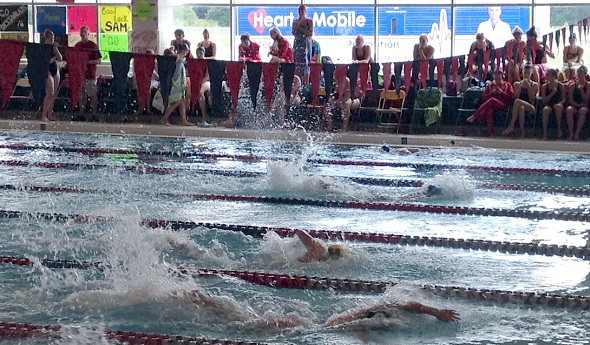
This past weekend, for the sixth straight season, the Highlanders hosted the Kenzie Classic, an invitational that served as a fundraiser for the Howell program and annual Mackenzie Watts scholarship – plus served to promote heart screenings by local National Diagnostic Services in their “HeartMobile” parked outside the pool.
NDS, which also has held screening events at Northville, Canton and Middleville Thornapple Kellogg schools among others, screened 20 students during this Kenzie Classic, said Wellness Director Heidi Enders.
Tests are ultrasound-based and non-invasive, and include an EKG to examine the heart’s electrical system for arrhythmias and an echocardiogram to examine the heart’s structure in case there is a thickening of the muscle (known as hyperthrophic cardiomyopathy). Adults were charged $199 and students $75, with discounted rates for adults in groups and children.
Click to check out coverage of the event from the Livingston County Daily Press & Argus.
Records Revamp
While tracking down 660 football schedules (give or take a few) took up most of the summer, there still was time for a few additions to the MHSAA record book – with more to come.
Track and field fans will notice records from retired yardage events (pre-1982 or earlier depending on the MHSAA class) have been added to the online records here for boys and here for girls.
Cross country fans should check out our lists of top MHSAA Finals times for every division and every class, plus overall top 10 lists for both boys and girls since the race was set to five kilometers in 1980. Click here for girls and here for boys.
Also added or updated were team championship counts for both cross countries, volleyball and girls golf. Click to check out girls golf here and volleyball here.
Fond Football Memories
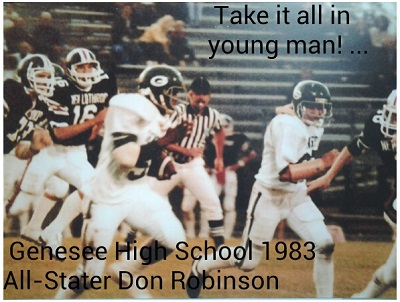
It has been 30 years since former Genesee all-state running back Don Robinson became the fourth player in Genesee County history to run for more than 300 yards in one game – which he did in gaining 317 on Sept. 23, 1983.
 High school football and those memories remain close to his heart even after going on to play at Eastern Michigan University, a stint in the U.S. Navy and a move to Georgia.
He’s paid attention over the years as that “300 club” has grown to 22 players including current New Orleans Saints back Mark Ingram, Jr., and the University of Michigan’s Thomas Rawls.
He’s also a regular reader of Second Half, and asked to send along some words of wisdom to those who will be taking the field to begin the season this weekend:
“When you run out onto the field this season, do me a favor. At least once, pause.
“Look around you. Look at the lights in the sky. See the faces of those that have come to see you play. Listen to the band and the cheerleaders. Look into the eyes of your teammates ...
“Take it all in. When you’re older and miss this amazing game that you are playing, you’ll be glad you did.”
PHOTOS: (Top) A swimmer takes the lead during a race at Saturday's Kenzie Klassic at Howell High School. (Photo courtesy of Howell High School.) (Middle) Genesee graduate Don Robinson runs the ball during the 1983 season. (Photo courtesy of Don Robinson.)
Add Rest Days to Your Workout Routine
June 2, 2020

Henry Ford Health System
Whether you're new to exercise or a seasoned enthusiast, it's tempting to adopt an all-go, no-quit attitude. This is especially common when you're are trying to achieve a fitness goal. Maybe you want to run a 5K, or maybe you have 10 pounds you want to shed before going on vacation.
"Whatever the driver, it's important to remember that scheduling time for rest and rejuvenation is a critical component of any workout regimen," says James Moeller, M.D., a sports medicine specialist at Henry Ford Health System.
Building in Rest Days
From high-intensity interval training (HIIT) and spin to barre and Zumba, popular workouts increasingly push exercisers to go faster, longer, stronger. This prolonged physical stress can lead to overuse injuries, such as stress fractures, muscle strains and joint pain. Excessive exercise can also lead to hormonal changes, disrupted sleep patterns, decreased immunity and mood swings.
“Working out, especially resistance training, breaks tissues down, causing microscopic damage,” Dr. Moeller says. "Rest days allow your muscles time to rebuild."
So how much rest do you really need? There isn't a one-size-fits-all prescription. Factors like your age, fitness level, the intensity of your workout and the amount of training you do weekly will impact the amount of recovery time you need. But there are some basic guidelines for rest days:
1. Go easy: Rest is a relative term. "It's not just sitting on the couch with an iced tea," says Dr. Moeller. "You may still be exercising on 'rest' days, but at a lower intensity." Maybe you go for a brisk walk or ride your bike to work. Take a yoga class or do some dynamic stretching. The key is to make sure you're not overworking the same body parts.
2. Get sufficient sleep: Sleep is a key component of muscle repair and rebuilding. During sleep, your body’s production of growth hormone increases. Not getting quality shuteye thwarts your body's production of growth hormone and can impact your performance.
3. Give overtaxed muscles a break: You don't need to skip the gym on specific days each week, but you do need to rotate which body parts you're working. The general rule is to give muscles 48 hours to recover after a workout. So it's a good idea to take two to three days off before working the same muscle groups again.
4. Stay hydrated: Make sure to restore lost fluids before, during and after a workout. Dehydration can lead to overheating, headaches and muscle fatigue, among other ailments. You don’t need a sports drink; water is best. "Sports drinks aren't required unless you're getting into very high intensity activity, or exercising for more than one hour at a time," Dr. Moeller says.
5. Pay attention to your body: A lot of people try to work out through pain and fatigue. If there's a heaviness to your movements, or if you feel like your muscles are not responding appropriately to the stress you're providing, take a time out. "It's really about learning to read your body's signals," says Dr. Moeller.
Health authorities and news headlines widely publicize the health benefits of exercise — and the consequences of inactivity. The American Heart Association recommends that adults get at least 150 minutes of moderate-intensity exercise per week, plus strength training two or three days per week. Less discussed are the negative effects of not allowing your body sufficient time to rest.
Getting sufficient rest between workouts is just as important as participating in regular exercise. "Both are part of the total process required to build strength, endurance and muscle mass," Dr. Moeller says.
Want to learn more? Henry Ford Health System sports medicine experts are treating the whole athlete, in a whole new way. From nutrition to neurology, and from injury prevention to treatment of sports-related conditions, they can give your athlete a unique game plan.
Visit henryford.com/sports or call (313) 972-4216 for an appointment within 24 business hours.