


Howell Puts Heart Into Memorial Meet
August 29, 2013
By Geoff Kimmerly
Second Half editor
An online tribute to Mackenzie Watts describes how she “made the people and world around her better.”
The Howell swimming and diving community continues to work so that her memory makes those who come after her safer as well.
 Watts died in 2005 after suffering a cardiac arrhythmia. She was a 15-year-old sophomore and key cog on her high school team.
This past weekend, for the sixth straight season, the Highlanders hosted the Kenzie Classic, an invitational that served as a fundraiser for the Howell program and annual Mackenzie Watts scholarship – plus served to promote heart screenings by local National Diagnostic Services in their “HeartMobile” parked outside the pool.
NDS, which also has held screening events at Northville, Canton and Middleville Thornapple Kellogg schools among others, screened 20 students during this Kenzie Classic, said Wellness Director Heidi Enders.
Tests are ultrasound-based and non-invasive, and include an EKG to examine the heart’s electrical system for arrhythmias and an echocardiogram to examine the heart’s structure in case there is a thickening of the muscle (known as hyperthrophic cardiomyopathy). Adults were charged $199 and students $75, with discounted rates for adults in groups and children.
Click to check out coverage of the event from the Livingston County Daily Press & Argus.
Records Revamp
While tracking down 660 football schedules (give or take a few) took up most of the summer, there still was time for a few additions to the MHSAA record book – with more to come.
Track and field fans will notice records from retired yardage events (pre-1982 or earlier depending on the MHSAA class) have been added to the online records here for boys and here for girls.
Cross country fans should check out our lists of top MHSAA Finals times for every division and every class, plus overall top 10 lists for both boys and girls since the race was set to five kilometers in 1980. Click here for girls and here for boys.
Also added or updated were team championship counts for both cross countries, volleyball and girls golf. Click to check out girls golf here and volleyball here.
Fond Football Memories
It has been 30 years since former Genesee all-state running back Don Robinson became the fourth player in Genesee County history to run for more than 300 yards in one game – which he did in gaining 317 on Sept. 23, 1983.
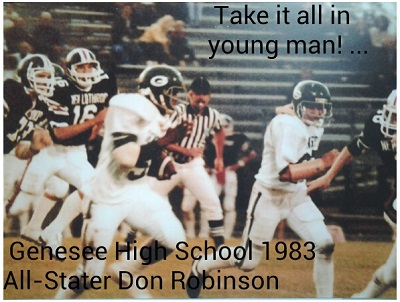 High school football and those memories remain close to his heart even after going on to play at Eastern Michigan University, a stint in the U.S. Navy and a move to Georgia.
He’s paid attention over the years as that “300 club” has grown to 22 players including current New Orleans Saints back Mark Ingram, Jr., and the University of Michigan’s Thomas Rawls.
He’s also a regular reader of Second Half, and asked to send along some words of wisdom to those who will be taking the field to begin the season this weekend:
“When you run out onto the field this season, do me a favor. At least once, pause.
“Look around you. Look at the lights in the sky. See the faces of those that have come to see you play. Listen to the band and the cheerleaders. Look into the eyes of your teammates ...
“Take it all in. When you’re older and miss this amazing game that you are playing, you’ll be glad you did.”
PHOTOS: (Top) A swimmer takes the lead during a race at Saturday's Kenzie Klassic at Howell High School. (Photo courtesy of Howell High School.) (Middle) Genesee graduate Don Robinson runs the ball during the 1983 season. (Photo courtesy of Don Robinson.)

Put a Stop to Recurring Injuries
May 5, 2020
 By Nick Parkinson, M.Ed., AT, ATC, TSAC-F
Henry Ford Health System
Recurring injuries happen — and they're especially common among single-sport athletes or people who focus on one type of exercise, like runners. The reason: You're working the same muscles repeatedly. The end result: Your joints, muscles and tissues get worn out.
Breaking Down Recurring Injuries
Overuse injuries are a big deal. Continuing to re-injure the same muscle groups can take you out of the game entirely and limit your ability to participate in other activities. Here's what you need to know about these all-to-common ailments:
What are Recurring Injuries?
Recurring injuries, also called repetitive and overuse injuries, are injuries that happen repeatedly in the same location. Think along the lines of tendinitis, stress fractures, shin splints and even carpal tunnel syndrome. Common sites include ankles, knees, hips and shoulders.
Who is at Risk for Repetitive Injuries?
Overuse injuries can happen to anyone, but they're more likely to occur among workers who do repetitive motions and single-sport athletes. The risk of these injuries also increases with age. They're more likely to occur if you don't recognize the impact aging can have on your muscles, joints and tissues and modify your activities accordingly.
Why Do Recurring Injuries Happen?
Recurring injuries happen when you overuse the same muscles without sufficient recovery. It's simple body mechanics: If you continue using compromised muscles, you're more likely to get reinjured. And once you get stuck in that same biomechanic loop, it's nearly impossible to recover without changing your routine and learning new techniques.
How Can You Prevent Recurring Injuries?
All sports have a risk of injury. The key is paying attention to your body and taking the appropriate steps to minimize your risk. Here's how:
• Use appropriate gear. Make sure you're wearing appropriate protective gear for the activity you're participating in and choose the right footwear.
• Alternate muscle groups. Instead of focusing on one type of exercise, switch things up. Incorporate low-impact activities, such as swimming, biking and water sports, and make sure you're not overloading any particular muscle group.
• Take rest days. It's important to give your muscles, joints and tissues time to recover. Two days of rest each week is best. If you play a sport, plan to have at least one off day per week and at least one month off per year.
• Strengthen muscles. Conditioning exercises can help strengthen the muscles you need to perform various activities.
• Use proper form. Overuse injuries are sometimes related to improper form during activity. Work with a professional to ensure you're using proper body mechanics and get back to your usual activities gradually.
Play it Safe
The best way to avoid recurrent injuries is to not get injured in the first place. Recover during the season — even if it means missing out on some play. It's better to show up to a game healthy but undertrained than to power through an injury and risk reinjury.
Talk to your doctor before starting a new activity or ramping up your current routine. If you're at risk of developing a recurrent injury, a professional can provide you with a workout regimen that can help prevent injury.
Most important: Don't let an overuse injury prevent you from being physically active. Instead, listen to your body, consult a professional and pace yourself. Treatment may involve avoiding a specific activity for a period of time, along with hot and cold therapy, massage and focused rehabilitation.
Nick Parkinson, M.Ed., AT, ATC, TSAC-F, is the Supervisor of Athletic Training with Henry Ford Sports Medicine and also leads Sports Performance training at the William Clay Ford Center for Athletic Medicine. Learn more about Nick.
Want to learn more? Henry Ford Health System sports medicine experts are treating the whole athlete, in a whole new way. From nutrition to neurology, and from injury prevention to treatment of sports-related conditions, they can give your athlete a unique game plan.
Visit henryford.com/sports or call (313) 972-4216 for an appointment within 24 business hours.