


Howell Puts Heart Into Memorial Meet
August 29, 2013
By Geoff Kimmerly
Second Half editor
An online tribute to Mackenzie Watts describes how she “made the people and world around her better.”
The Howell swimming and diving community continues to work so that her memory makes those who come after her safer as well.
 Watts died in 2005 after suffering a cardiac arrhythmia. She was a 15-year-old sophomore and key cog on her high school team.
This past weekend, for the sixth straight season, the Highlanders hosted the Kenzie Classic, an invitational that served as a fundraiser for the Howell program and annual Mackenzie Watts scholarship – plus served to promote heart screenings by local National Diagnostic Services in their “HeartMobile” parked outside the pool.
NDS, which also has held screening events at Northville, Canton and Middleville Thornapple Kellogg schools among others, screened 20 students during this Kenzie Classic, said Wellness Director Heidi Enders.
Tests are ultrasound-based and non-invasive, and include an EKG to examine the heart’s electrical system for arrhythmias and an echocardiogram to examine the heart’s structure in case there is a thickening of the muscle (known as hyperthrophic cardiomyopathy). Adults were charged $199 and students $75, with discounted rates for adults in groups and children.
Click to check out coverage of the event from the Livingston County Daily Press & Argus.
Records Revamp
While tracking down 660 football schedules (give or take a few) took up most of the summer, there still was time for a few additions to the MHSAA record book – with more to come.
Track and field fans will notice records from retired yardage events (pre-1982 or earlier depending on the MHSAA class) have been added to the online records here for boys and here for girls.
Cross country fans should check out our lists of top MHSAA Finals times for every division and every class, plus overall top 10 lists for both boys and girls since the race was set to five kilometers in 1980. Click here for girls and here for boys.
Also added or updated were team championship counts for both cross countries, volleyball and girls golf. Click to check out girls golf here and volleyball here.
Fond Football Memories
It has been 30 years since former Genesee all-state running back Don Robinson became the fourth player in Genesee County history to run for more than 300 yards in one game – which he did in gaining 317 on Sept. 23, 1983.
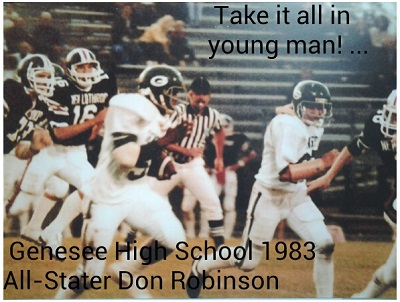 High school football and those memories remain close to his heart even after going on to play at Eastern Michigan University, a stint in the U.S. Navy and a move to Georgia.
He’s paid attention over the years as that “300 club” has grown to 22 players including current New Orleans Saints back Mark Ingram, Jr., and the University of Michigan’s Thomas Rawls.
He’s also a regular reader of Second Half, and asked to send along some words of wisdom to those who will be taking the field to begin the season this weekend:
“When you run out onto the field this season, do me a favor. At least once, pause.
“Look around you. Look at the lights in the sky. See the faces of those that have come to see you play. Listen to the band and the cheerleaders. Look into the eyes of your teammates ...
“Take it all in. When you’re older and miss this amazing game that you are playing, you’ll be glad you did.”
PHOTOS: (Top) A swimmer takes the lead during a race at Saturday's Kenzie Klassic at Howell High School. (Photo courtesy of Howell High School.) (Middle) Genesee graduate Don Robinson runs the ball during the 1983 season. (Photo courtesy of Don Robinson.)

NFHS Voice: Should Tech Aid Performance?
March 13, 2020
By Karissa Niehoff
NFHS Executive Director
One of the age-old objectives of the NFHS has been to preserve the records, tradition and heritage of education-based athletics and activities programs in the United States.
As the leader and advocate for high school sports and activities, the NFHS has been keeping records set by high school athletes since the first National High School Sports Record Book was published by the NFHS in 1978. The Record Book was printed annually until 2010, when it was moved online to www.NFHS.org.
Names of more than 100,000 high school student-athletes have appeared in the Record Book in the past 42 years; and while there are a few individuals and teams still remaining from that first publication, in the spirit of “records are made to be broken,” most categories have had multiple leaders.
In addition to bringing proper recognition to high school student-athletes, coaches and teams who achieve outstanding performances in interscholastic athletic competition, we believe this recognition stimulates interest in high school athletic programs and motivates other competitors to improve their skills.
And we have strived that only records set in the spirit of good sportsmanship and fair play are entered in the Record Book.
It is understandable that records are broken frequently, with continual improvements in equipment, nutrition, training methods and – most recently – technology. However, at what point do some of these improvements, particularly ever-changing technology, begin to affect the No. 1 principle of rules writing for the NFHS: Fair Play?
The NFHS has been writing playing rules for high school sports since the 1930s when it published football and basketball rules for the first time. Baseball and track & field were added in the 1940s, followed by wrestling in the 1960s and many others in the 1970s.
It is impossible that the early rules writers could have envisioned the advances in technology and how some of these improvements challenge rules writing today. Although the question about whether to utilize instant replay for game-ending plays has drawn much attention, some of the personal technology items – and the increasing presence of drones at athletic events – are more onerous.
With high-tech watches, and electronic devices such as cell phones and tablets, the ability to view and process data during actual competition is readily available, which leads to the ethical question of whether this use of technology unfairly aids performance.
This topic has generated a great deal of discussion, and some high school sports allow limited use of technology devices by coaches during games. However, when athletes are competing against each other on the field or court, the stakes should be even. No competitor in high school sports should gain an unfair advantage over an opponent based on anything other than his or her athletic preparedness for a contest.
At other levels of sport, particularly at the Olympic and professional levels, history shows that the pursuit of winning rather than the pursuit of excellence becomes the focus. While we understand the pressure to win at these levels, there is a very recent and clear example of the misuse of technology with the sign-stealing scandal in Major League Baseball.
In high school sports, the focus should not be on winning but having fun. NFHS playing rules, which are used by almost eight million participants across 17 sports, will continue to focus on risk minimization, sportsmanship and fair play.
Dr. Karissa L. Niehoff is in her second year as executive director of the National Federation of State High School Associations (NFHS) in Indianapolis, Indiana. She is the first female to head the national leadership organization for high school athletics and performing arts activities and the sixth full-time executive director of the NFHS, which celebrated its 100th year of service during the 2018-19 school year. She previously was executive director of the Connecticut Association of Schools-Connecticut Interscholastic Athletic Conference for seven years.