

Howell Puts Heart Into Memorial Meet
August 29, 2013
By Geoff Kimmerly
Second Half editor
An online tribute to Mackenzie Watts describes how she “made the people and world around her better.”
The Howell swimming and diving community continues to work so that her memory makes those who come after her safer as well.
 Watts died in 2005 after suffering a cardiac arrhythmia. She was a 15-year-old sophomore and key cog on her high school team.
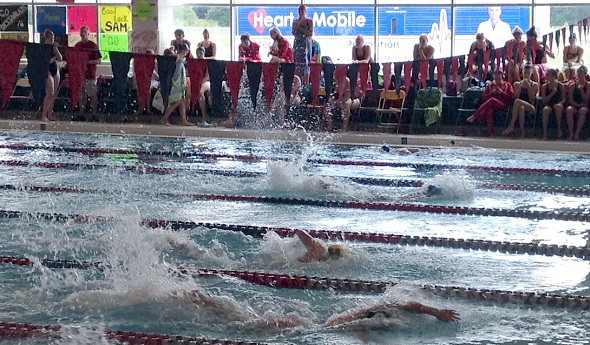
This past weekend, for the sixth straight season, the Highlanders hosted the Kenzie Classic, an invitational that served as a fundraiser for the Howell program and annual Mackenzie Watts scholarship – plus served to promote heart screenings by local National Diagnostic Services in their “HeartMobile” parked outside the pool.
NDS, which also has held screening events at Northville, Canton and Middleville Thornapple Kellogg schools among others, screened 20 students during this Kenzie Classic, said Wellness Director Heidi Enders.
Tests are ultrasound-based and non-invasive, and include an EKG to examine the heart’s electrical system for arrhythmias and an echocardiogram to examine the heart’s structure in case there is a thickening of the muscle (known as hyperthrophic cardiomyopathy). Adults were charged $199 and students $75, with discounted rates for adults in groups and children.
Click to check out coverage of the event from the Livingston County Daily Press & Argus.
Records Revamp
While tracking down 660 football schedules (give or take a few) took up most of the summer, there still was time for a few additions to the MHSAA record book – with more to come.
Track and field fans will notice records from retired yardage events (pre-1982 or earlier depending on the MHSAA class) have been added to the online records here for boys and here for girls.
Cross country fans should check out our lists of top MHSAA Finals times for every division and every class, plus overall top 10 lists for both boys and girls since the race was set to five kilometers in 1980. Click here for girls and here for boys.
Also added or updated were team championship counts for both cross countries, volleyball and girls golf. Click to check out girls golf here and volleyball here.
Fond Football Memories
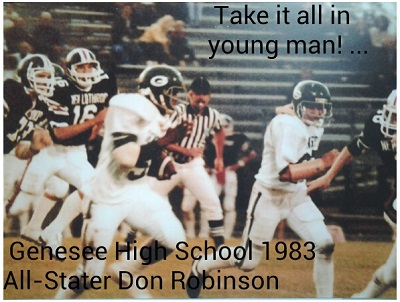
It has been 30 years since former Genesee all-state running back Don Robinson became the fourth player in Genesee County history to run for more than 300 yards in one game – which he did in gaining 317 on Sept. 23, 1983.
 High school football and those memories remain close to his heart even after going on to play at Eastern Michigan University, a stint in the U.S. Navy and a move to Georgia.
He’s paid attention over the years as that “300 club” has grown to 22 players including current New Orleans Saints back Mark Ingram, Jr., and the University of Michigan’s Thomas Rawls.
He’s also a regular reader of Second Half, and asked to send along some words of wisdom to those who will be taking the field to begin the season this weekend:
“When you run out onto the field this season, do me a favor. At least once, pause.
“Look around you. Look at the lights in the sky. See the faces of those that have come to see you play. Listen to the band and the cheerleaders. Look into the eyes of your teammates ...
“Take it all in. When you’re older and miss this amazing game that you are playing, you’ll be glad you did.”
PHOTOS: (Top) A swimmer takes the lead during a race at Saturday's Kenzie Klassic at Howell High School. (Photo courtesy of Howell High School.) (Middle) Genesee graduate Don Robinson runs the ball during the 1983 season. (Photo courtesy of Don Robinson.)

NFHS Voice: March Madness Begins Again
March 4, 2020
By Karissa Niehoff
NFHS Executive Director
The calendar has turned to March, which in the world of high school sports can only mean one thing – Basketball. It is time for state tournaments, March Madness and, yes, the annual rhetoric about the merits of the shot clock.
For the almost one million boys and girls who participate in high school basketball, there is nothing quite like the state tournament. Although there are great memories from the one-class days, led by Carr Creek’s almost upset of powerhouse Ashland in Kentucky in 1928 and Milan’s Cinderella victory in Indiana in 1954, today, basketball provides more opportunities for girls and boys teams to be crowned state champion than any other sport.
This month, about 450 girls and boys teams will earn state basketball titles in championships conducted by NFHS member state associations. Multiple team champions are crowned for both boys and girls in all states but two, with the majority of states sponsoring tournaments in 4-6 classifications for each, and four states conducting state championships in seven classes.
That is truly March Madness, which is appropriate since the term was first used in connection with high school basketball. Although the tag line became familiar to millions on a national scale in relation to the NCAA Division I Men’s Basketball Championship, the NCAA shares a dual-use trademark with the Illinois High School Association (IHSA), thanks to H. V. Porter, the first full-time executive director of the NFHS.
In his final year as IHSA executive director in 1939, Porter published his “March Madness” essay in reference to the mania surrounding the IHSA’s annual state basketball tournament. Eight years later, in a 1947 Associated Press article, Porter said, “Naturally, we think basketball has done a lot for high school kids, but it’s done something for the older people, too. It has made community life in general a lot more fun each winter.”
While many things have changed in the past 73 years, the value of high school sports – and especially state basketball tournaments – remains as strong as ever today. In some states, seemingly the entire community will travel to the site of the state tournament in support of the high school team.
As a footnote to the use of March Madness, Scott Johnson – recently retired assistant executive director of the IHSA in his book “Association Work” – discovered through research that the first recorded mention of March Madness in relation to basketball occurred in 1931 by Bob Stranahan, sports editor of the New Castle Courier-Times in Indiana.
While the sport remains strong and March Madness is set to begin in earnest across the nation, there is a belief by some that the addition of a shot clock would make the game even better.
Although there are some arguments for implementing the shot clock, the
NFHS Basketball Rules Committee, similar to the other 14 NFHS rules committees, must make decisions based on what is best for the masses – the small schools with less than 100 students as well as large urban schools with 3,000-plus students. Rules changes will always be made with considerations for minimizing risks, containing costs and developing rules that are best for high school athletes.
Nine of our member state associations have elected to use a shot clock in their states, which certainly adds to the clamor for its implementation nationally. And, we at the NFHS have read the headlines, seen the social media posts and received the phone calls advocating for the shot clock’s adoption. However, the Basketball Rules Committee will continue to assess the shot clock based on the aforementioned considerations, as well its members representing all areas of the country.
We encourage everyone to support their local high school teams by attending this year’s exciting state basketball tournaments.
Dr. Karissa L. Niehoff is in her second year as executive director of the National Federation of State High School Associations (NFHS) in Indianapolis, Indiana. She is the first female to head the national leadership organization for high school athletics and performing arts activities and the sixth full-time executive director of the NFHS, which celebrated its 100th year of service during the 2018-19 school year. She previously was executive director of the Connecticut Association of Schools-Connecticut Interscholastic Athletic Conference for seven years.