


Howell Puts Heart Into Memorial Meet
August 29, 2013
By Geoff Kimmerly
Second Half editor
An online tribute to Mackenzie Watts describes how she “made the people and world around her better.”
The Howell swimming and diving community continues to work so that her memory makes those who come after her safer as well.
 Watts died in 2005 after suffering a cardiac arrhythmia. She was a 15-year-old sophomore and key cog on her high school team.
This past weekend, for the sixth straight season, the Highlanders hosted the Kenzie Classic, an invitational that served as a fundraiser for the Howell program and annual Mackenzie Watts scholarship – plus served to promote heart screenings by local National Diagnostic Services in their “HeartMobile” parked outside the pool.
NDS, which also has held screening events at Northville, Canton and Middleville Thornapple Kellogg schools among others, screened 20 students during this Kenzie Classic, said Wellness Director Heidi Enders.
Tests are ultrasound-based and non-invasive, and include an EKG to examine the heart’s electrical system for arrhythmias and an echocardiogram to examine the heart’s structure in case there is a thickening of the muscle (known as hyperthrophic cardiomyopathy). Adults were charged $199 and students $75, with discounted rates for adults in groups and children.
Click to check out coverage of the event from the Livingston County Daily Press & Argus.
Records Revamp
While tracking down 660 football schedules (give or take a few) took up most of the summer, there still was time for a few additions to the MHSAA record book – with more to come.
Track and field fans will notice records from retired yardage events (pre-1982 or earlier depending on the MHSAA class) have been added to the online records here for boys and here for girls.
Cross country fans should check out our lists of top MHSAA Finals times for every division and every class, plus overall top 10 lists for both boys and girls since the race was set to five kilometers in 1980. Click here for girls and here for boys.
Also added or updated were team championship counts for both cross countries, volleyball and girls golf. Click to check out girls golf here and volleyball here.
Fond Football Memories
It has been 30 years since former Genesee all-state running back Don Robinson became the fourth player in Genesee County history to run for more than 300 yards in one game – which he did in gaining 317 on Sept. 23, 1983.
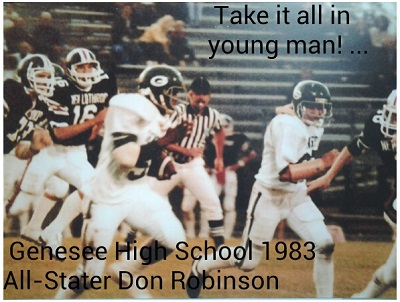 High school football and those memories remain close to his heart even after going on to play at Eastern Michigan University, a stint in the U.S. Navy and a move to Georgia.
He’s paid attention over the years as that “300 club” has grown to 22 players including current New Orleans Saints back Mark Ingram, Jr., and the University of Michigan’s Thomas Rawls.
He’s also a regular reader of Second Half, and asked to send along some words of wisdom to those who will be taking the field to begin the season this weekend:
“When you run out onto the field this season, do me a favor. At least once, pause.
“Look around you. Look at the lights in the sky. See the faces of those that have come to see you play. Listen to the band and the cheerleaders. Look into the eyes of your teammates ...
“Take it all in. When you’re older and miss this amazing game that you are playing, you’ll be glad you did.”
PHOTOS: (Top) A swimmer takes the lead during a race at Saturday's Kenzie Klassic at Howell High School. (Photo courtesy of Howell High School.) (Middle) Genesee graduate Don Robinson runs the ball during the 1983 season. (Photo courtesy of Don Robinson.)

NFHS Voice: Committed to HS Football
February 12, 2020
By Karissa Niehoff
NFHS Executive Director
The enduring popularity of football in the United States was celebrated in the past year at all levels of the sport.
The NFHS celebrated its 100th year of service in all areas of high school sports, including the writing of football playing rules, although the first-known games date to the 1870s.
This past year, the NCAA recognized the 150th anniversary of college football which started in 1869 when Princeton and Rutgers met for the first time. And the National Football League just closed its 100th season, which started with a 1919 game between Dayton and Columbus.
From those beginnings to today, the impact of football on life in America is incalculable. From the youth leagues, through high school and college, and on to the NFL, football is the runaway leader as this country’s most popular sport – both from a participant standpoint with about three million players annually at all levels, to the millions of fans who attend or watch games.
Every fall, millions of families spend a portion of their weekends supporting their grade-school kids in youth football programs. Through these programs, kids are exposed to the basics of the sport and, more importantly, they begin to learn teamwork, sportsmanship and how to win and lose in a proper manner.
On Friday nights, beyond the one million high school students – boys and girls – actually playing football, there are more than 150 million fans who attend games each year. Parents are involved in booster club activities, and homecoming activities occur during one football game every year. In many communities – particularly smaller cities and towns – Friday night football is often the most anticipated event of the week.
Another 50,000-plus players are involved in college football on Saturdays. As is the case at the high school level, homecoming events are tied to one football game every fall. Postseason bowl games have been a part of American culture for decades, and the new College Football Playoff has brought even more excitement to the end of the season.
NFL games on Sunday complete the three-day weekend focus on the country’s favorite sport. Thanks, in part, to the singular weekly focus as opposed to multiple games each week in the other three major professional sports, football dwarfs its competitors.
The interest level in playing football – and following the sport at all levels – has never been higher. With that continued interest in the sport comes the expectation that everything possible is being done – at all levels – to ensure that the safety of each and every participant is of the upmost concern.
With that backdrop, last week we met with leaders from USA Football, several state high school association executive directors and high school coaches and athletic directors representing the National High School Football Coaches Alliance and the National Interscholastic Athletic Administrators Association, respectively.
Collectively, these groups are committed to consistent messaging and support to ensure the ongoing popularity of the sport for the next 100 years. We believe the Football Development Model (FDM) enacted by USA Football will re-invigorate interest in the sport at the youth levels. The FDM reduces contact in youth football and advances the game through comprehensive education, game progressions and safety standards.
There was also agreement about the importance of high school football coaches. By connecting with coaches of youth football programs in their communities, high school football coaches can spur excitement on the part of youth players and their parents and improve chances of kids continuing to play the sport. Without a doubt, high school football coaches can be the focal point to success of programs in communities across the nation.
Working together, we can count on a continuation of the sport’s popularity at the high school level.
Dr. Karissa L. Niehoff is in her second year as executive director of the National Federation of State High School Associations (NFHS) in Indianapolis, Indiana. She is the first female to head the national leadership organization for high school athletics and performing arts activities and the sixth full-time executive director of the NFHS, which celebrated its 100th year of service during the 2018-19 school year. She previously was executive director of the Connecticut Association of Schools-Connecticut Interscholastic Athletic Conference for seven years.