


Howell Puts Heart Into Memorial Meet
August 29, 2013
By Geoff Kimmerly
Second Half editor
An online tribute to Mackenzie Watts describes how she “made the people and world around her better.”
The Howell swimming and diving community continues to work so that her memory makes those who come after her safer as well.
 Watts died in 2005 after suffering a cardiac arrhythmia. She was a 15-year-old sophomore and key cog on her high school team.
This past weekend, for the sixth straight season, the Highlanders hosted the Kenzie Classic, an invitational that served as a fundraiser for the Howell program and annual Mackenzie Watts scholarship – plus served to promote heart screenings by local National Diagnostic Services in their “HeartMobile” parked outside the pool.
NDS, which also has held screening events at Northville, Canton and Middleville Thornapple Kellogg schools among others, screened 20 students during this Kenzie Classic, said Wellness Director Heidi Enders.
Tests are ultrasound-based and non-invasive, and include an EKG to examine the heart’s electrical system for arrhythmias and an echocardiogram to examine the heart’s structure in case there is a thickening of the muscle (known as hyperthrophic cardiomyopathy). Adults were charged $199 and students $75, with discounted rates for adults in groups and children.
Click to check out coverage of the event from the Livingston County Daily Press & Argus.
Records Revamp
While tracking down 660 football schedules (give or take a few) took up most of the summer, there still was time for a few additions to the MHSAA record book – with more to come.
Track and field fans will notice records from retired yardage events (pre-1982 or earlier depending on the MHSAA class) have been added to the online records here for boys and here for girls.
Cross country fans should check out our lists of top MHSAA Finals times for every division and every class, plus overall top 10 lists for both boys and girls since the race was set to five kilometers in 1980. Click here for girls and here for boys.
Also added or updated were team championship counts for both cross countries, volleyball and girls golf. Click to check out girls golf here and volleyball here.
Fond Football Memories
It has been 30 years since former Genesee all-state running back Don Robinson became the fourth player in Genesee County history to run for more than 300 yards in one game – which he did in gaining 317 on Sept. 23, 1983.
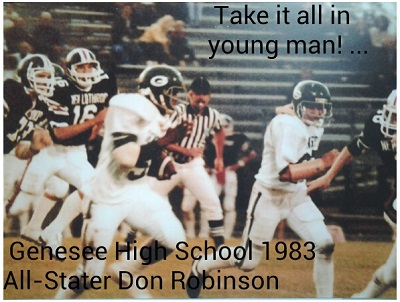 High school football and those memories remain close to his heart even after going on to play at Eastern Michigan University, a stint in the U.S. Navy and a move to Georgia.
He’s paid attention over the years as that “300 club” has grown to 22 players including current New Orleans Saints back Mark Ingram, Jr., and the University of Michigan’s Thomas Rawls.
He’s also a regular reader of Second Half, and asked to send along some words of wisdom to those who will be taking the field to begin the season this weekend:
“When you run out onto the field this season, do me a favor. At least once, pause.
“Look around you. Look at the lights in the sky. See the faces of those that have come to see you play. Listen to the band and the cheerleaders. Look into the eyes of your teammates ...
“Take it all in. When you’re older and miss this amazing game that you are playing, you’ll be glad you did.”
PHOTOS: (Top) A swimmer takes the lead during a race at Saturday's Kenzie Klassic at Howell High School. (Photo courtesy of Howell High School.) (Middle) Genesee graduate Don Robinson runs the ball during the 1983 season. (Photo courtesy of Don Robinson.)

NFHS Voice: MLK Provides Reminder
January 22, 2020
By Karissa Niehoff
NFHS Executive Director
On Monday, the nation observed Martin Luther King Jr. Day for the 35th time. This annual remembrance of the civil rights leader and his remarkable efforts in the 1950s and 1960s to combat racism in the United States continues as one of the most significant days on the calendar every year.
King’s “I Have a Dream” speech in Washington, D.C. in 1963 – one of the most iconic speeches in history – was the defining moment of the civil rights movement and led to the Civil Rights Act of 1964, which made desegregation a prerequisite to school funding and further strengthened the Supreme Court’s 1954 ruling in Brown v. Board of Education of Topeka.
As a result, separate schools for African Americans ended and King’s dream of equality for everyone began to occur.
Thanks, in part, to the efforts of King, who was a member of his school’s debate team at Booker T. Washington High School in Atlanta, blacks and whites were assimilated in schools and in athletics and other activities such as speech and debate.
A few years later in the early 1970s with the passage of Title IX, girls – both white and black – were provided the opportunity to participate in high school sports. With this landmark legislation on the heels of the civil rights movement, high school sports and activities were for EVERYONE.
Amazingly, participation in high school sports increased from 3.9 million to 6.4 million in seven years between 1971-72 and 1977-78 – a jump of about 2.5 million. Why? The opportunity to participate was now available to all.
High school athletes – male and female, black and white and other races – began to work together and excel both individually and as teams. Many have seized these opportunities and had a profound impact within their communities and nationally.
In the past five classes of the NFHS National High School Hall of Fame, 13 of the 22 athletes were minority males and females, including the likes of Derrick Brooks, Dusty Baker, Seimone Augustus, Nicole Powell, Lisa Fernandez, Nikki McCray and Marlin Briscoe. Other females were Tracey Fuchs, Carrie Tollefson, Missy West, Joni Huntley, Jackie Stiles and Cindy Brogdon.
In previous classes, there were Ozzie Newsome, Chauncey Billups, Kevin Johnson, Janet Evans, Sean Elliott, Cheryl Miller, Archie Griffin, Jackie Joyner-Kersee and Kim Mulkey.
Can you imagine the storied history of high school sports without these individuals?
Thanks to the efforts of many people in the 1960s and 1970s, there are more women and minorities in leadership positions today. Nine of our member state high school associations are led by minorities, including three females – Que Tucker of North Carolina, Sally Marquez of New Mexico and Rhonda Blanford-Green of Colorado.
Despite these advances in opportunities the past 50-plus years, the late Dr. King would be disappointed to hear about some of the disrespectful behavior in and around high school sports the past few years. Since our column in late October, we have heard of other racially-related incidents. Indeed, pain still occurs.
As we reflect on the tremendous efforts of Dr. Martin Luther King Jr. to bring everyone together, let it be a further reminder that all student activity participants – regardless of race, religion, political views or gender identity – should be treated with respect.
Dr. Karissa L. Niehoff is in her second year as executive director of the National Federation of State High School Associations (NFHS) in Indianapolis, Indiana. She is the first female to head the national leadership organization for high school athletics and performing arts activities and the sixth full-time executive director of the NFHS, which celebrated its 100th year of service during the 2018-19 school year. She previously was executive director of the Connecticut Association of Schools-Connecticut Interscholastic Athletic Conference for seven years.