


Howell Puts Heart Into Memorial Meet
August 29, 2013
By Geoff Kimmerly
Second Half editor
An online tribute to Mackenzie Watts describes how she “made the people and world around her better.”
The Howell swimming and diving community continues to work so that her memory makes those who come after her safer as well.
 Watts died in 2005 after suffering a cardiac arrhythmia. She was a 15-year-old sophomore and key cog on her high school team.
This past weekend, for the sixth straight season, the Highlanders hosted the Kenzie Classic, an invitational that served as a fundraiser for the Howell program and annual Mackenzie Watts scholarship – plus served to promote heart screenings by local National Diagnostic Services in their “HeartMobile” parked outside the pool.
NDS, which also has held screening events at Northville, Canton and Middleville Thornapple Kellogg schools among others, screened 20 students during this Kenzie Classic, said Wellness Director Heidi Enders.
Tests are ultrasound-based and non-invasive, and include an EKG to examine the heart’s electrical system for arrhythmias and an echocardiogram to examine the heart’s structure in case there is a thickening of the muscle (known as hyperthrophic cardiomyopathy). Adults were charged $199 and students $75, with discounted rates for adults in groups and children.
Click to check out coverage of the event from the Livingston County Daily Press & Argus.
Records Revamp
While tracking down 660 football schedules (give or take a few) took up most of the summer, there still was time for a few additions to the MHSAA record book – with more to come.
Track and field fans will notice records from retired yardage events (pre-1982 or earlier depending on the MHSAA class) have been added to the online records here for boys and here for girls.
Cross country fans should check out our lists of top MHSAA Finals times for every division and every class, plus overall top 10 lists for both boys and girls since the race was set to five kilometers in 1980. Click here for girls and here for boys.
Also added or updated were team championship counts for both cross countries, volleyball and girls golf. Click to check out girls golf here and volleyball here.
Fond Football Memories
It has been 30 years since former Genesee all-state running back Don Robinson became the fourth player in Genesee County history to run for more than 300 yards in one game – which he did in gaining 317 on Sept. 23, 1983.
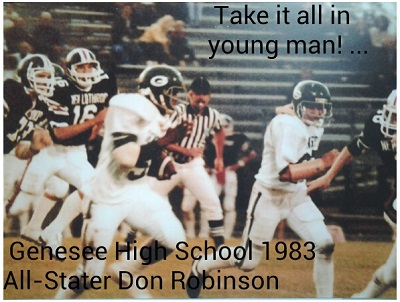 High school football and those memories remain close to his heart even after going on to play at Eastern Michigan University, a stint in the U.S. Navy and a move to Georgia.
He’s paid attention over the years as that “300 club” has grown to 22 players including current New Orleans Saints back Mark Ingram, Jr., and the University of Michigan’s Thomas Rawls.
He’s also a regular reader of Second Half, and asked to send along some words of wisdom to those who will be taking the field to begin the season this weekend:
“When you run out onto the field this season, do me a favor. At least once, pause.
“Look around you. Look at the lights in the sky. See the faces of those that have come to see you play. Listen to the band and the cheerleaders. Look into the eyes of your teammates ...
“Take it all in. When you’re older and miss this amazing game that you are playing, you’ll be glad you did.”
PHOTOS: (Top) A swimmer takes the lead during a race at Saturday's Kenzie Klassic at Howell High School. (Photo courtesy of Howell High School.) (Middle) Genesee graduate Don Robinson runs the ball during the 1983 season. (Photo courtesy of Don Robinson.)
Speakers Bureau Helps Generate Conversation
December 30, 2019
By Rob Kaminski
MHSAA benchmarks editor
As student mental health climbs the list of health and safety concerns, the MHSAA and state associations across the country are taking measures to provide resources and guidance aimed to keep school sports an enjoyable and valuable experience.
In sports, coaches and athletes learn to expect the unexpected. It’s the nature of competition; constructing gameplans tailored to utilize team strengths and expose opponents’ weaknesses. Often times this entails doing things that opponents won’t expect. Participants then learn and prepare for the next time; it’s one of the ways athletics prepares participants for life, as educational leaders often preach.
Today’s ever-changing culture recently threw such a curveball at the young people who populate our hallways and playing surfaces, calling for statewide associations and organizations to shift focuses and prepare for a new opponent while attempting to keep school sports one of the best means to a healthy adolescent lifestyle.
“I was at the NCAA summer meeting in 2017, discussing health and safety issues and the topic of concussions came up, as it often does. I assumed that concussions was the No. 1 health and safety issue,” said MHSAA Executive Director Mark Uyl. “I was quickly corrected that it’s student mental health; that knocked me back.”
It would not be an uncommon reaction, given the amount of information, media coverage and programs designed to recognize and reduce concussion incidents in recent years.
All the while, anxiety, depression and stress had been creeping into the picture beneath the surface. Such disorders are much more difficult to detect, as there are few visible symptoms when compared to sprains, fatigue, head injuries and other physical ailments.
“I became interested and began to research the topic. The more I read, the more concerned I became,” Uyl said. “The MHSAA, with a great deal of help and cooperation from our school leaders, has done a tremendous job educating and providing resources for health-related issues such as heat management, concussion reporting and practice policies, and now we have a new challenge.”
Fortunately, as has often been the case, there are knowledgeable and qualified people throughout Michigan’s roster of educational leaders who are willing to assist.
As word spread regarding the student mental health initiative, the MHSAA was able to establish a Mental Health Speakers Bureau composed of several experienced individuals willing to assist (see below).
“Our speakers bureau really grew by word of mouth,” Uyl said. “A school would bring in a speaker, or a league would invite a speaker, and once we were connected with them, then those people would share names and it grew from there.”
The resources range from former professional athletes, to behavioral specialists, to current MHSAA coaches.
Dave Ingles, basketball coach at Kent City, is one such individual. His credibility comes from first-hand experience.
“I privately struggled with deep depression for six years,” Ingles said. “Be alert. Talk to your athletes and students and actually listen to what they are saying. I always used the phrase, ‘I’m fine;’ that is not an acceptable answer to me anymore when I hear it.”
The National Institute of Mental Health reveals that most mental health conditions begin around the time children are transitioning from middle school to high school. The more people trained to identify symptoms and behavior, the better the chance to reduce or reverse some of the following numbers:
• 50% of all lifetime cases of mental illness begin by age 14
• 37% of students with a mental health condition age 14 or older drop out of school
• 20% of students ages 13-18 live with a mental health condition
• 11% of youth have a mood disorder and 8% have an anxiety disorder
• Suicide is the third leading cause of death for ages 10-24
Non-visible ailments always have been most difficult to detect, and today’s proliferation of technology – from streaming to social media – can serve to further mask symptoms.
“The more kids spend time with their devices, staring at their screens, isolation can be quick to take hold,” Uyl said. “Everything is instant. It used to be if our friends didn’t invite us somewhere, we didn’t worry about it; we probably wouldn’t find out for a couple days and had already moved on. Today, in about 10 minutes, there’s a picture on Instagram or Snapchat and kids instantly know, ‘I’m not included.’ Isolation leads to depression and anxiety, and in the worst cases can even lead to suicide.”
That message might sound familiar. Segments of the 2019-20 MHSAA online rules meetings include Uyl emphasizing student mental health and a video clip produced by benice.org promoting a mental health action plan endorsed by four of the state’s most recognized collegiate coaches.
It’s all part of the plan to promote awareness and generate conversation surrounding this serious health and safety issue during 2019-20 and beyond.
“We’re not going to try to do this all by ourselves,” Uyl said. “There are plenty of experts in the field, and we’re going to utilize their knowledge. We’ll build relationships and align ourselves with these people to provide a foundation. We need to become a resource center for our membership.”
In addition to the rules meetings messages, the MHSAA also partnered with the Michigan Association of Secondary School Principals Student Mental Health Summit on Oct. 8 in Lansing. This event – sold out within weeks of posting – invited principals, counselors, student leadership advisers and student leaders to come together to discuss and seek solutions for student mental health concerns impacting schools. The MHSAA lined up Eric Hipple, one of its speaker bureau members, who delivered a keynote, “Depression and Suicidal Awareness.”
Student mental health was among topics during the MHSAA Update and AD In-Service tour around the state this fall as well. The meeting at Comstock Park on Sept. 30 included a presentation from the Mental Health Foundation of West Michigan to introduce the be nice® action plan and encourage schools to take advantage of that and other resources the group has to offer.
The rise of mental health as one of the more prominent medical concerns nationally has occurred, as Ingles sees it, “because more people are talking about it now.”
Leaders like Ingles and those in numerous organizations have begun to assist the MHSAA in identifying and treating cases in our schools.
MHSAA Mental Health Speakers Bureau
Below is a list of individuals and organizations partnering with the MHSAA to assist in promoting mental well-being for students around the state. The MHSAA encourages school personnel to reach out to any of these experienced leaders in the field for programming in your buildings and districts.
• Christy Buck, Executive Director – Mental Health Foundation of West Michigan - be nice.® [email protected]
• Brooke Buys, Mental & Behavioral Health Specialist – BLND Health [email protected]
• Eric Hipple, former Detroit Lions quarterback [email protected]
• Dave Ingles, Basketball Coach & Speaker – Kent City High School [email protected]
• Cat Lanting, Program Coordinator – Mental Health Foundation of West Michigan - be nice.® [email protected]
• Halle Wangler, former University of Michigan basketball player [email protected]
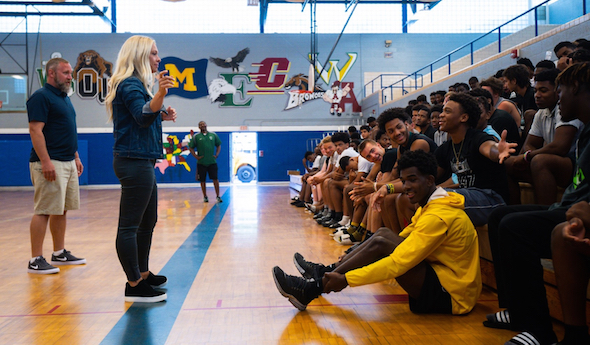
PHOTO: Brooke Buys, a mental and behavioral health specialist and founder of BLND Health, speaks with students. (Photo courtesy of BLND Health.)