

Howell Puts Heart Into Memorial Meet
August 29, 2013
By Geoff Kimmerly
Second Half editor
An online tribute to Mackenzie Watts describes how she “made the people and world around her better.”
The Howell swimming and diving community continues to work so that her memory makes those who come after her safer as well.
 Watts died in 2005 after suffering a cardiac arrhythmia. She was a 15-year-old sophomore and key cog on her high school team.
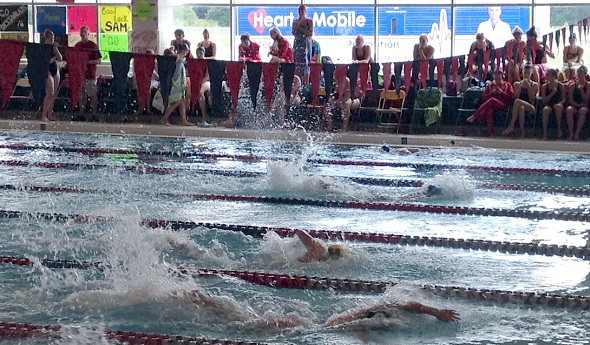
This past weekend, for the sixth straight season, the Highlanders hosted the Kenzie Classic, an invitational that served as a fundraiser for the Howell program and annual Mackenzie Watts scholarship – plus served to promote heart screenings by local National Diagnostic Services in their “HeartMobile” parked outside the pool.
NDS, which also has held screening events at Northville, Canton and Middleville Thornapple Kellogg schools among others, screened 20 students during this Kenzie Classic, said Wellness Director Heidi Enders.
Tests are ultrasound-based and non-invasive, and include an EKG to examine the heart’s electrical system for arrhythmias and an echocardiogram to examine the heart’s structure in case there is a thickening of the muscle (known as hyperthrophic cardiomyopathy). Adults were charged $199 and students $75, with discounted rates for adults in groups and children.
Click to check out coverage of the event from the Livingston County Daily Press & Argus.
Records Revamp
While tracking down 660 football schedules (give or take a few) took up most of the summer, there still was time for a few additions to the MHSAA record book – with more to come.
Track and field fans will notice records from retired yardage events (pre-1982 or earlier depending on the MHSAA class) have been added to the online records here for boys and here for girls.
Cross country fans should check out our lists of top MHSAA Finals times for every division and every class, plus overall top 10 lists for both boys and girls since the race was set to five kilometers in 1980. Click here for girls and here for boys.
Also added or updated were team championship counts for both cross countries, volleyball and girls golf. Click to check out girls golf here and volleyball here.
Fond Football Memories
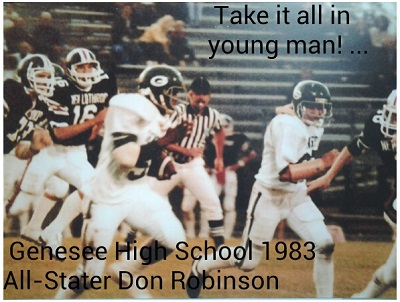
It has been 30 years since former Genesee all-state running back Don Robinson became the fourth player in Genesee County history to run for more than 300 yards in one game – which he did in gaining 317 on Sept. 23, 1983.
 High school football and those memories remain close to his heart even after going on to play at Eastern Michigan University, a stint in the U.S. Navy and a move to Georgia.
He’s paid attention over the years as that “300 club” has grown to 22 players including current New Orleans Saints back Mark Ingram, Jr., and the University of Michigan’s Thomas Rawls.
He’s also a regular reader of Second Half, and asked to send along some words of wisdom to those who will be taking the field to begin the season this weekend:
“When you run out onto the field this season, do me a favor. At least once, pause.
“Look around you. Look at the lights in the sky. See the faces of those that have come to see you play. Listen to the band and the cheerleaders. Look into the eyes of your teammates ...
“Take it all in. When you’re older and miss this amazing game that you are playing, you’ll be glad you did.”
PHOTOS: (Top) A swimmer takes the lead during a race at Saturday's Kenzie Klassic at Howell High School. (Photo courtesy of Howell High School.) (Middle) Genesee graduate Don Robinson runs the ball during the 1983 season. (Photo courtesy of Don Robinson.)

NFHS Voice: Source of HS Playing Rules
November 12, 2019
By Karissa Niehoff
NFHS Executive Director
When it comes to writing playing rules for major sports in the United States, it’s all in the acronyms. In football, you have the NFL, NCAA and NFHS. In basketball, it’s the NBA, NCAA and NFHS. In baseball, the rules-makers are MLB, NCAA and NFHS.
While the NFL, NBA, MLB and NCAA can be used on first reference without explanation, many people are unfamiliar with the NFHS. And yet the NFHS has been around as long – or longer – than the other four major sports organizations.
In many cases, references to NFHS rules – not only in these three major sports but the other 14 sports for which the organization writes rules – are simply noted as “high school rules.” The reality, however, is that the NFHS – the National Federation of State High School Associations – has been the national organization most directly focused on sports playing rules in the past 90 years since it published its first Football Rules Book in 1932.
With almost eight million participants in high school sports, NFHS rules are written for more individuals than all other levels of sports combined. As a result, risk minimization and the fundamentals of good sportsmanship are paramount to the rules-writing process for the NFHS and often are the distinguishing factors from rules at the higher levels of the sport.
Perhaps football is the best example of the commitment to risk minimization. In the mid-1970s, the NFHS was at the forefront of change when it outlawed spearing in high school football. The 1976 rule revision changed the landscape of high school football from an injury standpoint – from a high of 36 direct fatalities in 1968 to an average of about two per year by 2018.
Some people have questioned why there are multiple rules codes for a sport. Very simply, NFHS rules for high school play must be different than at the college and professional levels.
As an example, while professional baseball is concerned with how fast a baseball exits the batter’s box (Velocity Exit Speed) and how far the ball travels on a home run, the NFHS has enacted bat standards during the past 20 years to reduce the speed of balls coming off aluminum bats. In wrestling, the NFHS has enacted strict weight-management plans to reduce the risk of health issues. In ice hockey, while fighting is an accepted part of the sport at the professional level, NFHS rules have strict rules prohibiting all forms of unsportsmanlike conduct. In football, NFHS rules do not permit the excessive celebration displays following touchdowns that occur during NFL games.
In addition to risk minimization and sportsmanship, the NFHS must also weigh financial implications for schools when considering equipment and uniform changes. With schools ranging in size from less than 100 to more than 5,000 students, decisions must be made for the masses and cannot put undue financial hardships on schools.
NFHS rules are also written with the understanding that appropriate behavior begins with the coach, who is responsible for ensuring that his or her team exhibits good sporting behavior. Many penalties for unsportsmanlike conduct on the team are first directed against the coach.
While the NFHS and its member state associations govern the high school place in various sports – not only with playing rules but other issues as well – we maintain relationships with the National Governing Bodies (NGBs) in these sports to assist in meeting the needs of all participants.
Last week, the NFHS hosted a summit of various leaders of NGBs in Indianapolis. Leaders from about 15 NGBs were set to meet with NFHS staff to discuss various initiatives and opportunities for collaborative programs. We hope this is the first of many such meetings as it is crucial that all levels of sport work together to ensure ongoing opportunities for all sports participants.
Dr. Karissa L. Niehoff is in her second year as executive director of the National Federation of State High School Associations (NFHS) in Indianapolis, Indiana. She is the first female to head the national leadership organization for high school athletics and performing arts activities and the sixth full-time executive director of the NFHS, which celebrated its 100th year of service during the 2018-19 school year. She previously was executive director of the Connecticut Association of Schools-Connecticut Interscholastic Athletic Conference for seven years.